

Usufruct and Superficies in Thailand Explained
Usufruct and Superficies in Thailand Explained
These two terms show up in villa contracts constantly, but most buyers sign documents referencing them without understanding what they actually grant — which is a real problem, since these rights determine exactly what happens to a villa if a lease dispute arises or an owner passes away. Usufruct and superficies in Thailand explained simply: they're two distinct registered rights, each granting something different, and neither is automatically included in a standard leasehold villa purchase unless specifically registered as part of the transaction.
This guide covers what each right specifically grants, how they're registered, what that registration costs, how long they last, and how they combine with leasehold to actually protect a villa purchase.
What Is Usufruct in Thailand?
Usufruct is a registered right under Thai property law that grants someone the ability to use and enjoy a property — including any income it generates — without holding ownership of the property itself.
What Is Usufruct and How Does It Work in Thailand?
Under the Civil and Commercial Code, usufruct gives the holder the legal right to possess, use, and derive benefit from a property, such as living in it or collecting rental income from it, while legal ownership remains with someone else. This right is registered at the Land Department, which is what makes it enforceable as a legal right rather than just a private arrangement between two parties. The usufruct holder has real, legally protected rights and corresponding obligations — such as maintaining the property in reasonable condition — for the duration the right is granted.
What Is Superficies in Thailand?
Superficies works differently from usufruct: instead of granting use of an existing property, it separates ownership of a structure from ownership of the land beneath it.
What Is Superficies and Why Do Villa Buyers Need It?
Superficies is a registered right that allows someone to own a building or structure independently of who owns the underlying land. For a foreign villa buyer, this is what makes it possible to genuinely own the villa itself — walls, roof, fixtures, the structure as a whole — even though the land it sits on remains under a separate lease with a Thai landowner, since foreigners cannot own land directly.
This right isn't automatically included in every leasehold villa purchase. It has to be specifically registered as part of the transaction's legal structure, which means it needs to be checked and arranged project by project rather than assumed to come standard. A villa purchase without superficies registered leaves the buyer's ownership of the physical structure resting on less solid legal footing than most buyers realize going in.

Usufruct vs. Superficies — What's the Difference?
These two rights get mentioned together often enough that buyers understandably confuse them, but they grant fundamentally different things.
What's the Difference Between Usufruct and Superficies?
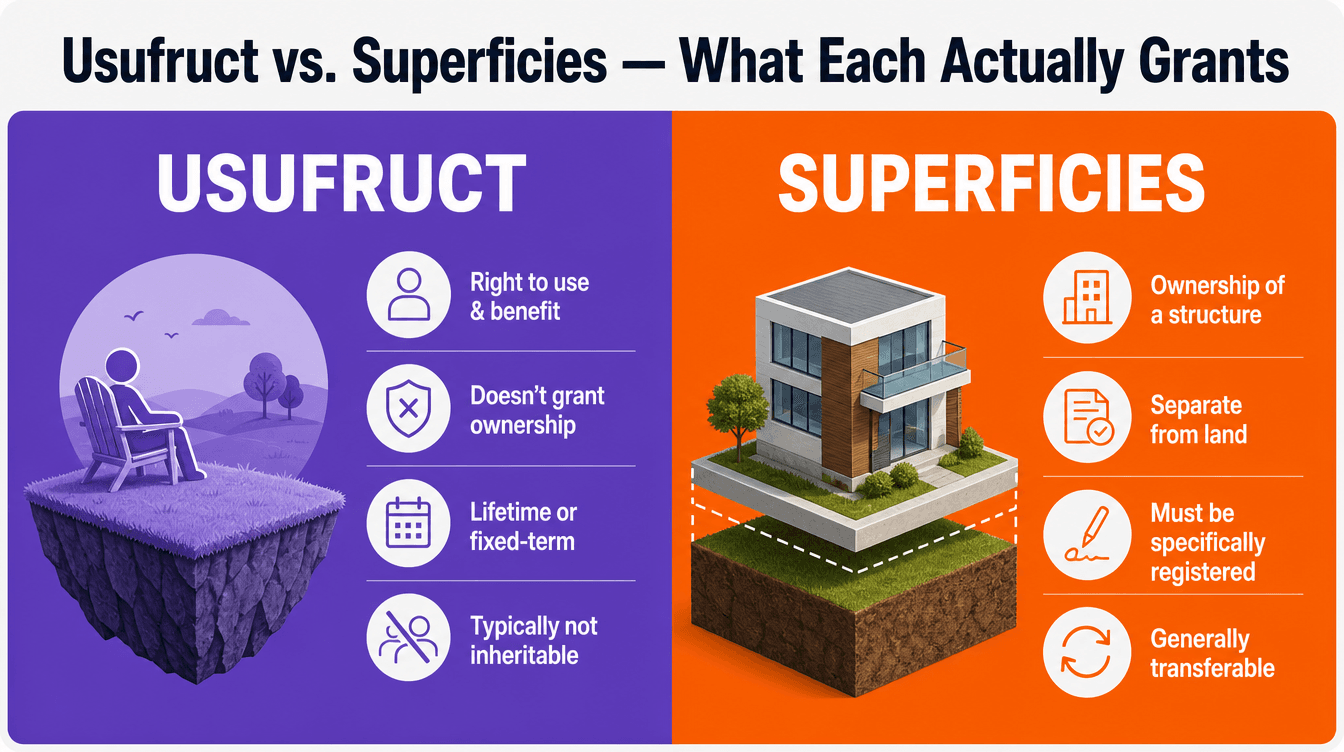
Usufruct grants the right to use and benefit from a property — living in it, renting it out, enjoying its income — without owning any part of it, structure or land. Superficies grants actual ownership of a structure, separate and distinct from ownership of the land it sits on. In practical terms: usufruct is a right to use something that belongs to someone else, while superficies is genuine ownership of one specific thing (the building) even while the land beneath it belongs to someone else entirely. For villa buyers, superficies is typically the more relevant and commonly used right of the two, since it directly addresses ownership of the structure itself.
Registering Usufruct or Superficies in Thailand
Both rights only carry legal weight once properly registered — a private agreement referencing usufruct or superficies without Land Department registration doesn't carry the same enforceable protection.
How Do You Register a Superficies Right in Thailand?
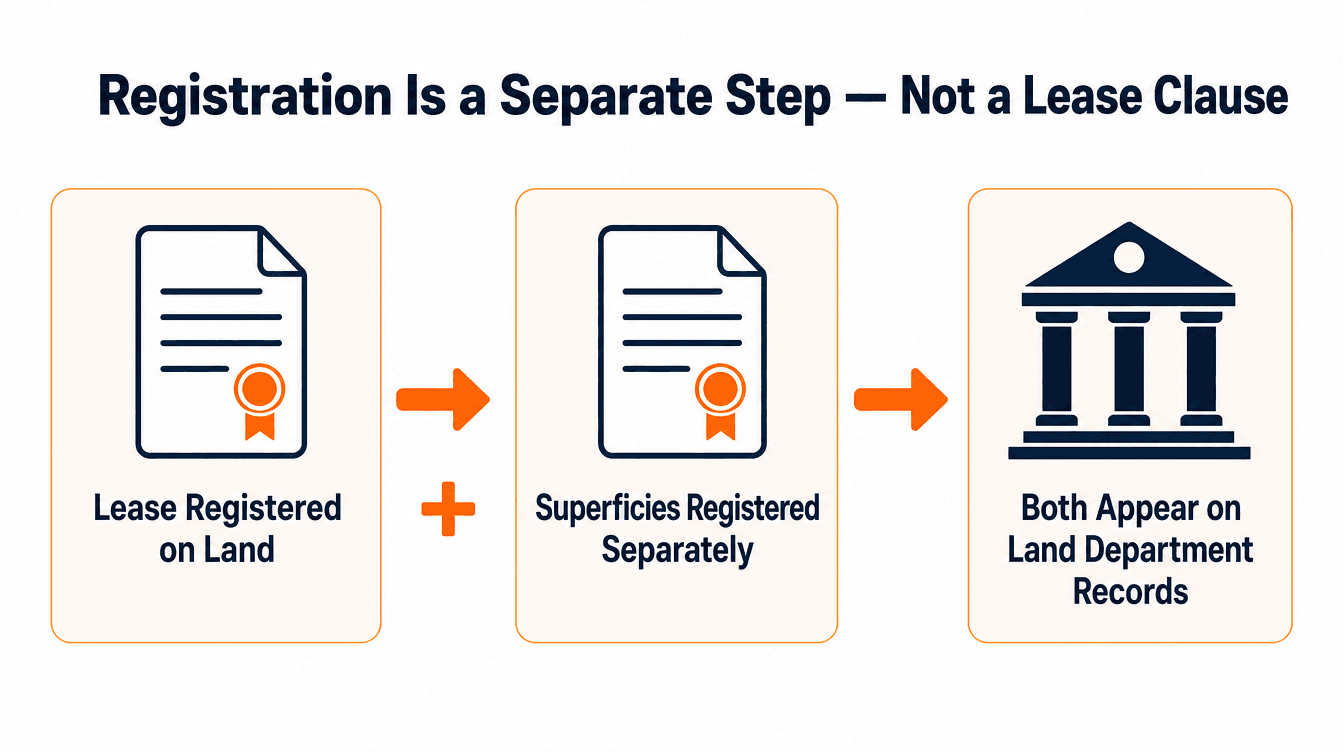
Registration happens at the Land Department, alongside or shortly after the lease registration for the underlying land. The right needs to be specifically documented and registered as its own legal instrument — it isn't a clause buried in the lease agreement, but a distinct registered right that appears on the relevant land records. This is exactly the kind of detail that needs to be handled correctly during the transaction itself, since retrofitting a missing superficies registration after a villa purchase is already complete is a far more complicated process than arranging it correctly from the outset.
How Much Does It Cost to Register Usufruct or Superficies?
Registration involves a fee paid to the Land Department at the time of registration. [DATA NEEDED: current Land Department registration fee for usufruct and superficies rights]. This cost is modest relative to the overall value of a villa purchase, which is exactly why it's worth insisting on rather than skipping to save a small amount upfront on a right that meaningfully strengthens the buyer's legal position.
How Long Do These Rights Last, and Can They Be Transferred?
Both rights have defined lifespans and specific rules around what happens to them over time — details that matter considerably for anyone thinking beyond the initial purchase.
How Long Does a Usufruct Right Last in Thailand?
A usufruct right can be granted for a specific term or for the lifetime of the holder, depending on how it's structured at registration. A lifetime usufruct is a distinct planning tool, particularly relevant in specific personal or estate-planning circumstances, while a fixed-term usufruct functions more like a defined-period right similar in spirit to a lease term.
Can Usufruct Be Inherited or Transferred in Thailand?
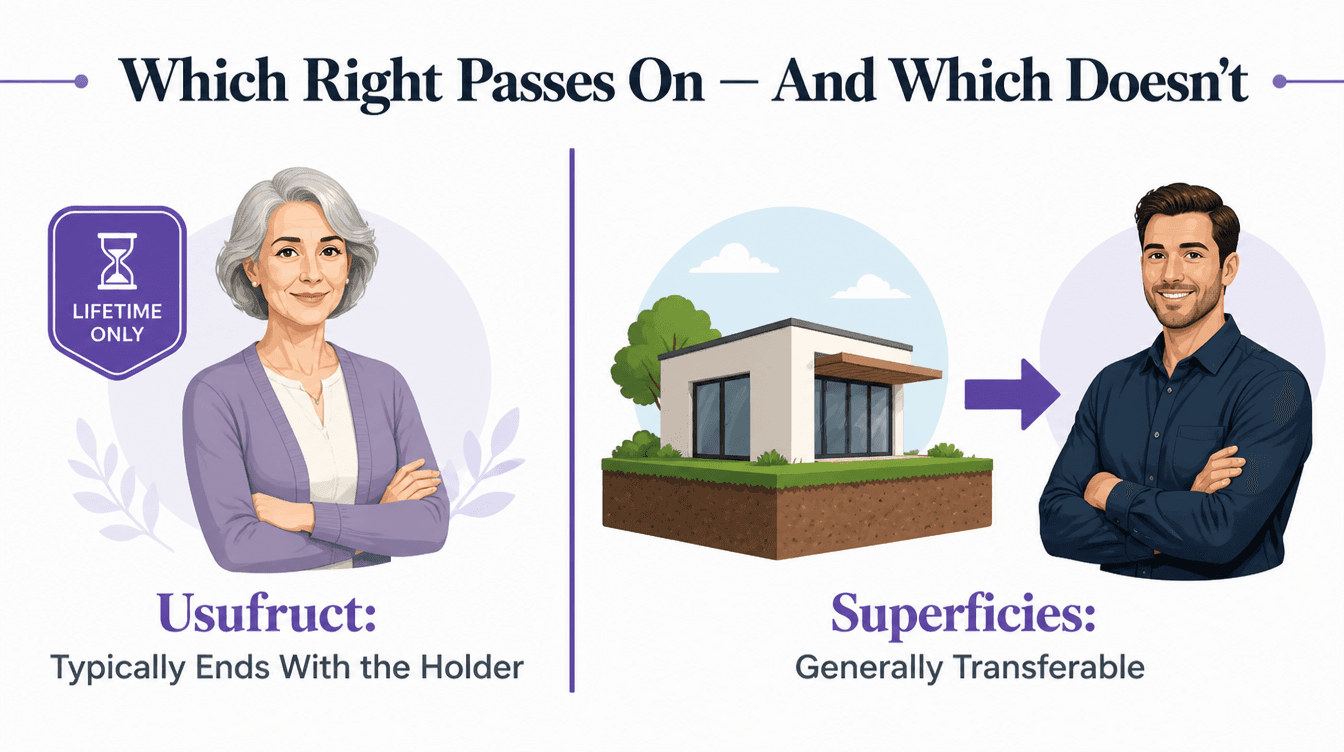
Usufruct is generally a personal right tied to the specific holder, which means it typically doesn't transfer automatically to heirs the way property ownership would — a lifetime usufruct, by its nature, ends with the holder rather than passing on. This is an important distinction from superficies, which as an ownership right over a structure can generally be transferred, subject to the terms under which it was originally registered.
Can a Usufruct or Superficies Right Be Terminated Early?
Both rights can be terminated under specific conditions set out in Thai law or in the terms of the original registration — for usufruct, this can include the death of the holder (for a lifetime grant) or breach of the holder's obligations regarding the property. For superficies, termination conditions are typically tied to what was agreed at registration, which is another reason the registration itself needs to be drafted carefully rather than treated as a formality.
Usufruct vs. Leasehold in Thailand
Leasehold is the structure most foreign buyers already know, so it's worth being precise about how usufruct and superficies relate to it rather than treating all three as interchangeable.
What's the Difference Between Superficies and Leasehold?
A lease grants the right to use land or property for a defined term under a rental-style contractual arrangement, registered at the Land Department but fundamentally a contract-based right. Superficies grants actual ownership of a structure, which is a stronger and more fundamentally different right than a lease's right to use. In a typical villa purchase, these work together rather than as alternatives: a lease covers the land, while superficies covers genuine ownership of the villa built on it — combining a rental-style right over the land with real ownership of the structure itself.
How to Protect a Villa Purchase in Thailand
Pulling everything together, the practical question for most readers isn't which right to choose in isolation — it's how to combine them correctly for a specific villa purchase.
Do You Need Both a Lease and Superficies for a Villa?
For most foreign villa buyers, yes — a registered lease on the land combined with a registered superficies right on the structure is the standard, well-protected structure for villa ownership. Usufruct is used less frequently in typical villa purchases, but it becomes relevant in specific situations, such as certain estate-planning arrangements or cases where a buyer wants a lifetime right of use rather than a fixed-term lease structure.
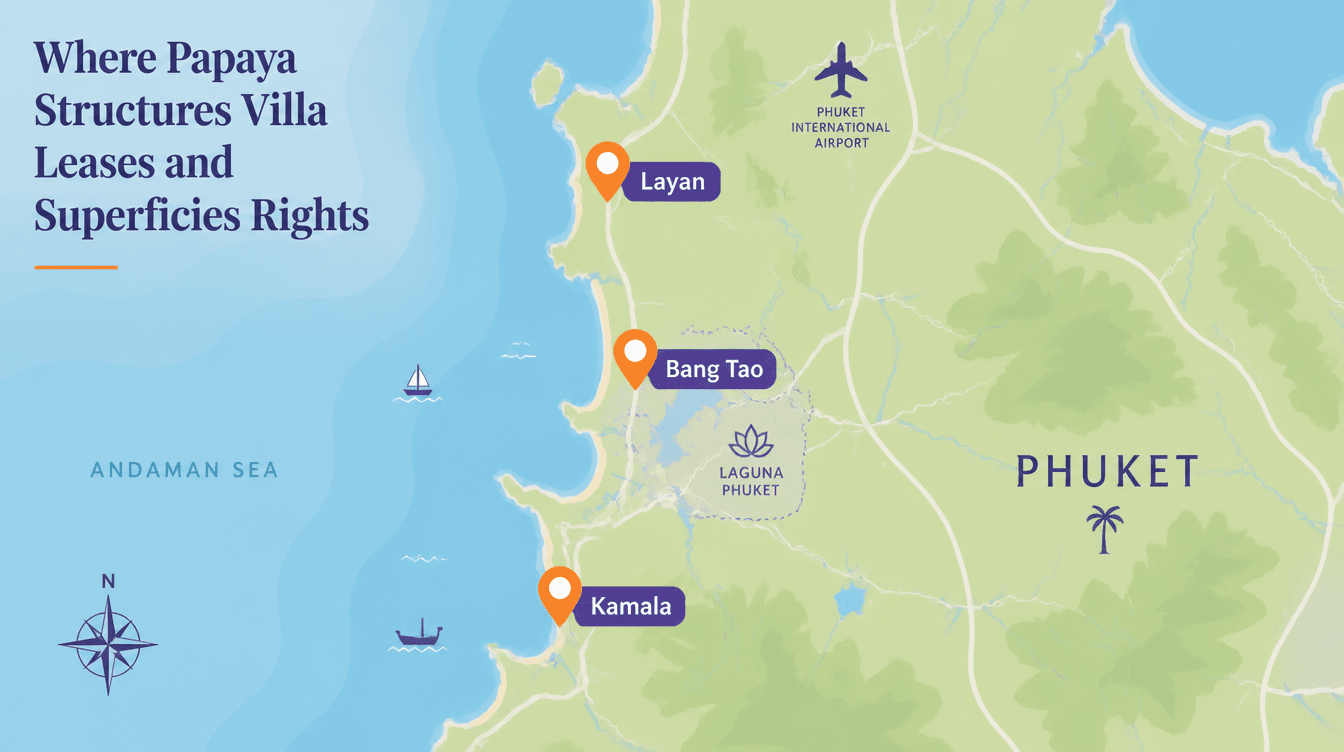
Getting this combination right requires proper legal structuring at the time of purchase, not an assumption that a standard contract template covers it. For villa purchases in Bang Tao, Kamala, Laguna, or Layan, having legal support confirm that the lease, superficies, and — where relevant — usufruct are all correctly registered as part of the transaction is what actually protects a foreign buyer's position long after the paperwork is signed, rather than leaving gaps that only become apparent when a dispute or resale eventually surfaces them.
The Bottom Line
Usufruct and superficies aren't interchangeable, and they aren't automatically included in every villa purchase — they're two distinct registered rights that grant fundamentally different things, and understanding exactly what each covers is what allows a buyer to confirm their villa purchase is actually structured correctly. Superficies, securing ownership of the structure itself, is the right most villa buyers need alongside their lease; usufruct serves a narrower, more situational purpose. Either way, registration at the Land Department — not a private contractual reference — is what makes these rights legally enforceable.
If you're purchasing a villa in Bang Tao, Kamala, Laguna, or Layan and want to confirm your lease, superficies, and any relevant usufruct rights are structured and registered correctly, the Papaya Property team can walk you through exactly what applies to your purchase. Reach out via Telegram, WhatsApp, or email for a free consultation — no forms, just a direct conversation with someone who can answer the questions specific to your situation.