

Developer Buyback Programs: Pros and Cons

Developer Buyback Programs: Pros and Cons
A buyback guarantee sounds like a built-in safety net — the developer promises to repurchase your unit at a set price, so what's the downside? Developer buyback programs pros and cons need honest examination, because a buyback offer changes the economics of a purchase in ways that aren't always visible at the point of sale, and the value of the promise depends entirely on terms most buyers don't read closely enough.
This guide covers how buyback programs actually work, a genuinely balanced breakdown of the real advantages and real drawbacks, and how to evaluate whether a specific offer is one worth relying on.
What Is a Property Buyback Program?
Before weighing whether a buyback program is a good deal, it's worth understanding precisely what's being promised — since the term covers a range of structures that aren't all equivalent.
What Is a Developer Buyback Program?
A developer buyback program is a contractual commitment in which the developer agrees to repurchase the unit from the buyer at a predetermined price (or pricing formula) after a specified holding period, provided the buyer meets the conditions set out in the agreement. It functions as a built-in exit option, distinct from simply hoping to find a buyer on the open market when the time comes to sell.
How Does a Condo Buyback Program Work?
Structurally, the buyback terms are written into the original sale contract or a separate buyback agreement, specifying the trigger date (or window) when the buyback option becomes available, the price or formula that will apply, and any conditions the buyer needs to meet — such as maintaining the unit in good condition or having held it for a minimum period. The buyer isn't obligated to exercise the buyback option; it's typically structured as a right the buyer can choose to use, not a requirement.
How Buyback Programs Show Up in Phuket Off-Plan Marketing
Buyback offers are a recurring feature in off-plan sales materials specifically, often packaged alongside other incentives to make a project's overall offer more compelling.
Buyback programs are frequently marketed together with rental guarantees as a combined package — a guaranteed income stream during a holding period, followed by a guaranteed exit at the end of it. This combination can genuinely reduce uncertainty for an investor, but it's worth evaluating each component independently rather than treating the combined package as a single number, since the buyback price formula and the rental guarantee terms carry entirely separate risks and conditions that need their own scrutiny.
How Is the Buyback Price Calculated?
This is the detail that determines whether a buyback offer is actually favorable, and it varies meaningfully across different structures.
What Price Does a Developer Buy Back a Unit For?
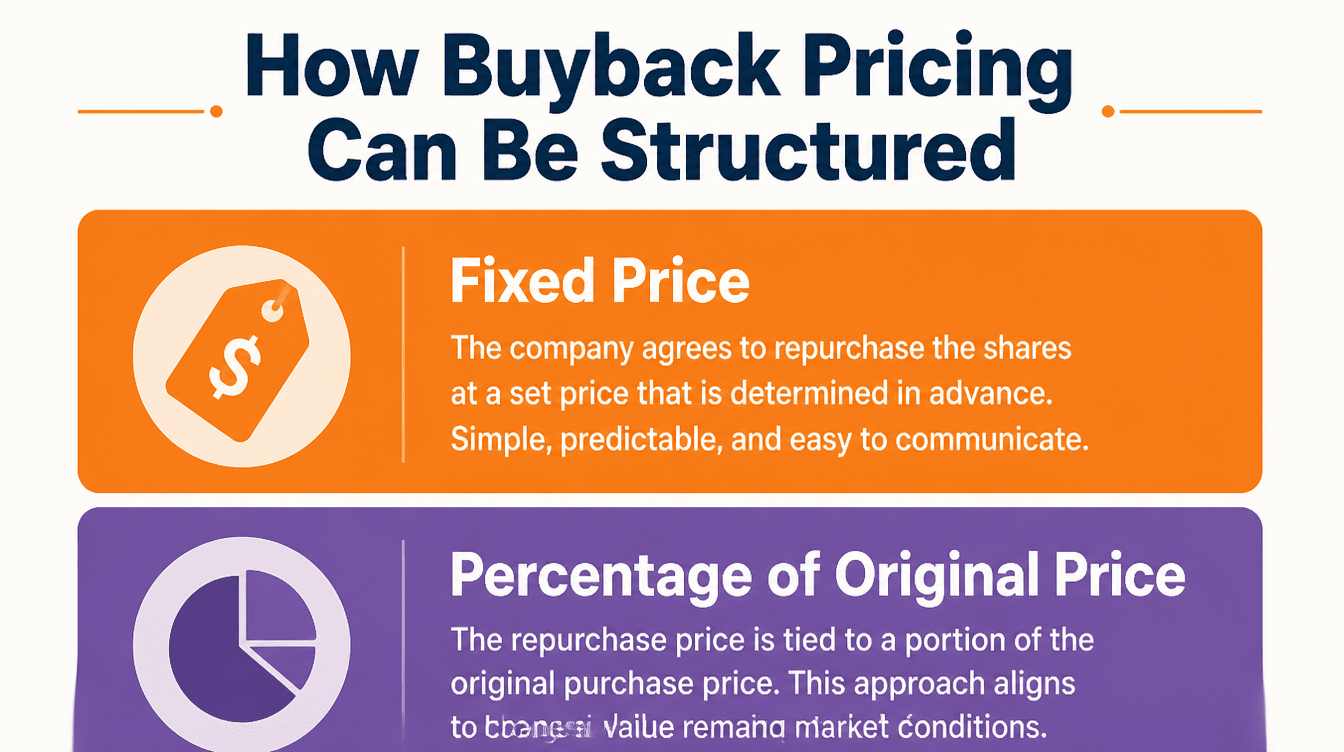
Buyback pricing typically follows one of a few structures: a fixed price agreed at the time of purchase, a percentage of the original purchase price (which may be below, at, or above 100%), or a formula tied to some measure of market value at the buyback date. [DATA NEEDED: typical buyback price structures and percentage ranges offered on current Phuket off-plan projects]. The specific structure matters enormously — a buyback at 90% of original purchase price is a fundamentally different offer than a buyback at 100%, or one indexed to a market valuation that could exceed the original price.
How Is the Buyback Price Calculated?
Where the buyback price is expressed as a formula rather than a flat figure, the calculation method needs to be spelled out clearly enough that both parties can independently verify the resulting number at the buyback date — vague language like "market value" without a specified valuation method or independent appraiser leaves room for dispute exactly when the buyer is relying on the promise most. A buyback clause worth trusting specifies precisely how the price will be determined, not just that a price will be offered.
The Pros of Developer Buyback Programs
Treated honestly, there are genuine circumstances where a buyback program adds real value for an investor.
Is a Buyback Program a Good Exit Strategy?
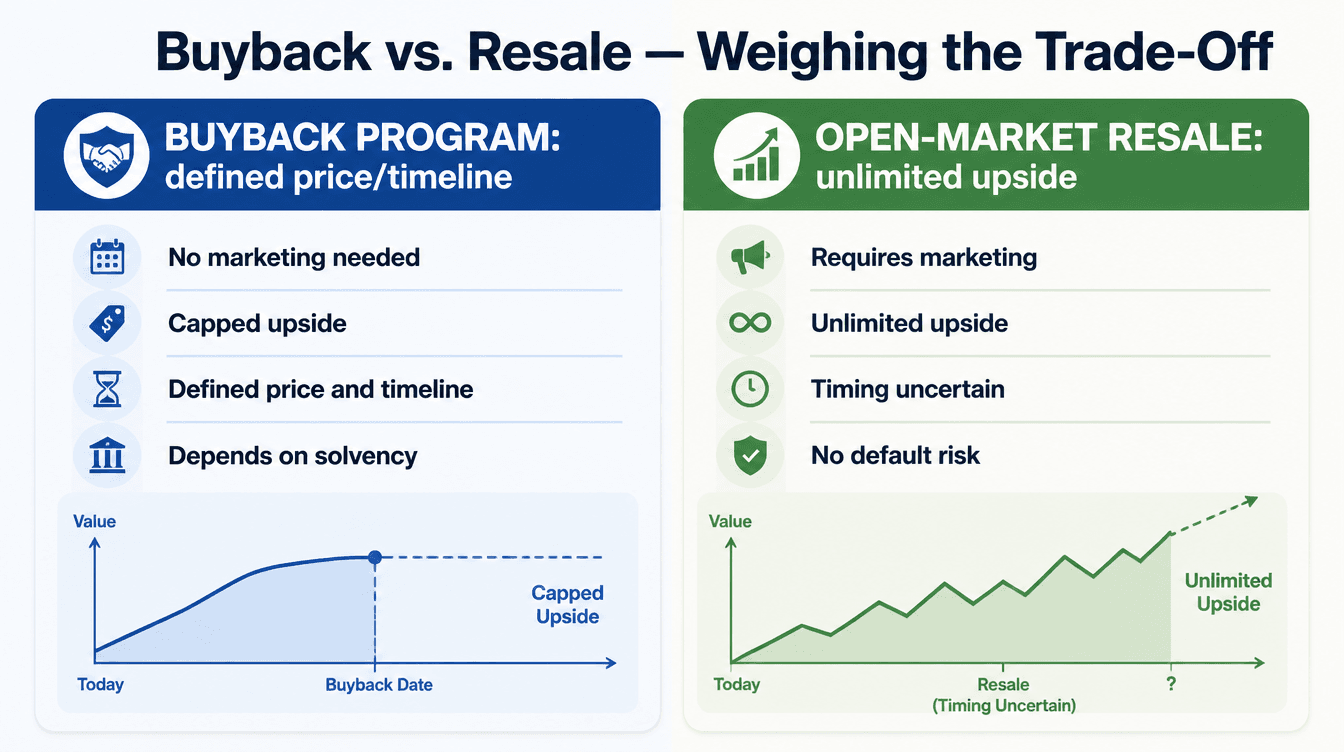
A well-structured buyback program can be a genuinely useful exit strategy, particularly for investors who want defined downside protection and a known exit timeline rather than depending entirely on market conditions and buyer demand at the time they want to sell. It removes the marketing effort, negotiation uncertainty, and unknown holding period that come with a standard open-market resale, replacing them with a fixed, contractually defined outcome. For risk-averse investors, or those purchasing specifically with a defined investment horizon in mind, that certainty has real value — provided the underlying promise is actually reliable.
The Cons of Developer Buyback Programs
The downside deserves the same level of seriousness as the upside, not a brief caveat tucked in afterward.
What Happens if a Developer Can't Honor a Buyback Offer?
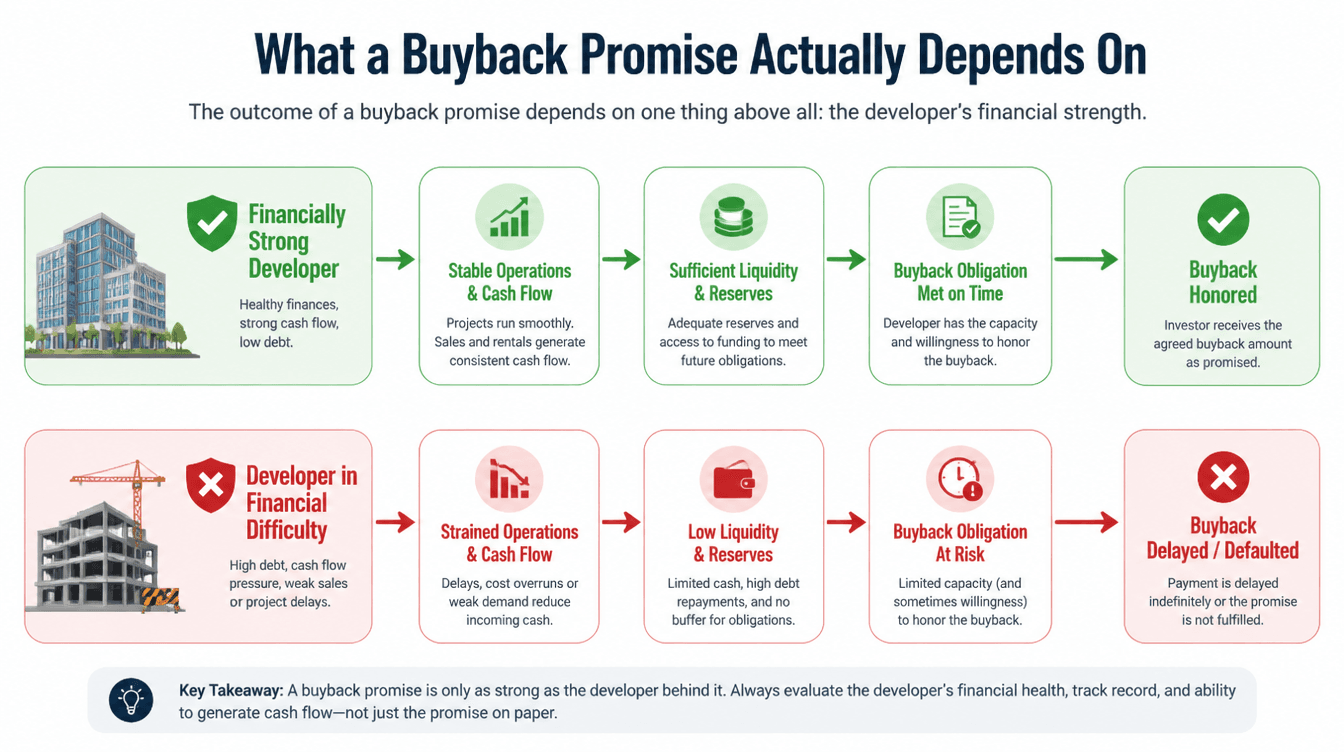
A buyback promise is only as reliable as the developer's financial capacity to fulfill it years after the original sale. If a developer faces financial difficulty by the time the buyback date arrives, honoring the repurchase commitment can be delayed, renegotiated, or defaulted on entirely, and pursuing a contractual claim against a financially distressed developer is considerably harder than simply having the buyback proceed as agreed. This risk is structurally similar to the risk covered in guaranteed rental return schemes — a promise dated years into the future is only as strong as the entity that has to keep it.
Can a Buyback Program Limit Your Resale Value?
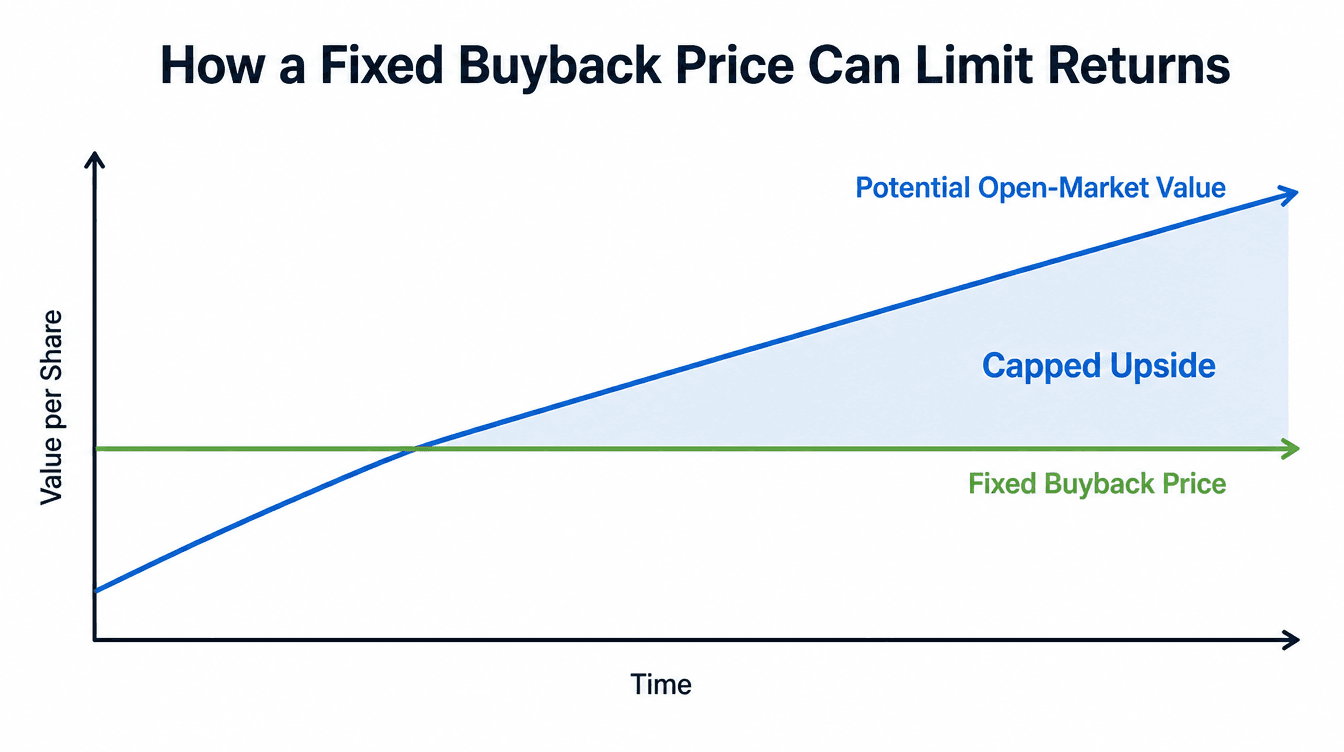
Yes, in some structures. If the buyback price is fixed below what the unit might reasonably achieve on the open market by the buyback date, an investor who exercises the buyback option effectively caps their return at a level below what independent resale could have delivered — particularly in a project or area experiencing genuine capital appreciation. This is exactly why understanding the buyback formula relative to realistic market appreciation matters before treating the buyback price as guaranteed upside; in a strongly appreciating market, the buyback option can become the less attractive of the buyer's two exit paths.
Buyback vs. Resale — Which Is the Better Exit Strategy?
This is the direct comparison every investor evaluating a buyback offer actually needs to make.
Is a Buyback Guarantee Better Than Selling on the Open Market?
It depends entirely on how the buyback price compares to realistic market conditions at the time of exit. A buyback guarantee offers certainty and a defined timeline, which has genuine value particularly in slower or less liquid market conditions. Open-market resale offers unlimited upside if the property has appreciated meaningfully, but with real uncertainty around timing, negotiation, and whether a buyer materializes on the investor's preferred schedule. Neither option is categorically better — the right choice depends on the buyback price relative to realistic market value, and on how much the investor values certainty over potential upside.
Is a Buyback Program Worth It?
This deserves an honest, non-binary verdict rather than treating every buyback offer as equally trustworthy or equally suspect.
What Should You Check Before Relying on a Buyback Program?
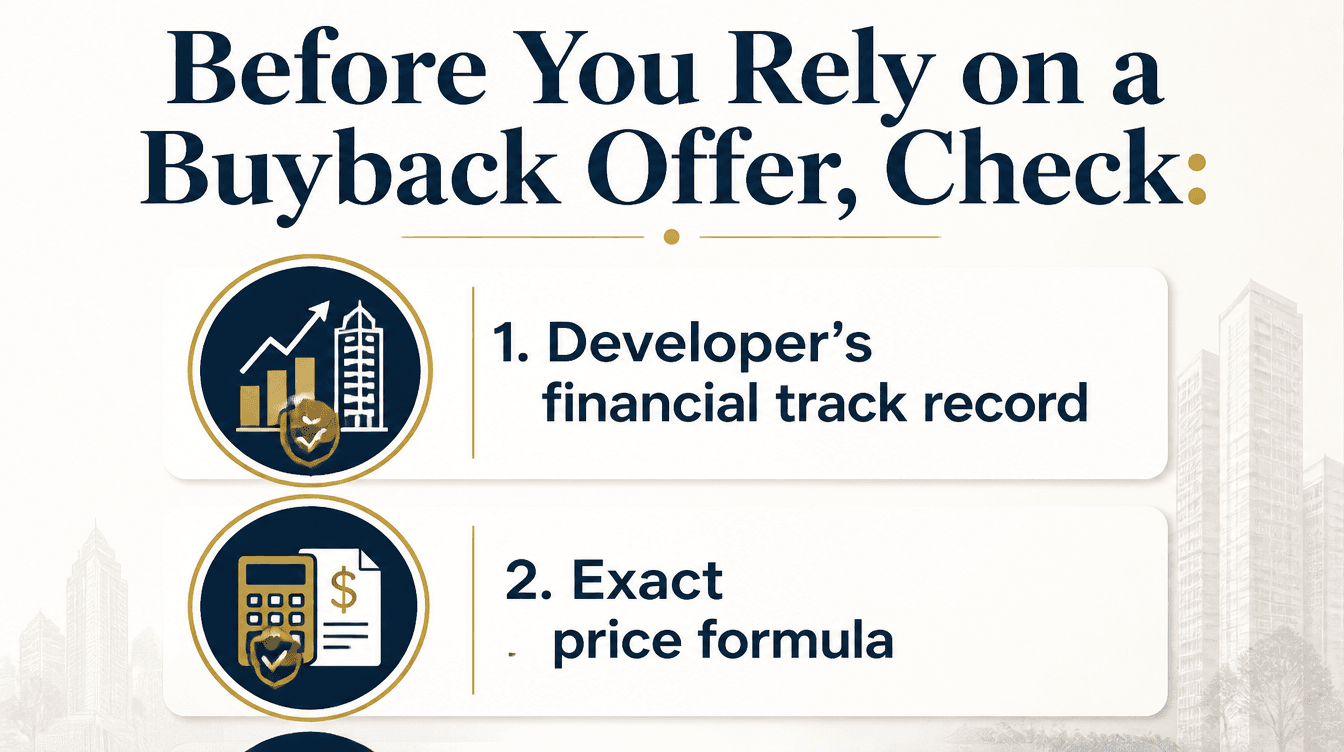
Before treating a buyback offer as a meaningful part of the investment case, verify the developer's financial track record and capacity to honor long-dated commitments, confirm the exact buyback price formula and how it's calculated (not just the headline percentage), and review the specific conditions that could disqualify the buyer from exercising the option. This is precisely the kind of contract review that belongs in legal due diligence before a purchase decision is made — Papaya Property's legal support includes reviewing buyback contract terms specifically as part of evaluating any off-plan purchase that includes one, so a client understands exactly what's being promised rather than relying on the marketing summary.
Are Buyback Programs Common in Phuket Real Estate?
Where they do appear, they're typically one component of a broader package of buyer incentives rather than a universal feature of every off-plan project, which is exactly why each specific offer needs individual evaluation rather than assuming buyback terms are standardized across the market.
The Bottom Line
A developer buyback program isn't inherently good or bad — it's a specific contractual promise whose real value depends entirely on the price formula, the developer's financial capacity to honor it years into the future, and what it might cost an investor in capped upside along the way. The pros are real: defined exit certainty and reduced market-timing risk. So are the cons: default risk tied to the developer's future financial health, and a potential ceiling on returns if the market outperforms the buyback formula. Evaluating a specific offer on its actual terms, rather than on the reassurance of the word "guaranteed," is what separates a genuinely useful buyback program from an expensive marketing device.
If you're evaluating a project in Bang Tao, Kamala, Laguna, or Layan that includes a buyback offer, the Papaya Property team can review the contract terms and the developer's track record with you before you commit. Reach out via Telegram, WhatsApp, or email for a free consultation — no forms, just a direct conversation with someone who can answer the questions specific to your investment.