

Property Title Deeds in Thailand Explained

Property Title Deeds in Thailand Explained
Not every document called a "title deed" in Thailand actually represents the same level of ownership security. Some are strong, fully registered titles with surveyed boundaries; others are considerably weaker rights that get casually referred to using similar terminology, which is exactly the kind of confusion that catches buyers off guard during a purchase. Understanding property title deeds in Thailand explained properly means knowing the full hierarchy — not just recognizing the word "Chanote" and assuming everything else works the same way.
This guide covers what makes Chanote the strongest title type, the full range of other title documents you might encounter, how to verify a title deed before buying, and what title deed actually applies to a condo unit specifically.
What Is a Chanote Title Deed in Thailand?
The Chanote is the strongest and most secure form of land title in Thailand, and it's the benchmark every other title type in this guide gets measured against.
What Is a Chanote Title Deed in Thailand?
A Chanote represents full ownership, issued and maintained in the official Land Department records, with the property's boundaries precisely surveyed and mapped using GPS coordinates tied to the national survey grid. This survey-based precision is what distinguishes Chanote from weaker title types, which often rely on less precise boundary descriptions. Land or a condo unit registered under Chanote can be freely sold, transferred, mortgaged, and inherited, with the Land Department's records serving as conclusive proof of ownership rather than evidence that could be disputed or reinterpreted.
The Different Types of Land Title in Thailand
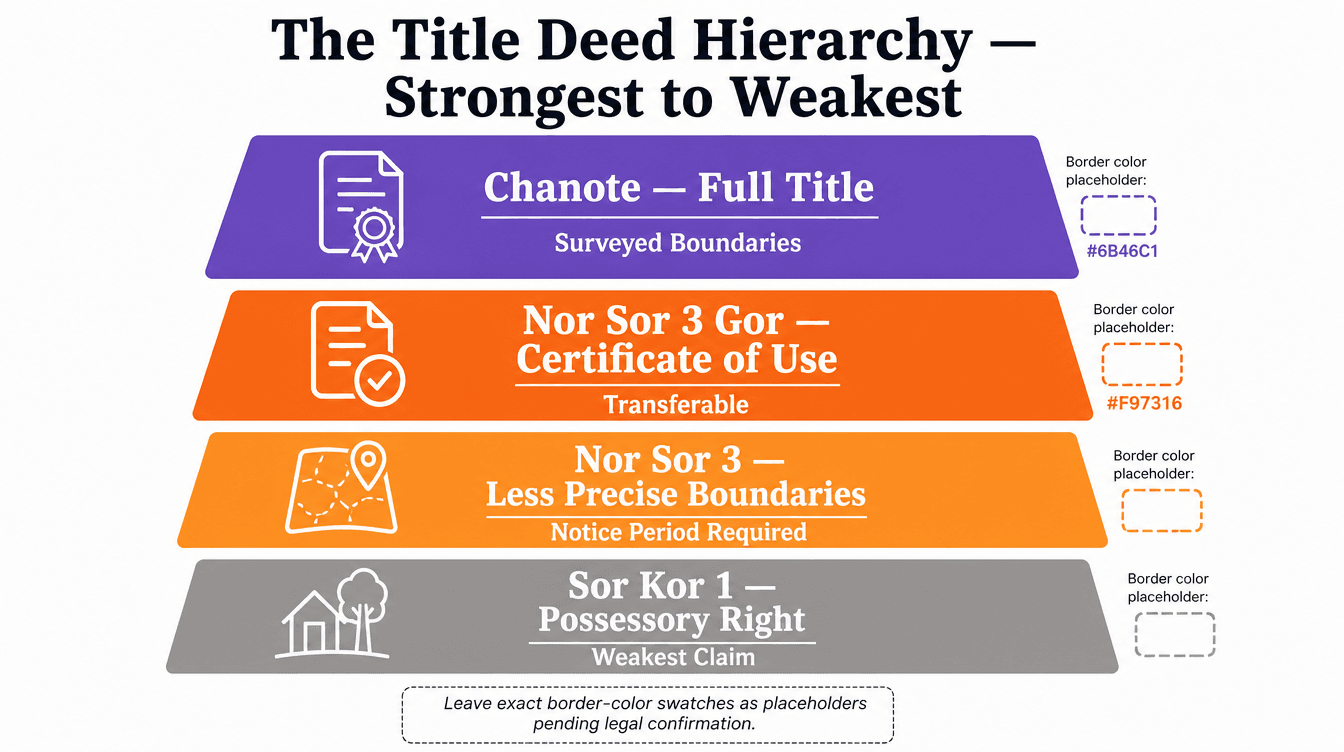
Chanote sits at the top of a hierarchy, but it isn't the only type of title document in circulation — several other categories exist, each carrying a different level of legal security.
What Are the Different Types of Land Title in Thailand?
Below Chanote, the most commonly encountered title types include:
Nor Sor 3 Gor — a certificate of use with surveyed boundaries, one step below full Chanote status but still a relatively strong and transferable title
Nor Sor 3 — similar in concept but with less precise boundary documentation, requiring a public notice period before a transfer can be registered
Sor Kor 1 — a possessory right notification rather than a registered title, representing one of the weakest forms of land claim in this hierarchy
Each step down this hierarchy represents less certainty about exact boundaries and, in some cases, less legal security around the underlying ownership claim itself. Buyers who assume any document referred to informally as a "title deed" carries Chanote-level security are exactly the buyers who run into problems later.
Can a Title Deed Be Upgraded to Chanote?
In some cases, yes — certain lower-tier titles like Nor Sor 3 Gor can be upgraded to full Chanote status through a Land Department process that typically involves a formal survey to establish precise boundaries. This process takes time and isn't guaranteed to succeed for every property, depending on the specific land's history and documentation. For a buyer evaluating a property with a lower-tier title, whether an upgrade path exists — and how straightforward it would be — is a meaningful factor in assessing the property's long-term value and security.
What Does the Color of a Title Deed Mean in Thailand?
Title deed documents in Thailand are commonly distinguished by border color, which offers a quick visual reference for the title type at a glance. [DATA NEEDED: confirmation of current official color coding by title type, for accurate use in the infographic]. Relying on color alone isn't a substitute for reading the document itself, but it's a useful first indicator when reviewing paperwork, particularly for buyers unfamiliar with Thai title documentation.
Nor Sor 3 Gor vs. Chanote
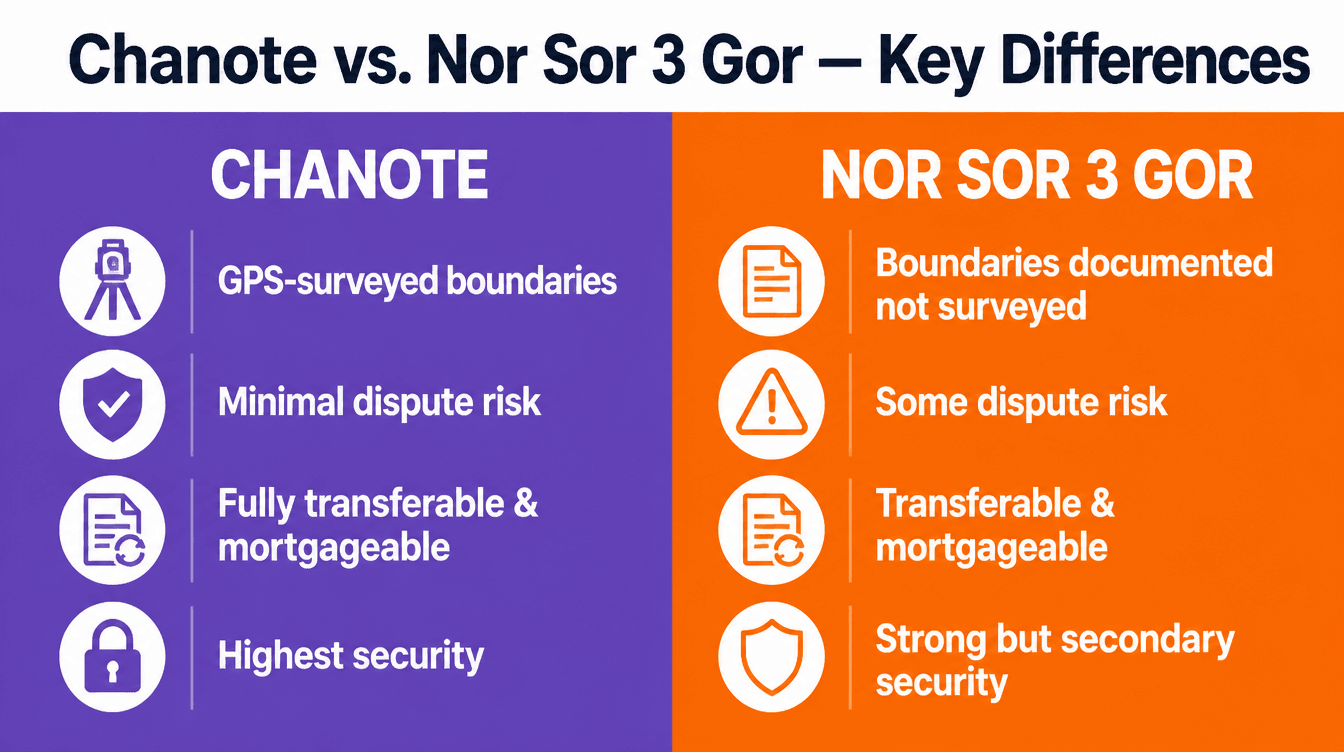
These two title types are the ones buyers most commonly encounter and most commonly confuse, since both represent genuinely transferable, reasonably secure forms of title.
What Is the Difference Between Nor Sor 3 Gor and Chanote?
Chanote boundaries are precisely surveyed and mapped against the national grid, making disputes over exact boundary lines rare. Nor Sor 3 Gor boundaries are documented but not surveyed to the same precision, which leaves more room for boundary disputes with neighboring landowners than a Chanote would. Both title types can be transferred and mortgaged, but Chanote's superior boundary precision is what makes it the preferred and more valuable title type where a choice exists.
What Is a Possessory Right and Is It a Real Title?
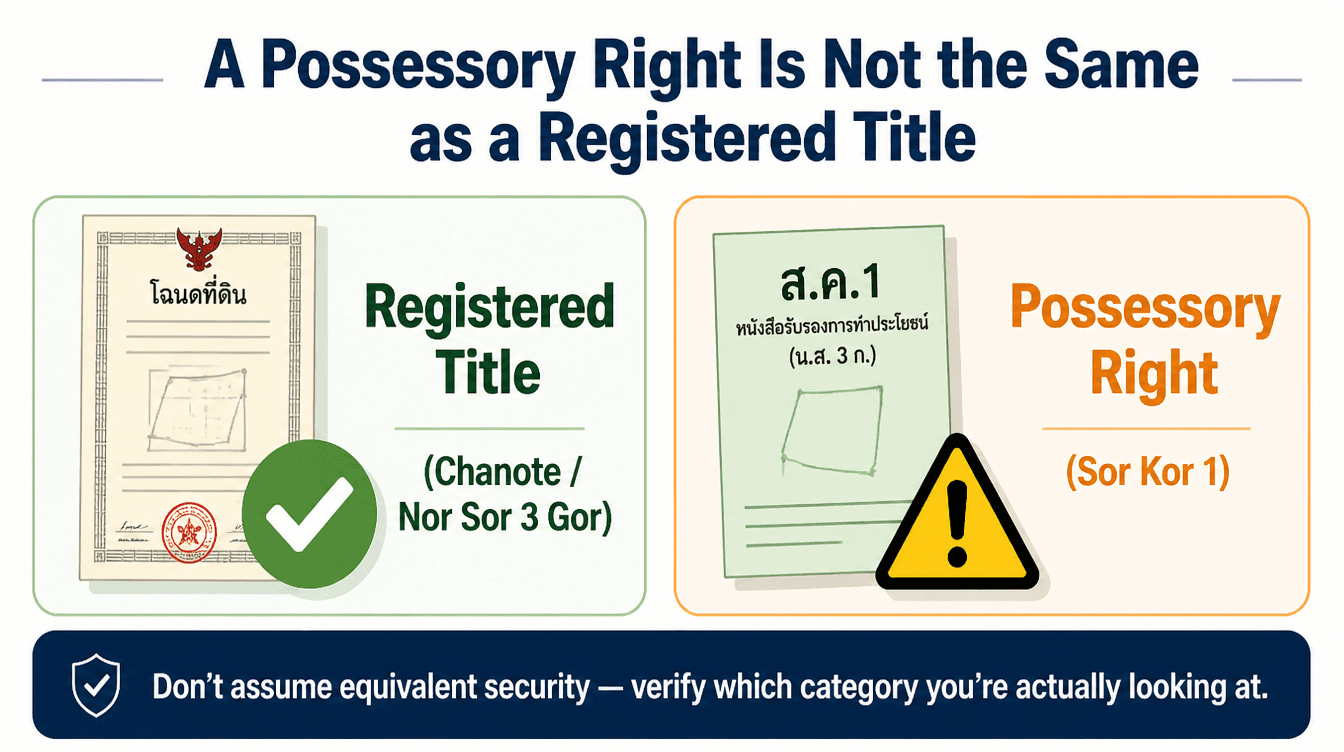
A possessory right, such as the Sor Kor 1 notification, reflects a claim of occupation and use rather than a formally registered, surveyed title. It's a real legal concept in the sense that it can be recognized and, in some circumstances, has a pathway toward formal registration — but it does not carry the same transferability or security as a registered title deed, and treating it as equivalent to Chanote or even Nor Sor 3 Gor is a mistake that can leave a buyer with a considerably weaker legal position than they realized.
How to Check a Title Deed in Thailand
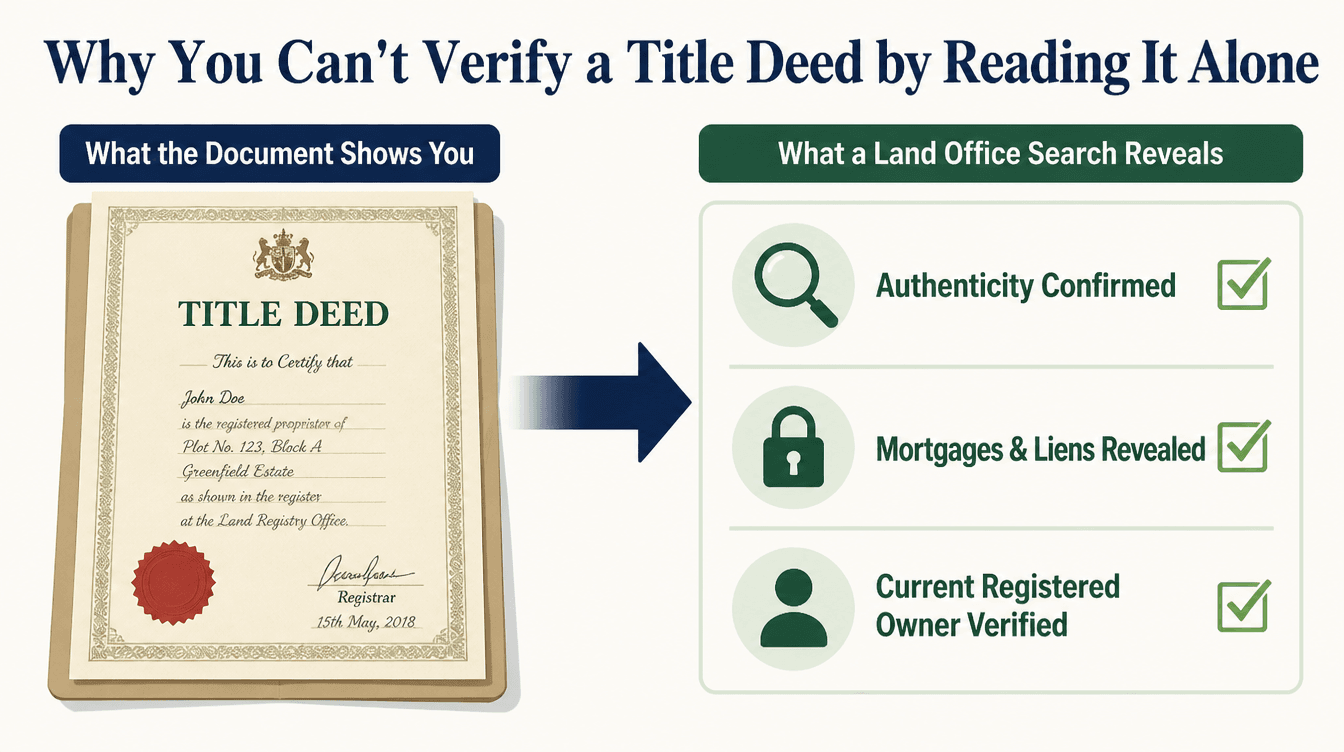
Reading a title deed document is only the first step — genuine verification means confirming what the document actually says against the Land Department's own records.
How Do You Check if a Title Deed Is Genuine in Thailand?
Verification involves a title search conducted directly at the relevant Land Office, cross-referencing the document presented against the official land records. This confirms the title is authentic, correctly reflects the current registered owner, and hasn't been altered or fraudulently reproduced — a step that matters because title deed fraud, while not common, does occur, and a forged or altered document can look convincing to anyone without the ability to check it against official records directly.
How Do You Check for Encumbrances on a Title Deed?
Beyond confirming authenticity, a title search reveals any encumbrances registered against the property — mortgages, liens, or other registered claims that would affect the buyer once ownership transfers. A registered mortgage on a title deed, for example, remains attached to the property regardless of a sale unless it's specifically cleared as part of the transaction, which is exactly why this check needs to happen before money changes hands, not after. This is precisely the kind of verification that belongs in a full due diligence process — Papaya Property handles title search and encumbrance checks as a standard part of due diligence before a client commits to a purchase, rather than treating it as an optional add-on.
What Title Deed Does a Condo Unit Actually Have?
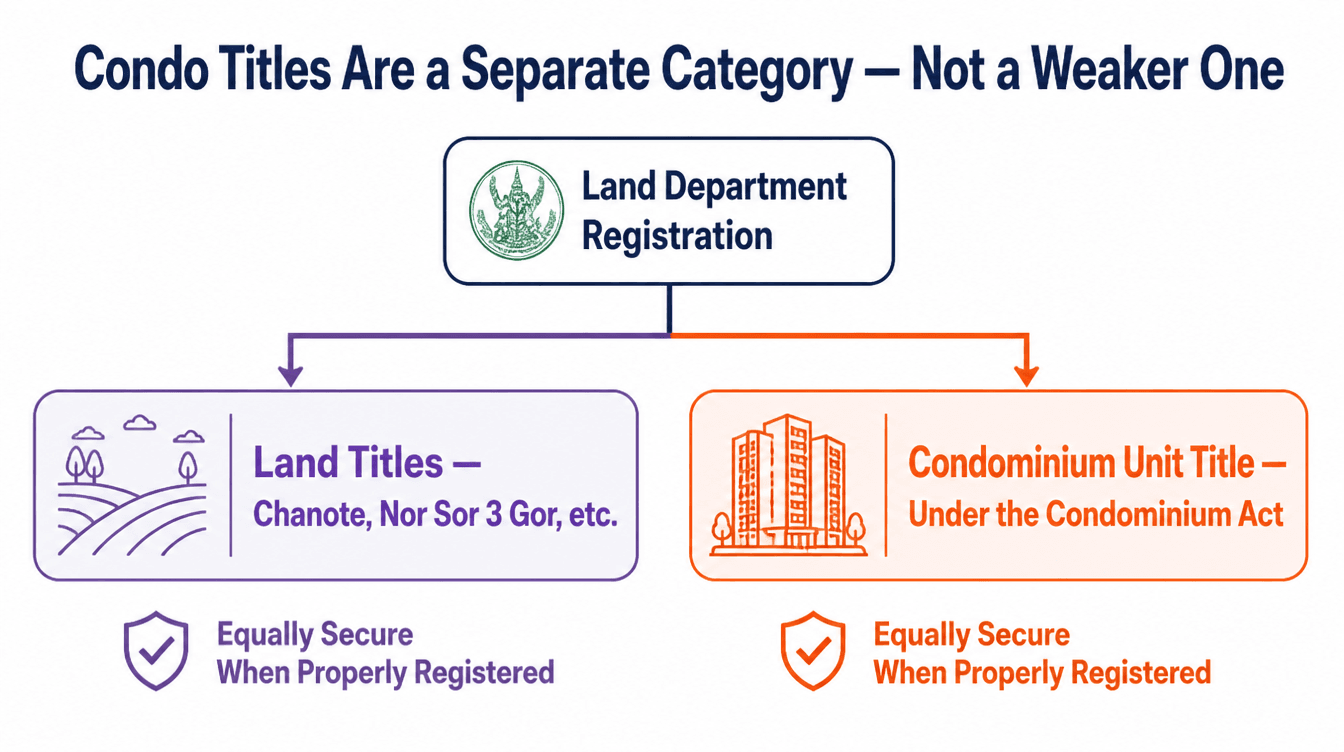
Condo buyers sometimes assume title deed concepts apply to their unit exactly the way they apply to land, which isn't quite accurate.
What Title Deed Does a Condo Unit Actually Have?
A condo unit has its own specific form of title registration under the Condominium Act, distinct from land-based title deeds like Chanote, though it operates on a similarly secure, Land Department-registered basis. This condominium unit title confirms ownership of the specific unit along with a proportional interest in the building's common areas, and — for foreign buyers — it's the document that reflects freehold ownership once the unit is properly registered under the foreign ownership quota with funds transferred correctly via the FET form. The security this title offers is comparable to Chanote's strength, since it's a fully registered, surveyed form of ownership specific to condominium law rather than a lesser or weaker category of title.
Title Deed Verification for Phuket Property Purchases
How much title risk a buyer actually faces varies significantly depending on whether they're buying resale or buying direct from an established developer.
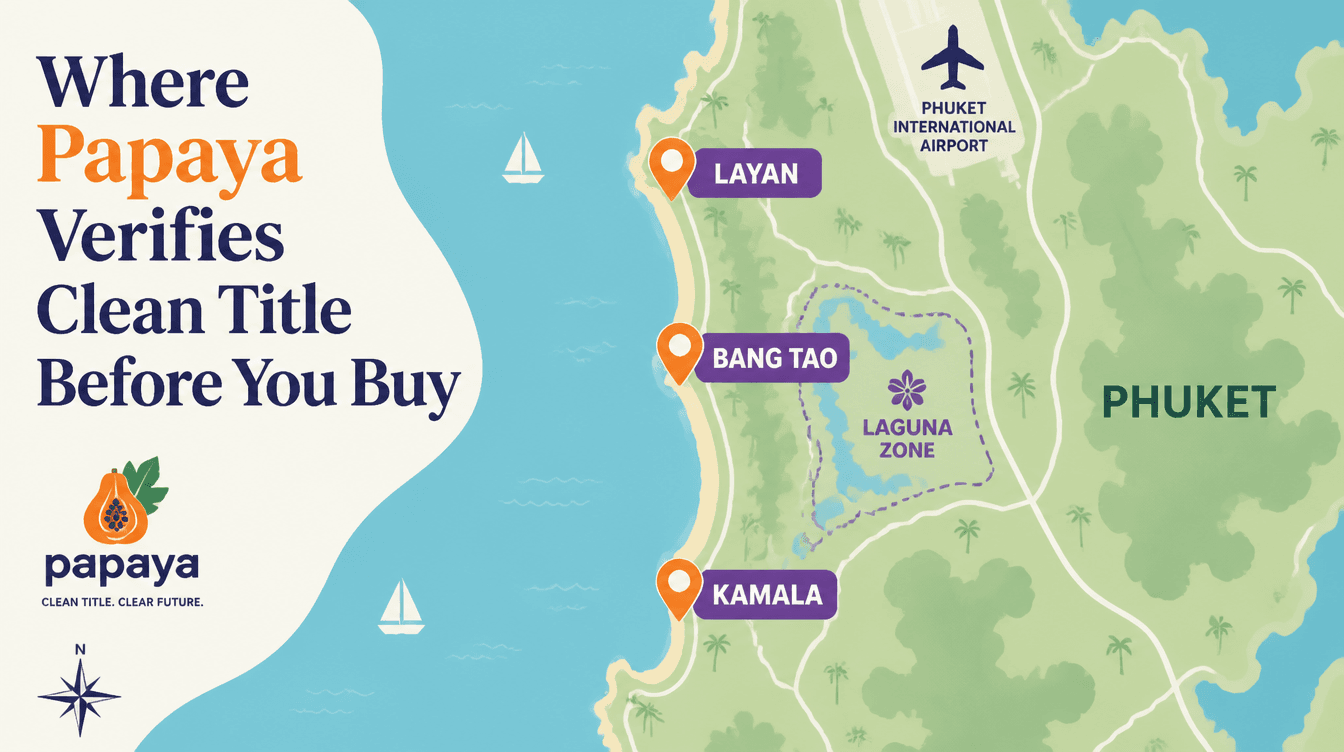
Resale properties carry title history that needs to be traced and verified — prior owners, any past encumbrances, and confirmation that the chain of ownership is clean all the way back. Off-plan purchases from established developers carry a different risk profile: the title is typically clean and newly registered at the point of sale, since the developer is the current registered owner transferring a freshly issued title rather than passing along decades of ownership history. Buying directly from developers like Sansiri, Laguna Property, and The Title across Bang Tao, Kamala, Laguna, and Layan means starting from a verifiable, current title rather than untangling a resale property's full ownership history.
This is exactly where working with a team that handles due diligence directly makes a practical difference — Papaya Property confirms clean title as part of every purchase it coordinates, whether that means a straightforward check on a new developer title or a more thorough historical search on a resale unit.
The Bottom Line
Not every document called a "title deed" in Thailand offers the same protection. Chanote sits at the top of the hierarchy with surveyed, GPS-precise boundaries; Nor Sor 3 Gor and Nor Sor 3 offer meaningfully less security; possessory rights like Sor Kor 1 are a different category altogether and shouldn't be mistaken for a registered title. Knowing the difference — and verifying the specific document in front of you against official Land Department records rather than taking it at face value — is what actually protects a buyer's investment.
If you're evaluating a title deed for a property in Bang Tao, Kamala, Laguna, or Layan, the Papaya Property team can verify exactly what you're looking at and confirm it's clean before you commit any funds. Reach out via Telegram, WhatsApp, or email for a free consultation — no forms, just a direct conversation with someone who can answer the questions specific to your purchase.