

Phuket Property Capital Appreciation: Full Guide
Phuket Property Capital Appreciation: What Actually Drives Long-Term Value Growth
Intro
Capital appreciation is a fundamentally different investment strategy from rental income, and conflating the two leads investors toward the wrong properties entirely. Understanding Phuket property capital appreciation means understanding what actually drives long-term value growth — not rental yield, occupancy rates, or short-term price swings.
This guide covers what capital appreciation actually means, how it differs from a rental yield strategy, what drives value growth in Phuket specifically, which areas have historically performed best, and how long you should realistically plan to hold a property to benefit from it.
What Is Capital Appreciation in Real Estate?
Before looking at Phuket specifically, it's worth establishing exactly what this term means and how it's measured.
Capital appreciation refers to the increase in a property's market value over time, realized as profit when the property is sold — distinct from rental income, which generates ongoing cash flow while the property is held. Capital gains real estate Thailand investors earn come specifically from this value increase, calculated as the difference between purchase price and eventual sale price, minus transaction costs and any applicable taxes.
Property appreciation rate Phuket sees, like anywhere, isn't guaranteed or linear — it depends on a combination of location, timing, property quality, and broader market conditions, which is exactly why understanding the underlying drivers matters more than chasing a headline number.
What Is Capital Appreciation in Real Estate?
In practical terms, capital appreciation is what you earn by selling a property for more than you paid for it, after accounting for costs. It's a long-term, exit-driven return, as opposed to rental yield, which is an ongoing, income-driven return — the two require genuinely different property choices, timing, and risk tolerance.
Capital Appreciation vs. Rental Yield — Which Strategy Fits Phuket?
This distinction matters more than most first-time investors realize, and it should shape which property you buy from the outset.
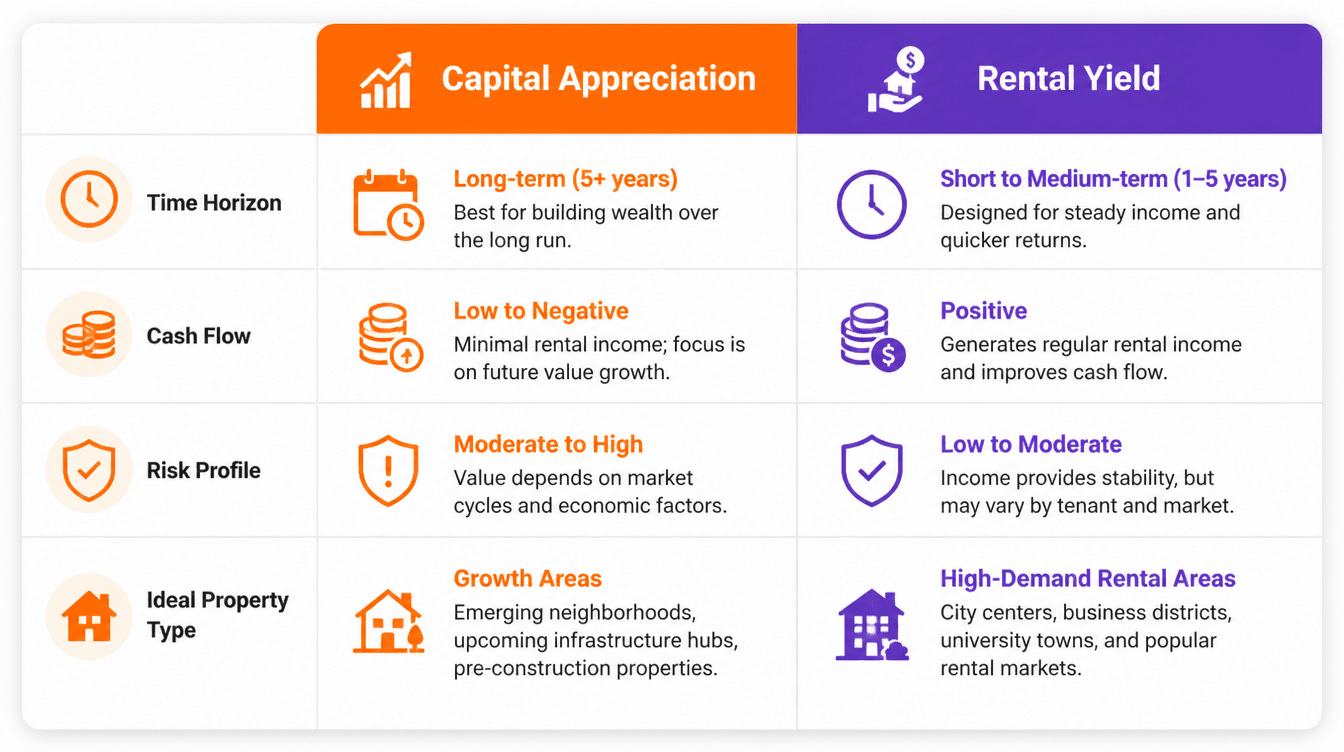
Long-term vs short-term property investment thinking splits roughly along these lines: a capital appreciation strategy favors properties in areas with strong structural growth drivers — limited land, improving infrastructure, rising demand — held over several years until sale. A rental yield strategy favors properties with strong immediate occupancy potential and rental demand, generating income from day one regardless of whether the property's resale value grows significantly. Exit strategy property investment Thailand plans should account for which of these two goals is primary, since a property optimized for one doesn't always optimize for the other.
For readers focused specifically on rental income and yield figures, our dedicated guide to rental ROI by area in Phuket covers that side of the equation in depth — this article focuses specifically on the capital growth side.
Is Capital Appreciation or Rental Yield Better for Phuket Property?
Neither is universally better — it depends entirely on the investor's goals and timeline. An investor prioritizing near-term income and willing to manage a rental property should weight their decision toward yield. An investor with a longer time horizon, less need for immediate cash flow, and confidence in an area's growth trajectory should weight their decision toward capital appreciation. Many properties in Phuket's established areas offer a reasonable balance of both, but rarely maximize either in isolation.
What Drives Property Value Growth in Phuket?
Understanding the actual mechanisms behind appreciation matters more than simply assuming prices will rise because a location is popular.
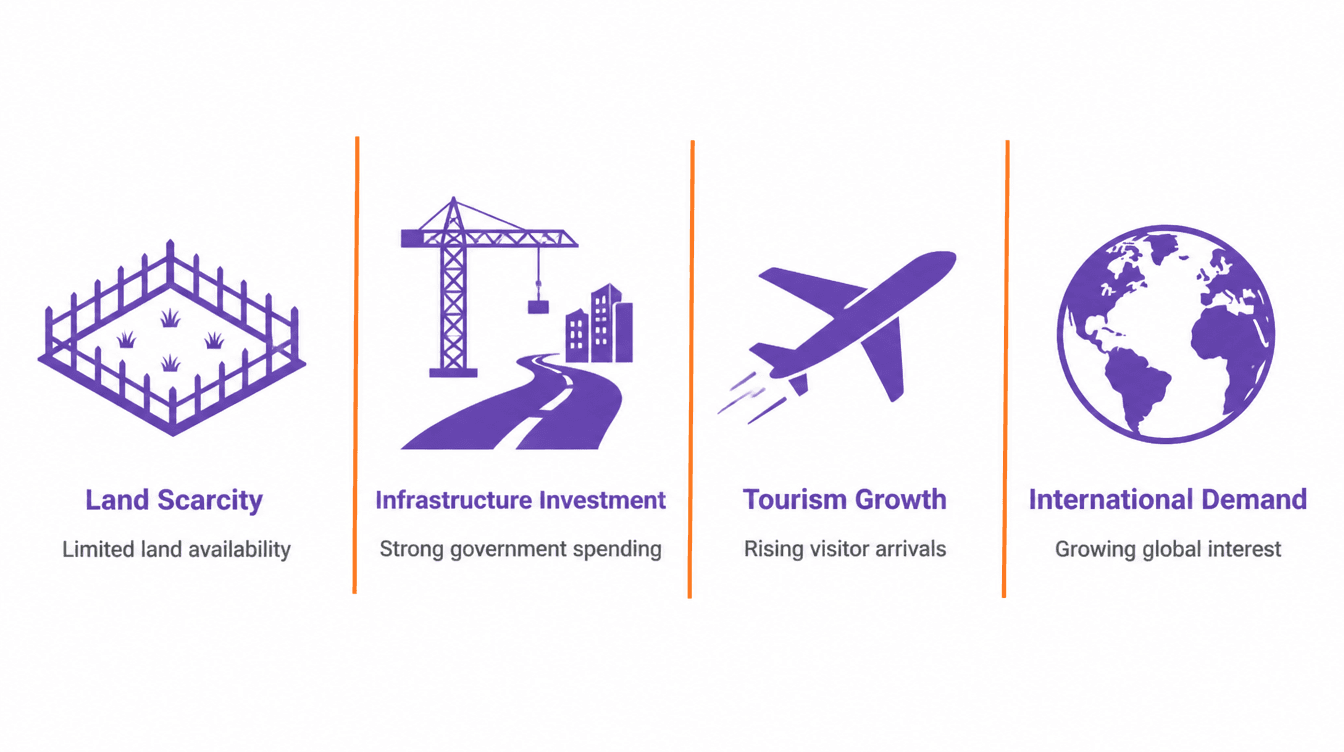
Phuket property value growth has historically been driven by a consistent set of structural factors: land scarcity in established coastal areas, ongoing infrastructure investment, sustained tourism growth supporting the broader economy, and continued international buyer demand. Infrastructure development Phuket property value benefits from includes road improvements, airport capacity expansion, and utilities upgrades — all of which tend to support property values in the areas they touch by improving accessibility and quality of life. Tourism growth impact property value sees is significant but indirect: more visitors support the local economy, rental demand, and overall area desirability, which in turn supports property values even for buyers who never intend to rent out their unit.
Prime location appreciation real estate sees tends to outpace less established areas specifically because of land value appreciation Phuket has experienced in its most desirable coastal zones — as buildable coastal land becomes scarcer, existing developments in those areas become relatively more valuable over time.
How Does Infrastructure Development Affect Property Values in Phuket?
Infrastructure investment tends to have a compounding effect: a road improvement or new amenity doesn't just make an area more livable, it also makes it more accessible to a wider pool of future buyers, which supports demand and, over time, price growth. Areas that have seen sustained infrastructure investment alongside private development — Bang Tao and Laguna being clear examples — have generally shown stronger long-term value growth than areas that haven't.
Which Areas in Phuket Have the Best Capital Appreciation?
This is the question most investors actually want answered, and it deserves an honest, area-specific answer rather than an island-wide generalization.
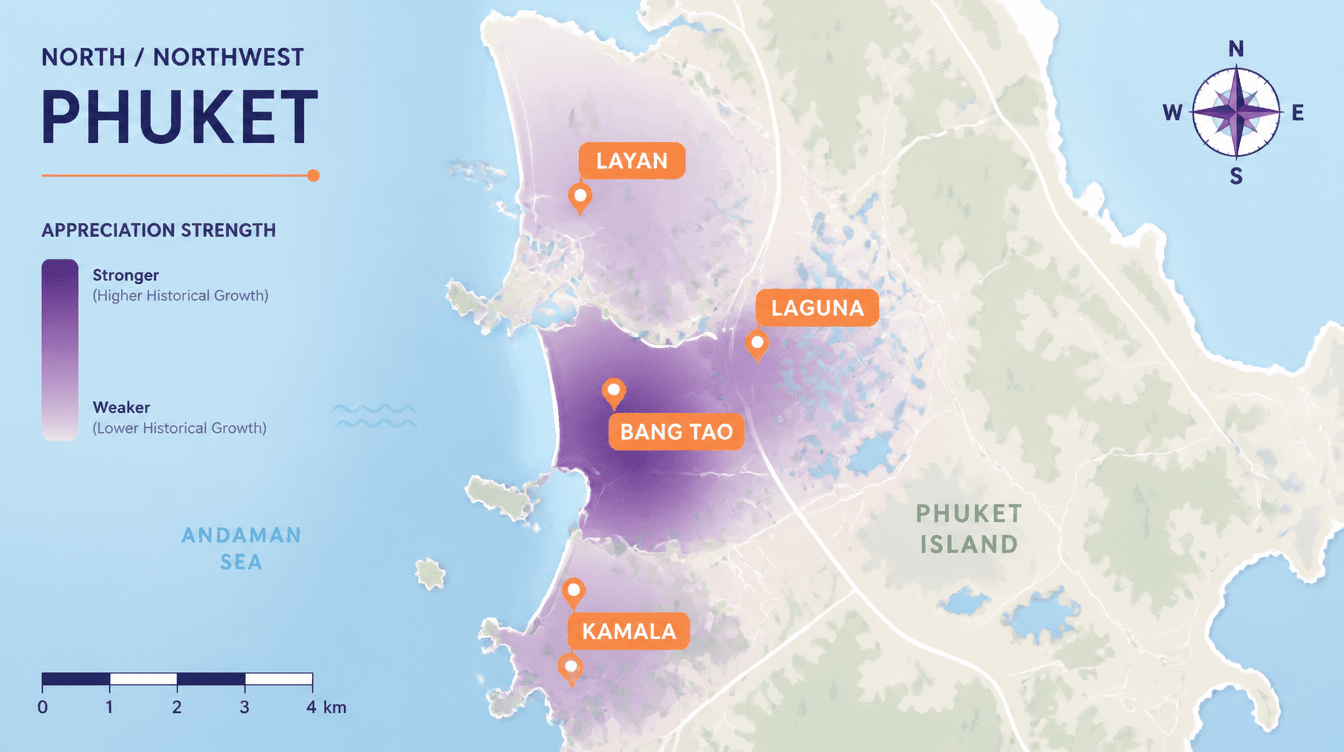
Bang Tao Laguna price growth has historically outpaced less established parts of the island, reflecting the concentration of infrastructure investment, credible developer activity, and sustained buyer demand in these areas specifically. Phuket property price history across the island as a whole shows meaningful variation by area — prime, land-constrained locations have generally appreciated more consistently than areas with abundant available land and less developed infrastructure. New developments driving property value in a given area also matters directly: a steady pipeline of quality projects from established developers like Sansiri, Laguna Property, and The Title tends to reinforce an area's desirability rather than dilute it, provided the pace of development doesn't outstrip demand.
Which Areas in Phuket Have Seen the Most Property Value Growth?
Bang Tao and Laguna have generally led the island on structural growth drivers, while Kamala and Layan offer differentiated appeal — quieter, more residential settings — that supports steady rather than explosive appreciation.
Does Off-Plan Property Appreciate Faster Than Resale?
This question connects directly to purchase timing, and it's worth separating from the payment-structure comparison covered elsewhere.
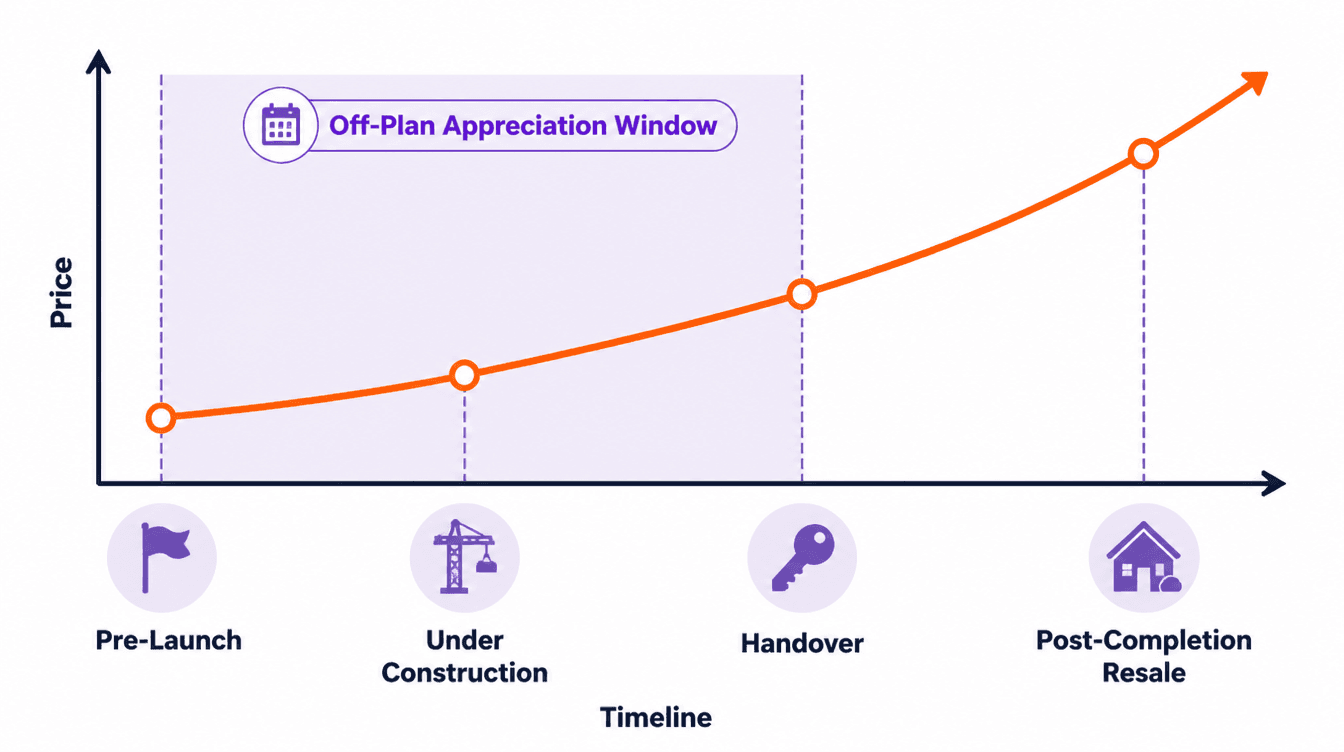
Off-plan appreciation potential is generally strongest in the earliest phase of a project's sales cycle, since pre-launch and early-phase pricing typically sits meaningfully below where a completed, fully-sold project eventually prices. Resale value Phuket condo owners realize depends heavily on how the specific project and area have performed since original purchase — a well-selected off-plan unit in a strong area can appreciate significantly by the time construction completes, before the owner even factors in further appreciation after handover.
Does Off-Plan Property Appreciate Faster Than Resale?
In many cases, yes — off-plan buyers who enter at the earliest sales phase of a credible project in a strong area capture appreciation that happens simply by construction progressing and the project de-risking, independent of broader market appreciation. This isn't guaranteed and depends heavily on developer credibility and area fundamentals, but it's a genuine, structural source of appreciation specific to off-plan purchases that resale buyers don't have access to.
How Long Should I Hold a Property in Phuket for Capital Appreciation?
Realistic timeline expectations matter as much as area selection when planning for capital growth.
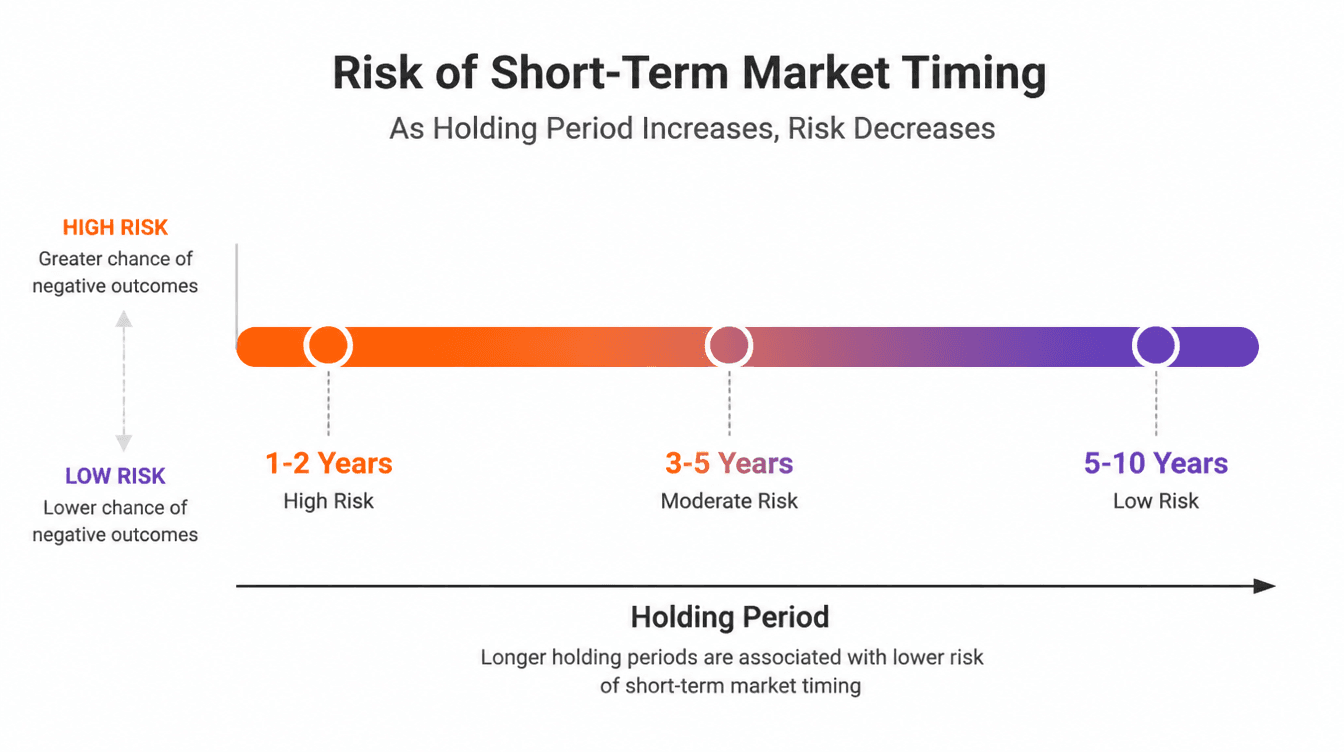
Holding period real estate returns depend on is typically measured in years, not months — capital appreciation is a long-term strategy by nature, and short-term price fluctuations shouldn't be mistaken for the underlying trend. Thailand property investment horizon planning generally works best over a five-to-ten-year timeframe, long enough to ride out short-term market noise and let the structural growth drivers — infrastructure, land scarcity, demand — play out.
What Is a Realistic Holding Period for Capital Appreciation in Phuket?
A shorter holding period increases exposure to short-term market timing risk, while a longer holding period allows structural drivers more time to compound and reduces the impact of any single market cycle. Investors specifically targeting capital appreciation should generally plan for a multi-year hold from the outset, rather than treating the property as a short-term flip, since transaction costs and market timing risk both work against a short holding period.
How Do I Calculate Capital Appreciation on a Property?
Beyond the concept, it helps to know the actual mechanics of tracking appreciation on a specific property.
The basic calculation is straightforward: subtract the original purchase price (plus acquisition costs — transfer fees, legal fees, stamp duty where applicable) from the eventual sale price (minus selling costs), then express the result as a percentage of the original investment.
How Do I Calculate Capital Appreciation on a Property?
Track the all-in acquisition cost (purchase price plus fees), monitor comparable sales in the same project or area over time to estimate current market value, and calculate the percentage gain when comparing your cost basis to a realistic current or eventual sale price. Keeping thorough documentation from the original purchase — the SPA, transfer documents, and any capital improvements made — makes this calculation far more straightforward when the time comes to sell.

Conclusion
Capital appreciation and rental yield are genuinely different investment strategies that call for different property choices, not two labels for the same outcome. Phuket's prime areas — Bang Tao and Laguna in particular — benefit from strong structural drivers for long-term value growth: land scarcity, sustained infrastructure investment, and consistent international demand.
If you want the fuller investment picture, our guides to rental ROI by area and Phuket property market supply and demand cover the income and market-timing sides in more depth. For guidance on which specific projects and areas best fit a capital appreciation strategy, reach out to the Papaya team directly via Telegram, WhatsApp, or email — we're happy to walk you through what fits your investment goals.