

Property Taxes and Fees in Thailand: Full Cost Guide
Property Taxes and Fees in Thailand: The Complete Cost of Ownership
Buyers budget carefully for the purchase price, then get surprised by a second layer of costs — some paid once at closing, others recurring for as long as they own the unit — that never made it into their original calculation. Understanding property taxes and fees in Thailand in full means looking past the sale price to two distinct categories: one-time costs paid at purchase, and ongoing costs paid every year (or every month) for the life of ownership.
This guide breaks down every tax and fee involved — what's paid once, what's paid annually, what applies specifically to rental income or resale, and the costs buyers most commonly forget to budget for.
How Much Does It Cost to Own a Condo in Thailand?
The honest answer requires splitting costs into two buckets that behave very differently over time.
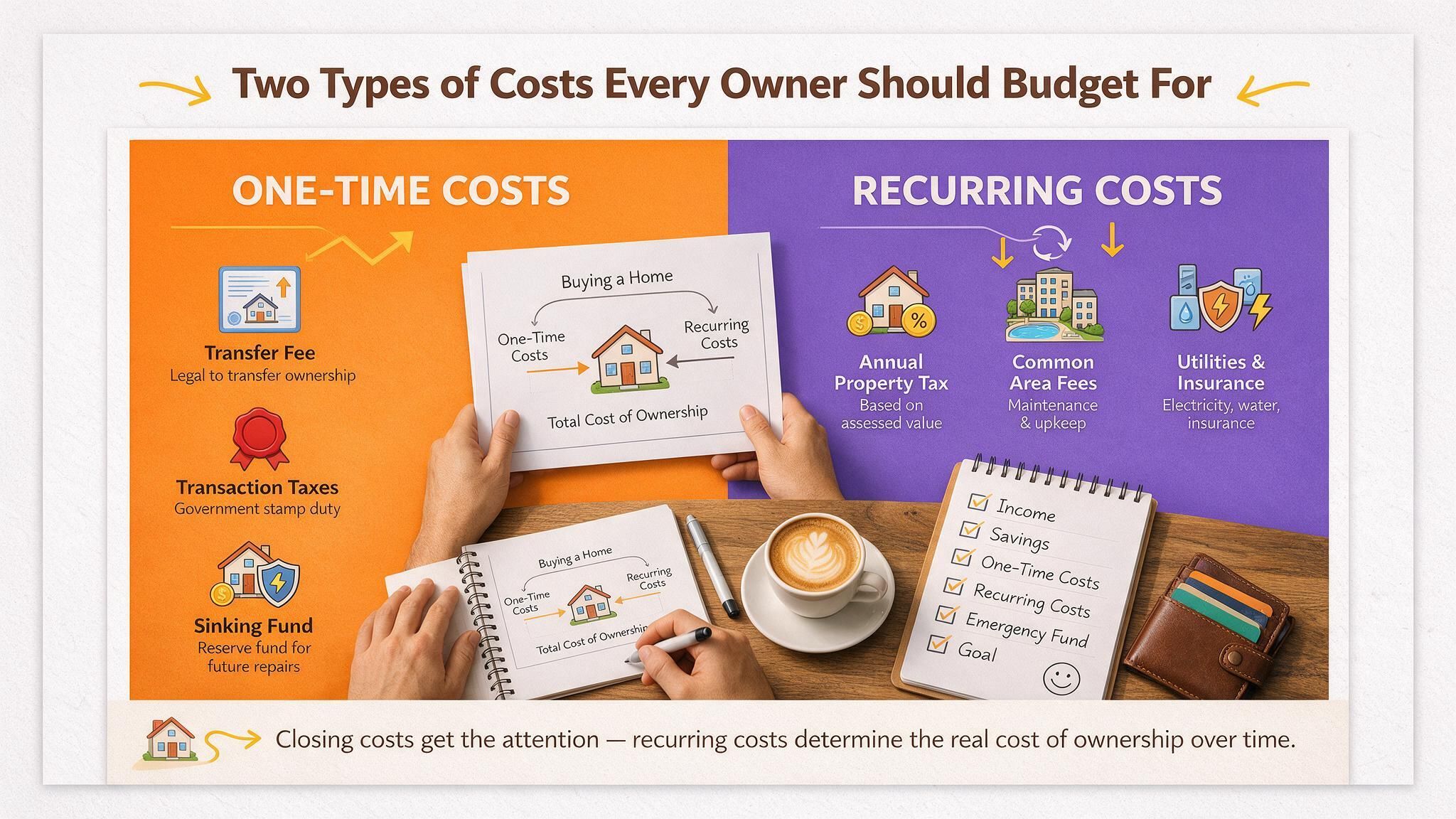
One-time costs are paid at the point of purchase and don't recur: the transfer fee, applicable taxes on the transaction, and the sinking fund contribution. Recurring costs are paid annually or monthly for as long as you own the unit: the land and building tax, common area management fees, utilities, and insurance. Closing costs get most of the attention because they're immediate and visible on a settlement statement, but recurring costs are what actually determine the true cost of ownership over years of holding a property.
One-Time Taxes and Fees at Purchase
These costs are paid once, at the point of title transfer, and they sit on top of the purchase price itself.
What Taxes Do You Pay When Buying a Condo in Thailand?
The costs due at transfer typically include:
Transfer fee — a percentage of the registered sale price or government-assessed value, paid to the Land Department and often split between buyer and seller
Specific business tax — applies when the seller has held the property for a short period, calculated as a percentage of the sale price
Stamp duty — applies as an alternative to specific business tax when the seller has held the property longer
Withholding tax — deducted from the seller's proceeds at the point of transfer
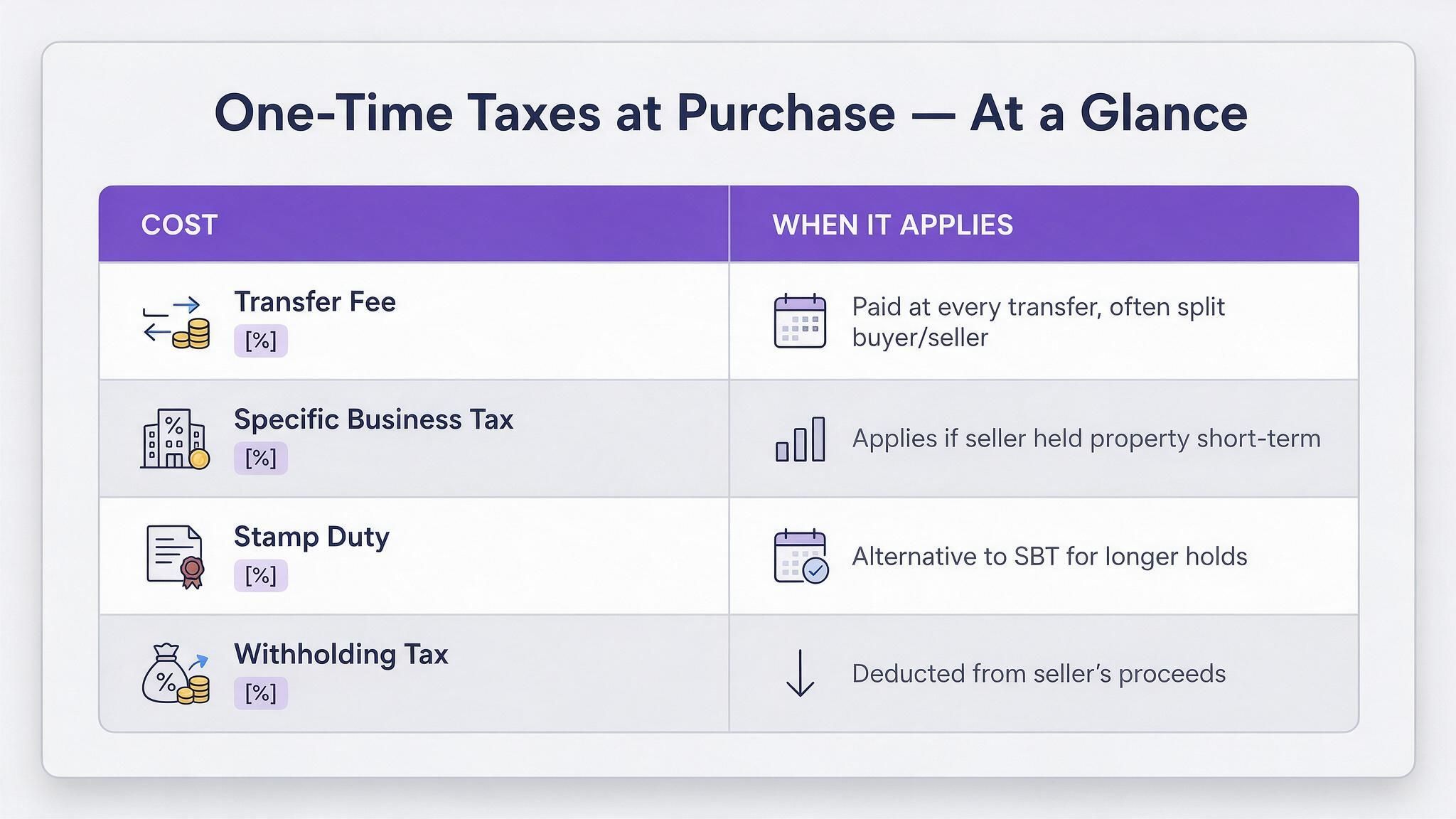
Which of these apply, and in what combination, depends on the specifics of the sale — for off-plan purchases from a developer, the split of these costs between buyer and developer is typically standardized in the SPA rather than individually negotiated.
Annual Property Tax in Thailand
Beyond the costs paid at purchase, owning property in Thailand comes with a recurring government tax that applies every year you hold the title.
How Much Is Annual Property Tax in Thailand?
The land and building tax is assessed annually based on the property's appraised value and its usage classification (residential, commercial, or vacant). [DATA NEEDED: current land and building tax rates by property value band and usage classification]. This tax is separate from anything paid at the point of transfer — it's an ongoing obligation tied to holding the property, not a one-time transaction cost, and it applies regardless of whether the owner lives in the unit, rents it out, or leaves it vacant.
Common Area Fees and the Sinking Fund
Every condo owner in Thailand pays into the building's shared upkeep, through two distinct mechanisms that work differently from each other.
What Is a Sinking Fund and Do You Have to Pay It?
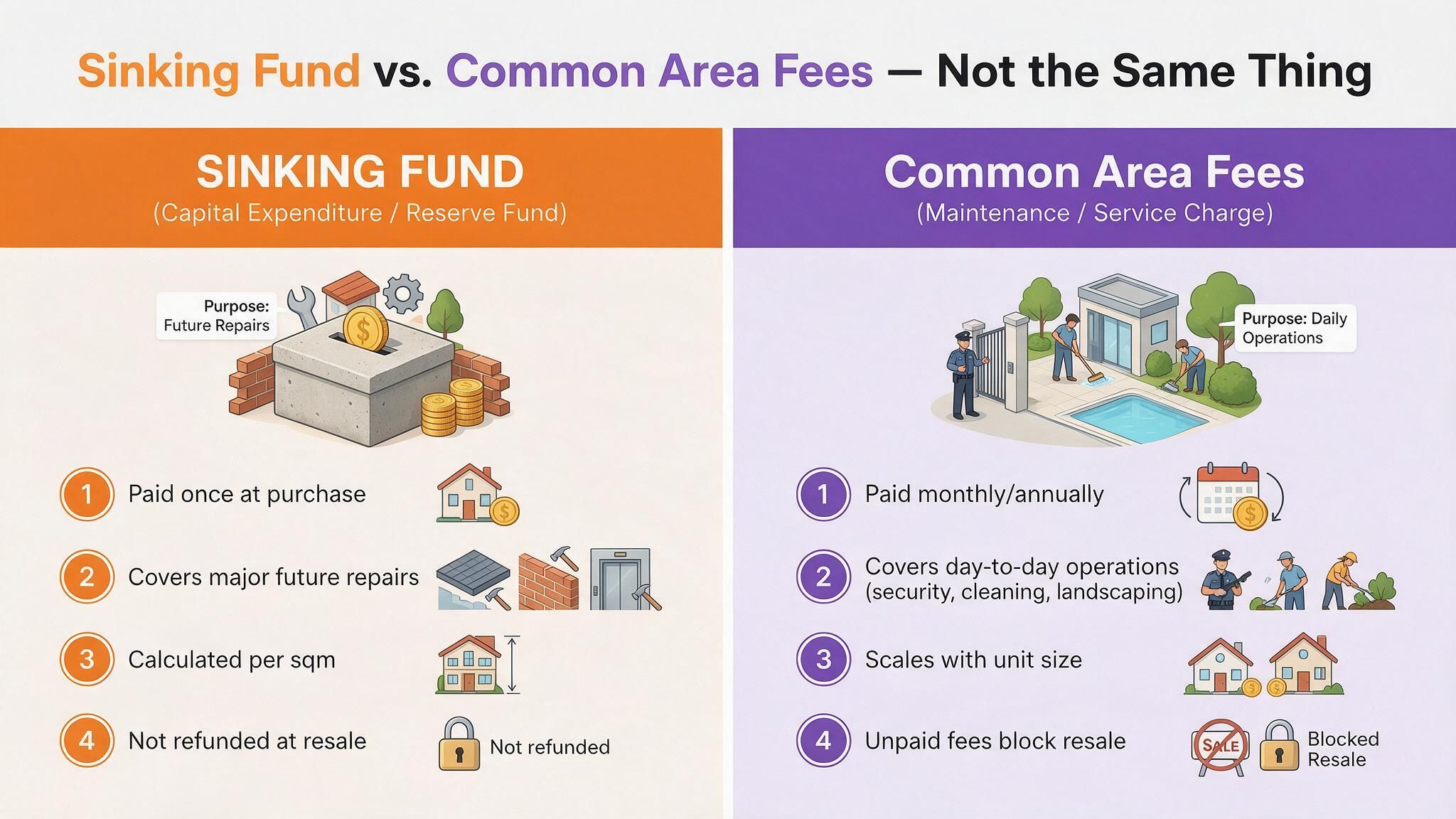
The sinking fund is a one-time contribution paid at purchase, held in reserve by the building's juristic person to cover major future repairs and capital expenditures — roof replacement, structural maintenance, or large equipment upgrades that routine monthly fees aren't designed to cover. Every owner pays into it once, typically calculated per square meter of the unit, and it isn't refunded or transferred when the unit is later resold.
How Much Are Common Area Fees in Phuket Condos?
Common area fees are the recurring monthly or annual charge that funds day-to-day building operations — security, cleaning, landscaping, and shared facility maintenance. [DATA NEEDED: typical common area fee range per square meter for current Phuket condo projects]. These fees are set by the juristic person and typically scale with unit size, since larger units draw proportionally more use of shared facilities and services.
What Happens If You Don't Pay Common Area Fees?
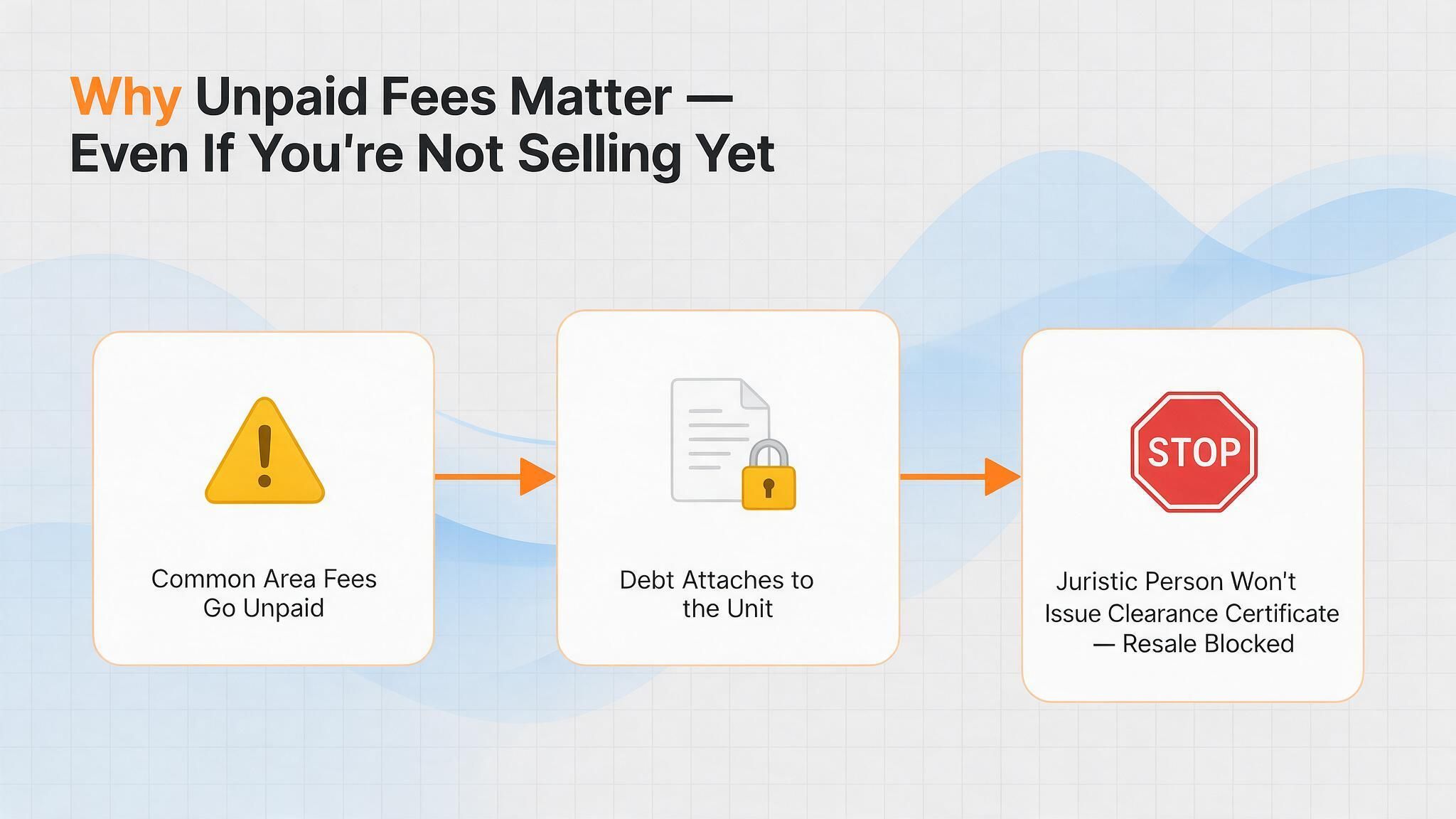
Unpaid common area fees become a debt attached to the unit, not just to the owner personally. This matters directly at resale — the juristic person issues a clearance certificate confirming no outstanding fees before the Land Department will register a transfer, so unresolved arrears effectively block a sale until they're settled. For buyers, this is exactly why checking for outstanding common area fees is a standard part of due diligence on any resale unit.
Other Ongoing Ownership Costs
Beyond formal taxes and building fees, there are a few recurring costs that are easy to leave out of an initial budget simply because they're less structured.
Are There Ongoing Costs After Buying a Condo in Thailand?
Yes. Utilities — electricity, water, and internet — are billed directly to the owner or tenant based on usage, separate from common area fees. Property insurance, while not always mandatory, is worth budgeting for given Phuket's coastal climate and the value of protecting against damage or liability. Neither of these costs is unique to Thailand, but both are worth including in a realistic annual ownership budget rather than treating the purchase price as the full financial picture.
Taxes on Rental Income and Resale
For buyers purchasing with investment intent, there are two further tax categories that only apply once the property starts generating income or is eventually sold.
What Taxes Apply If You Rent Out Your Condo in Thailand?
Rental income earned from a Thai property is subject to Thai income tax, with the specific rate and filing requirements depending on how the income is structured and the owner's overall tax residency situation. [DATA NEEDED: current rental income tax rates and thresholds applicable to foreign property owners]. This is a distinct obligation from the property taxes covered above — it applies specifically when a unit is generating rental income, not simply from owning it.
Do Foreigners Pay More Tax on Thai Property?
No — the tax obligations described throughout this guide apply based on the transaction and the property itself, not on the buyer's nationality. Foreign and Thai owners face the same land and building tax, the same transfer-related taxes, and the same rental income tax framework. What differs for foreign buyers isn't the tax rate, but the additional legal requirements around fund transfers (the FET form) and the foreign ownership quota — neither of which is a tax, but both of which are frequently confused with one by first-time buyers.
Costs Buyers Commonly Overlook
Pulling everything together, a few specific costs are the ones that most consistently catch buyers off guard because they don't appear on a simple purchase-price calculation.
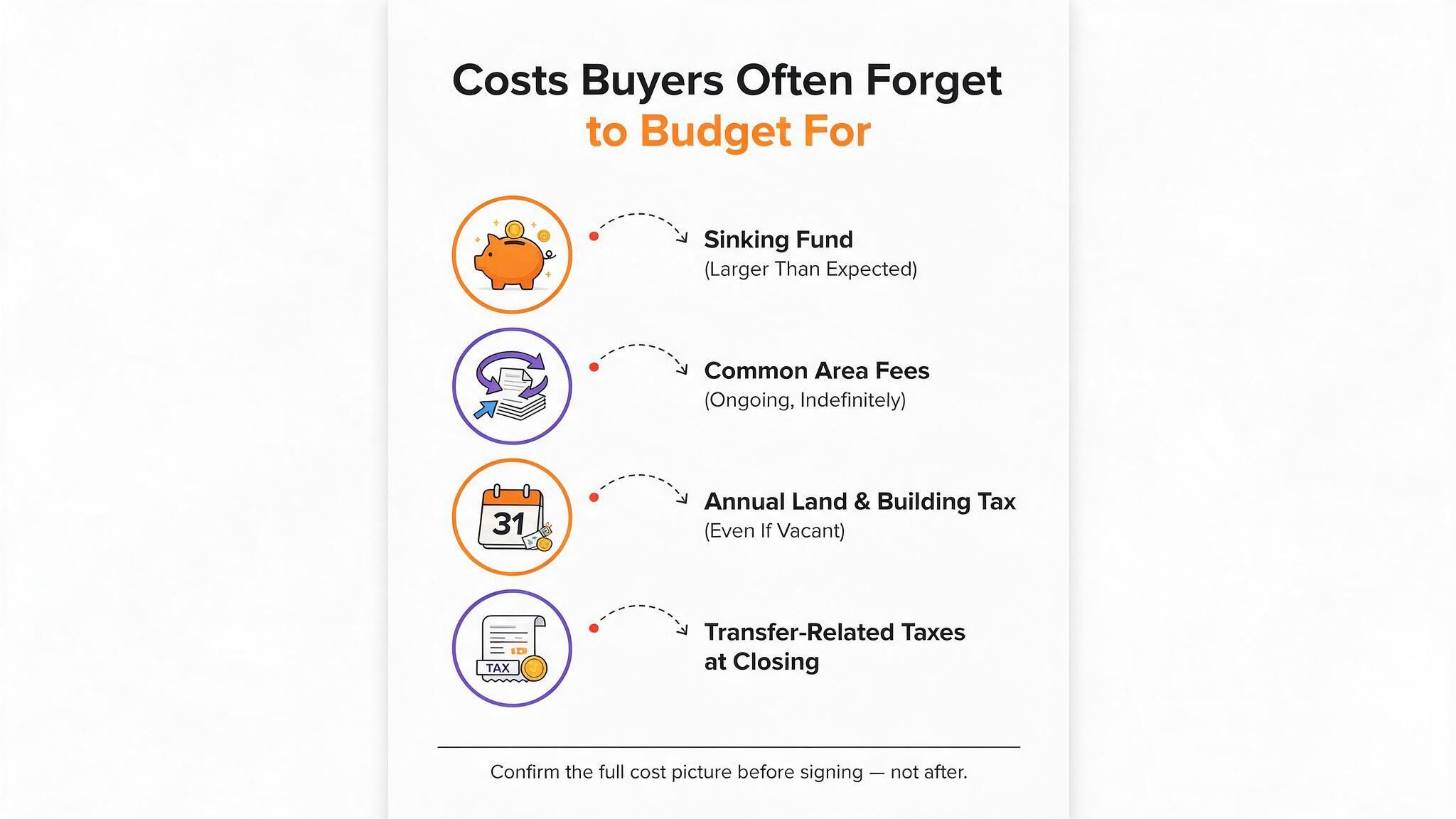
What Costs Should You Budget for Beyond the Purchase Price?
Budget explicitly for:
The sinking fund contribution, paid once at purchase but often larger than buyers expect
Common area fees, which continue indefinitely for as long as the unit is owned
Annual land and building tax, which applies whether or not the unit is occupied
Transfer-related taxes and fees, which add a meaningful percentage on top of the sale price at closing
This is exactly the kind of full-picture cost breakdown that should be confirmed before signing anything, not discovered incrementally after the fact. Buyers working with legal support who lay out every applicable cost upfront — rather than just the headline purchase price — go into a transaction with a complete, accurate budget rather than a partial one.
Total Cost of Ownership for Phuket Condos
How these costs actually add up in practice depends heavily on the specific project and developer involved.
For off-plan purchases from developers like Sansiri, Laguna Property, and The Title across Bang Tao, Kamala, Laguna, and Layan, the fee structure — including the split of transfer-related costs and the sinking fund amount — is typically set out clearly in the SPA from the start, which makes total cost of ownership far easier to calculate before committing than piecing figures together from a resale listing. Several of these developers also offer 0% installment plans structured over the construction period, which reduces the upfront capital pressure of the purchase price itself, even though it doesn't change the recurring ownership costs that apply once the unit is complete.
Because Papaya Property works directly with these developers, buyers get the full cost breakdown — purchase-related taxes, sinking fund, and ongoing common area fees — confirmed upfront as part of the buying process, rather than discovering pieces of it after signing.
The Bottom Line
The purchase price is only the starting point. A complete understanding of property taxes and fees in Thailand means budgeting for transfer-related taxes at closing, the one-time sinking fund contribution, and the recurring costs — annual property tax, common area fees, utilities — that continue for as long as the unit is owned. Buyers who map out this full picture before purchasing budget accurately from day one; buyers who don't are the ones who end up surprised by costs that were entirely knowable in advance.
If you're evaluating a purchase in Bang Tao, Kamala, Laguna, or Layan and want a complete cost breakdown for a specific unit or project, the Papaya Property team can walk you through every tax and fee involved. Reach out via Telegram, WhatsApp, or email for a free consultation — no forms, just a direct conversation with someone who can answer the questions specific to your purchase.