

Off-Plan Property Risks in Phuket and How to Avoid Them
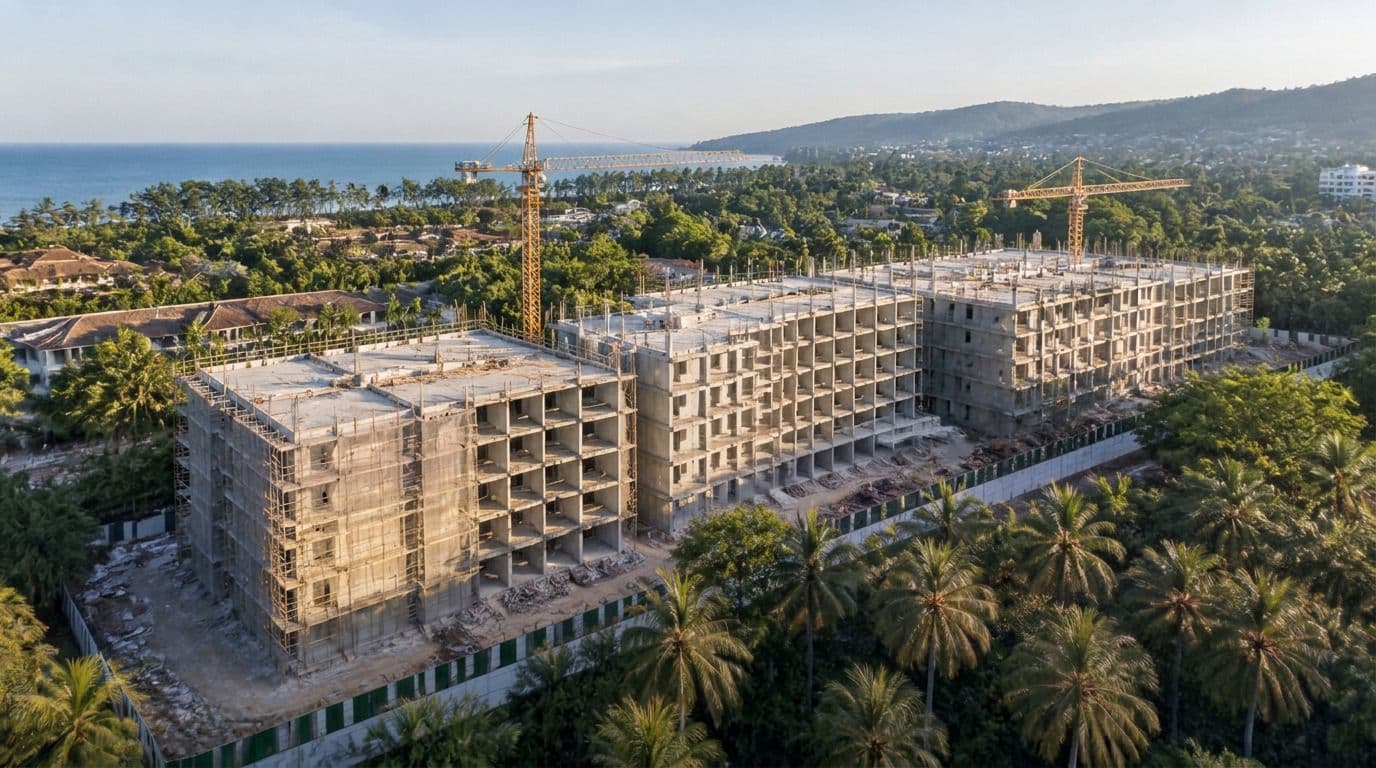
Off-Plan Property Risks in Phuket: What Can Go Wrong and How to Protect Yourself
Off-plan property risks in Phuket are the price of the main advantages of buying early: the developer's launch pricing, the best choice of units and a payment plan spread across construction. You commit to a building that does not exist yet, and you pay for it in stages over the construction period.
Most of those risks are well known, and Thai law addresses many of them directly. Condominium sale contracts must follow a government-prescribed form, delays give buyers clear refund rights, and new buildings come with a statutory defects warranty. The buyers who run into trouble are usually the ones who never checked what their contract said.
This guide covers:
whether buying off-plan in Phuket is safe, especially for foreign buyers
the seven main risks, and how each one is managed
off-plan compared with completed property
a protection plan from signing to handover
your exit options if plans change
Is Buying Off-Plan in Phuket Safe?
Yes, for buyers who check the developer, the land and the contract before they sign, and who verify progress during construction. Off-plan is the standard way to buy in Phuket's primary market. Most new condos and villas in Bang Tao, Laguna, Layan and Kamala sell before completion.
Off-plan risk is not about whether the building exists. It is about whether the developer delivers what the contract promises, when the contract says, at the quality the contract sets. Each of those points is something you can check in advance.
Is Off-Plan Property Safe for Foreign Buyers in Thailand?
Foreign buyers have the same contractual protections as Thai buyers, plus two extra points to manage:
The foreign ownership quota. Foreigners can own up to 49% of a condominium project's saleable area as freehold. Your unit must fall within that quota.
Money from abroad. For freehold registration, every payment must arrive in Thailand in foreign currency, documented with an FET form or a bank confirmation letter.
Both are straightforward to handle when you plan for them from the reservation stage. The rest of the protections are in the Sale and Purchase Agreement (SPA), and they work the same way for every buyer.
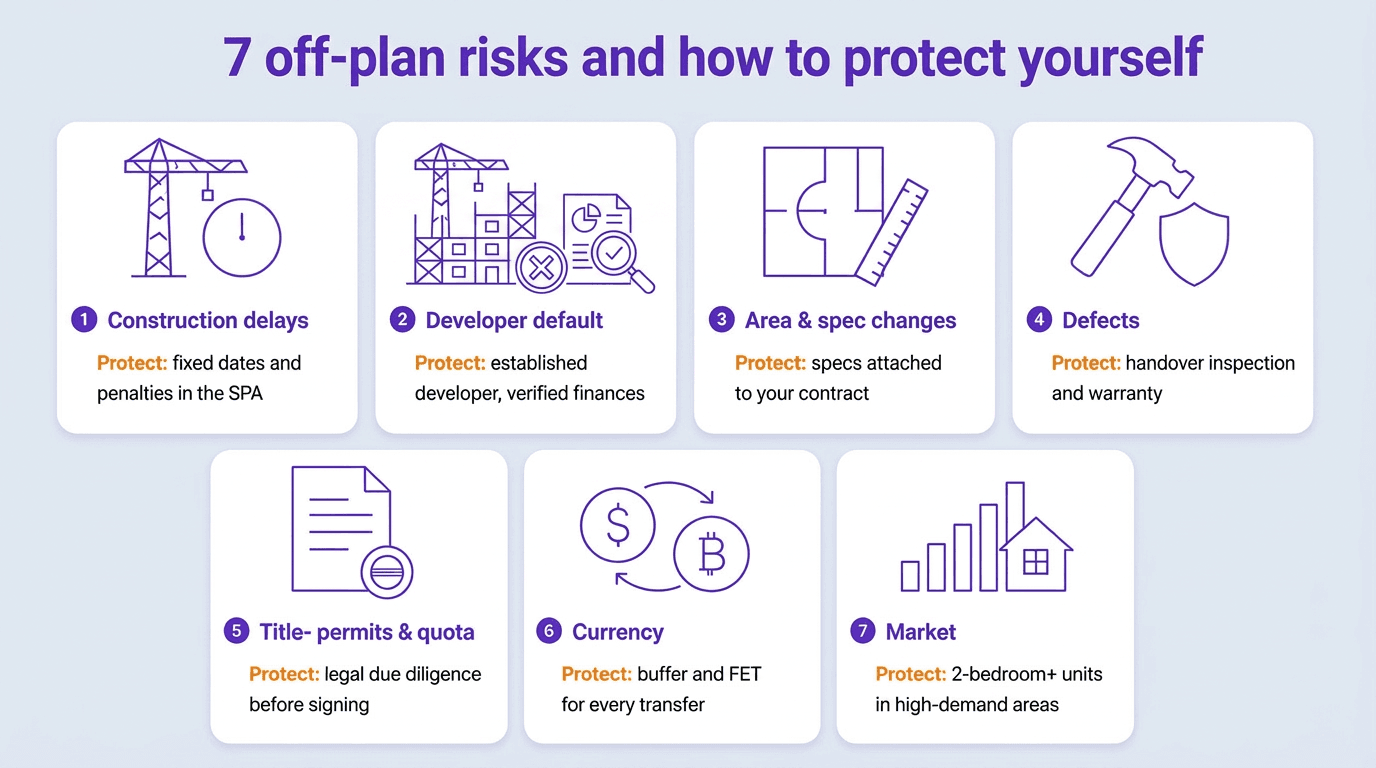
The 7 Main Off-Plan Property Risks in Phuket
These are the risks that matter in practice, in the order buyers most often meet them.
Off-Plan Construction Delays in Phuket
Delay is the most common off-plan risk. Projects slip because of contractor problems, material shortages, permit issues or slow sales that limit the developer's cash flow. Phuket's monsoon season, roughly May to October, also slows outdoor work every year.
A few months of delay is common and usually manageable. A long delay with little visible progress is a warning sign.
For condos, the SPA must state both a construction completion date and an ownership transfer date. That is a requirement of the standard condominium sale contract prescribed under Section 6/2 of the Condominium Act. Read those dates as carefully as the price, and confirm what the contract allows the developer in extensions, such as force majeure.
Papaya's off-plan construction quality control tracks progress on site and reports to you before each payment falls due. You see slippage early, while you still have options, not at the expected handover date.
Can You Get Your Money Back If an Off-Plan Project Is Delayed in Thailand?
Yes. Under the standard condominium sale contract, if the developer fails to transfer the unit by the contract date, you have two remedies:
Terminate the contract and recover everything you have paid, with interest at the rate set in the contract for the buyer's late payments.
Keep the contract and claim a daily penalty for each day of delay, up to a cap set in the standard form.
If construction stops because of genuine force majeure, the developer must return your payments with interest at Krung Thai Bank's highest fixed-deposit rate.
Two practical points matter:
Terms that disadvantage the buyer are invalid. Clauses that depart from the standard form against the buyer have no effect. A developer who asks you to accept weaker delay terms cannot enforce them.
A right is only as good as the developer's ability to pay. Refund rights protect you fully against a solvent developer that is late. They protect you less against a developer that has run out of money, which is the next risk.
Villa purchases follow different contract rules, so the delay and refund terms depend on what your contract says. Have a lawyer check them before you sign.
What Happens If a Developer Goes Bankrupt in Thailand?
Developer insolvency is the most serious off-plan risk, and it is rare among established developers. If a developer enters bankruptcy:
you file a claim with the official receiver as a creditor
buyers rank as unsecured creditors, behind banks that hold a mortgage over the land
recovery depends on the assets left, and it is usually partial
Sometimes another developer takes over a stalled project and offers buyers new contracts. Review those terms carefully, because they can be weaker than your original standard-form SPA.
Thailand has an Escrow Act, which lets a licensed escrow agent, usually a bank, hold buyer payments until delivery. Escrow funds are protected even if the developer fails. Escrow is voluntary, however, and few developers use it.
The real protection is choosing the developer well:
Listed developers such as Sansiri publish audited accounts.
Long-established developers such as Laguna Property have completed projects you can visit.
Bank project financing means a lender has reviewed the project before funding it.
Our guide on how to check a developer in Phuket covers all seven checks.
What If the Finished Unit Is Smaller Than in the Contract?
Unit area and specifications change more often than buyers expect. Floor plans are adjusted during construction, materials are substituted, and the final measured area differs from the brochure.
Thai law sets a clear rule for area under the Civil and Commercial Code:
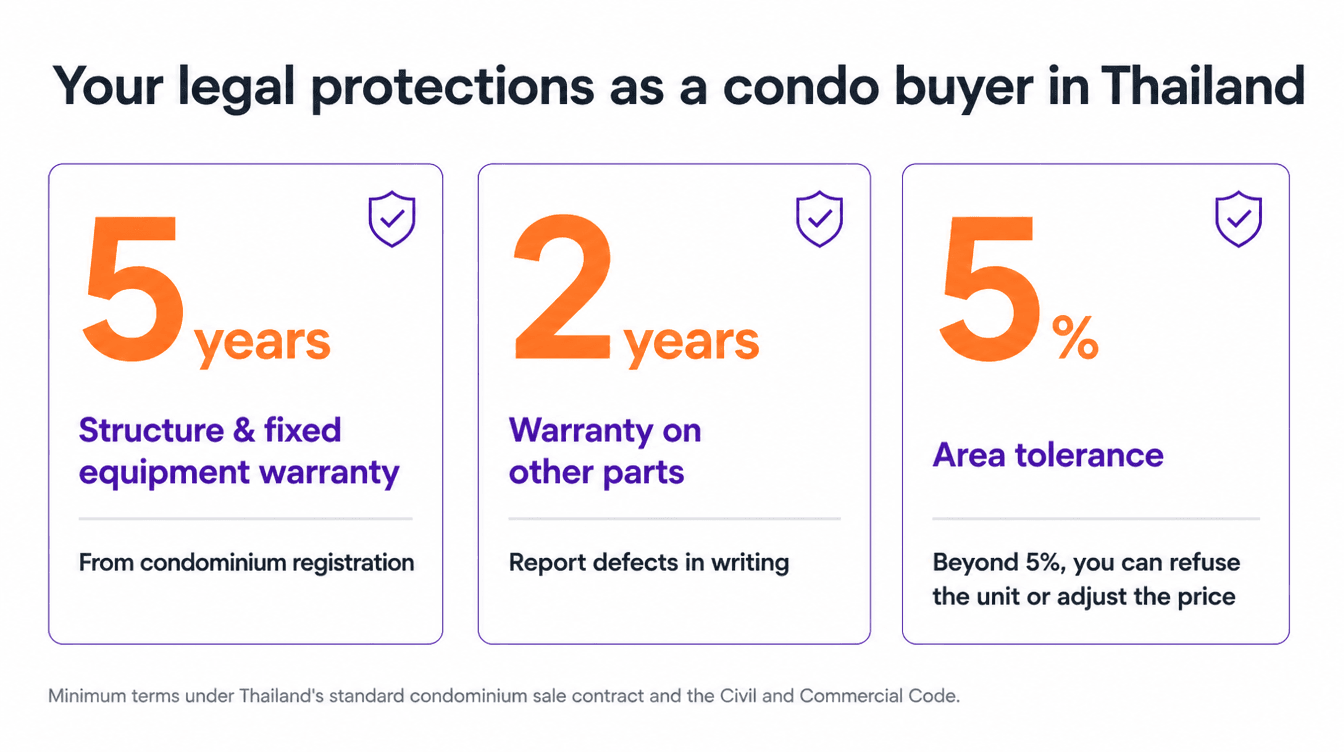
A difference of up to 5%: the buyer generally takes the unit, and the price adjusts in proportion, up or down.
A difference of more than 5%: the buyer can refuse the unit or take it at a proportionally adjusted price.
A clause that forces you to accept a smaller unit at the full price is unenforceable against the standard condominium contract.
For specifications, the SPA should list finishes, fittings and appliances, with any substitution allowed only for materials "of equal or better quality". Keep the brochure, the floor plan and the specification sheet attached to your contract, so you can compare them with the finished unit at handover.
What Warranty Do New Condos in Thailand Come With?
The standard condominium sale contract sets a minimum statutory warranty:
At least 5 years for the structure and fixed building equipment
At least 2 years for other component parts
Both periods run from the registration of the condominium, not from the transfer of your unit. A buyer who takes transfer late has less warranty time left. The developer must start repairs after written notice of a defect, so report every defect in writing as soon as you find it.
The warranty protects you after handover, but it does not replace a proper handover inspection. It is much easier to have a defect fixed before you accept the unit than to claim it later.
Title, Permit and Foreign Quota Risk
These are the risks you remove before you sign, not during construction:
Land title. The project should sit on a Chanote title, owned by or validly leased to the developer, with registered road access.
Permits. The construction permit and, for larger condos, EIA approval must cover the building as sold.
Foreign quota. Your unit must fall within the 49% foreign freehold quota. Get written confirmation from the developer and a clause in the SPA setting out the remedy if the quota is not available at transfer.
The final quota check happens at the Land Department on transfer day. That is why the written confirmation and the SPA clause matter. Papaya's legal support and due diligence covers all three checks before you pay a main installment.
For villas, the equivalent checks are lease registration at the Land Department and any superficies right, which is project-specific. Never accept a Thai nominee structure to hold land. It is illegal and puts the whole investment at risk.
How Do Exchange Rates Affect Off-Plan Payments?
Your price is fixed in Thai baht, but your money is in pounds, euros, Australian or Singapore dollars, dirhams or rubles. Over a construction period of several years, the baht will move against your currency. Every installment costs a different amount at home, and the final payment at handover carries the largest exposure.
Manage it with three habits:
Build a currency buffer into your budget for every installment.
Track due dates so you can transfer when rates suit you within the payment window.
Send foreign currency from an account in your own name, and let the Thai bank convert it, with an FET form or bank letter for every payment.
Papaya's fund transfer support confirms the transfer instructions for each installment and checks that every FET document is issued correctly. A missing FET record at transfer is the one currency mistake that costs you freehold title.
Market Risk: Oversupply and Resale Value
Off-plan buyers commit to today's price for a market they will enter in the future. If many similar units complete at the same time, rents and resale prices come under pressure. Resellers before completion also compete with the developer's own unsold stock.
Reduce market risk with your choice of unit, not by trying to time the market:
Buy in areas with year-round demand. Bang Tao and Laguna draw holiday guests, residents and families.
Choose two-bedroom and larger units with usable layouts. They rent and resell to the widest pool of buyers. Studios and one-bedroom units face the most competition.
Check how much competing supply is completing nearby at the same time.
Off-Plan vs Completed Property in Phuket
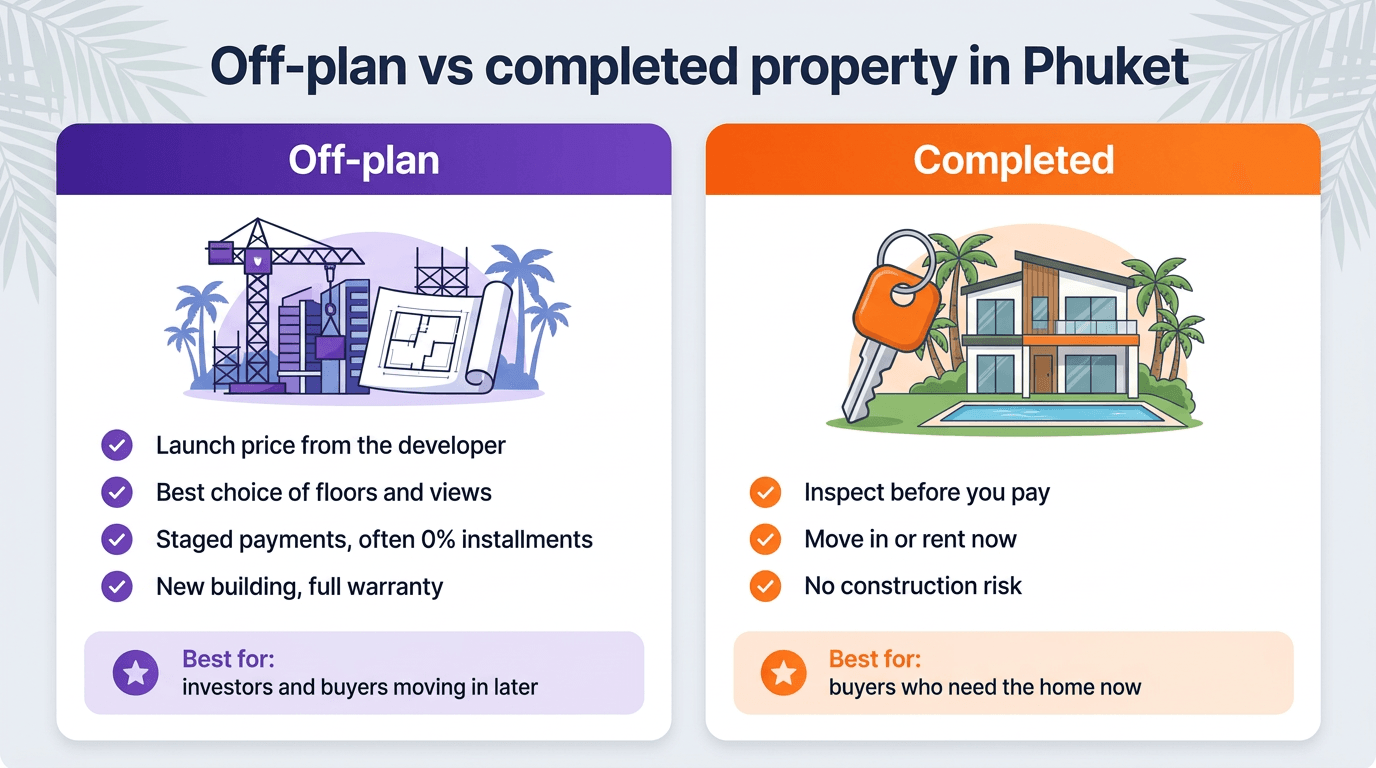
Off-plan and completed property suit different buyers. The trade-off is simple: off-plan gives better terms, and completed property gives certainty.
Off-plan gives you:
launch pricing directly from the developer
the best choice of floors, views and layouts
staged payments spread over construction, often with 0% developer installments
a new building with a full statutory warranty
Completed property gives you:
a finished unit you can inspect before you pay
immediate use or rental income
no construction or delivery risk
Investors with a few years' horizon, and end-buyers who plan to move in later, usually do best off-plan. Buyers who need to move in or earn rent now do best with completed stock.
Is Off-Plan Property Cheaper Than Completed Property in Phuket?
Usually, yes, at the start of a project. Developers set their lowest prices for early phases to build sales, and they raise prices as construction progresses and units sell. Early buyers lock in the launch price and pay it over time.
The saving is real only if you buy at the developer's actual price. Through Papaya, you pay the developer-direct price with no agency markup. The payment plan is the developer's own, including 0% installments tied to construction milestones on many projects.
How to Reduce Off-Plan Investment Risk
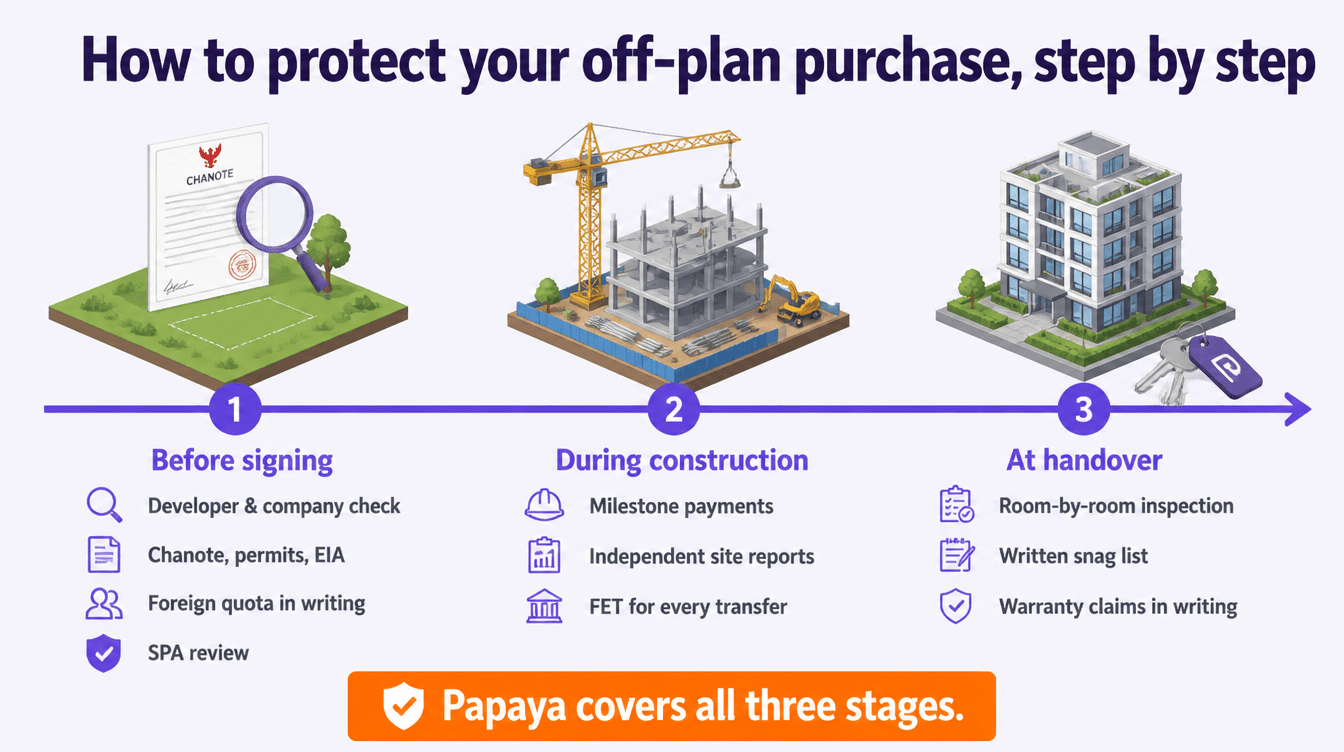
Protection works in three stages: before you sign, during construction and at handover. The pre-signing checks on the company, track record, land, permits and quota are covered in our developer due diligence guide. This section covers the contract and what comes after it.
SPA Clauses That Protect Off-Plan Buyers
Check these clauses before your first main payment:
Standard form: for condos, the SPA follows the government-prescribed condominium sale contract.
Completion and transfer dates: fixed dates, with the developer's penalty for late delivery.
Payment triggers: installments tied to construction milestones, not only fixed calendar dates.
Refunds: your right to terminate and recover payments with interest if the developer fails to deliver.
Area and specifications: the unit area, the specification sheet and the rule on substitutions.
Foreign quota: your unit is sold as foreign freehold, with the remedy if it is not available.
Mortgage release: how a bank mortgage on the land is discharged for your unit at transfer.
Assignment: your right to transfer the contract before completion, and the fee.
Language: which version prevails if the contract exists in Thai and English.
The reservation stage has its own rules. Since early 2025, condo reservation contracts in Thailand must follow a prescribed standard form. The reservation fee is not a deposit, and the developer must refund it if the developer fails its obligations, for example on permits.
How to Check Off-Plan Construction Progress from Abroad
Most of Papaya's clients buy from the UK, Germany, Australia, Singapore, the UAE and elsewhere, so remote verification is part of the process. Effective monitoring combines:
Regular site visits by someone who reports to you, not to the developer
Dated photos and video of each construction stage
Milestone verification before each payment that depends on it
Early defect flags while problems are still cheap to fix
Papaya's off-plan construction quality control covers all four. Before each milestone payment, you receive a report on whether the stage is actually complete. If you pay on a milestone schedule, you are then paying for verified work, not for a progress update.
Handover: The Snag List Inspection
Handover is your last and strongest point of leverage. Before you take transfer:
inspect the finished unit room by room: walls, floors, doors, windows, plumbing, electrics, air-conditioning and balcony drainage
compare the unit with the floor plan and specification sheet attached to your SPA
measure the area if it looks smaller than the plan
record every defect on a written snag list signed by the developer, with a date for repairs
Inspect during or just after rain if possible, since leaks and drainage problems show up quickly. Papaya carries out a full inspection with a snag list before handover. Defects that appear later are reported in writing under the statutory warranty.

Exit Options If Your Plans Change
Circumstances change during a construction period of several years. Plan your exit at the point of purchase, not when you need it.
Can You Sell an Off-Plan Condo in Phuket Before Completion?
Yes, if your SPA allows it. The usual route is contract assignment: you transfer your rights under the SPA to a new buyer, who takes over the remaining payments. Check three points in the contract:
Whether assignment is allowed and whether it needs the developer's consent
The assignment fee the developer charges
Any restrictions, for example a minimum share of the price already paid
The other exits are to complete the purchase and resell after transfer, or to complete and hold the unit for rental income. Our exit strategies guide compares all three.
FAQ
What are the biggest off-plan condo risks in Thailand?
The biggest off-plan condo risks in Thailand are:
construction delays
developer insolvency
changes to area or specifications
a sold-out foreign quota
currency movements over the payment period
Each is reduced by choosing an established developer, a standard-form SPA, milestone payments with independent verification and documented transfers from abroad.
Is a reservation deposit refundable if I change my mind?
Generally, no. Under the standard reservation contract, the developer can keep the reservation fee if you do not sign the SPA within the agreed period. The fee must be refunded if the developer fails its own obligations, such as permits, or changes key project details without your consent.
How much does working with a large developer reduce the risk?
It reduces insolvency and delivery risk the most, because large developers have published finances and a track record you can verify. It does not remove contract, quota or currency risk. Those still need checking on every project.
Conclusion
Off-plan property risks in Phuket are real, but they are known, and most of them are manageable. Three steps cover most of the risk:
Before you sign, check the developer, the land, the permits and the quota.
During construction, tie payments to verified milestones and document every transfer.
At handover, inspect the unit properly and put every defect in writing.
Buyers who follow those steps keep the advantages of off-plan, the launch price and the payment plan, with far less of the risk.
If you are considering an off-plan project in Bang Tao, Laguna, Layan or Kamala, the Papaya team can show you current projects at developer-direct prices. We'll run the legal checks with you and monitor construction until handover. Message us on Telegram or WhatsApp, or send an email, for a free consultation with a Papaya manager.