

Phuket vs Bali Property Investment: 2026 Comparison
Phuket vs Bali Property Investment: 2026 Comparison for Foreign Investors
Phuket and Bali compete for the same buyer: an international investor who wants a holiday-island property that pays its way through tourist rentals and serves as a winter base. On the surface the two markets look alike — beaches, villas, a strong short-stay rental culture. Under the surface they work very differently.
This guide compares Phuket vs Bali property investment on the factors that decide your return: what you can legally own, what it costs to buy and sell, where rental demand comes from, how safe off-plan buying is, and what residency options sit alongside your purchase. By the end you will know where to invest in property abroad in 2026 for your own goals.
Phuket vs Bali Property Investment: The Key Differences
Five differences shape every decision that follows:
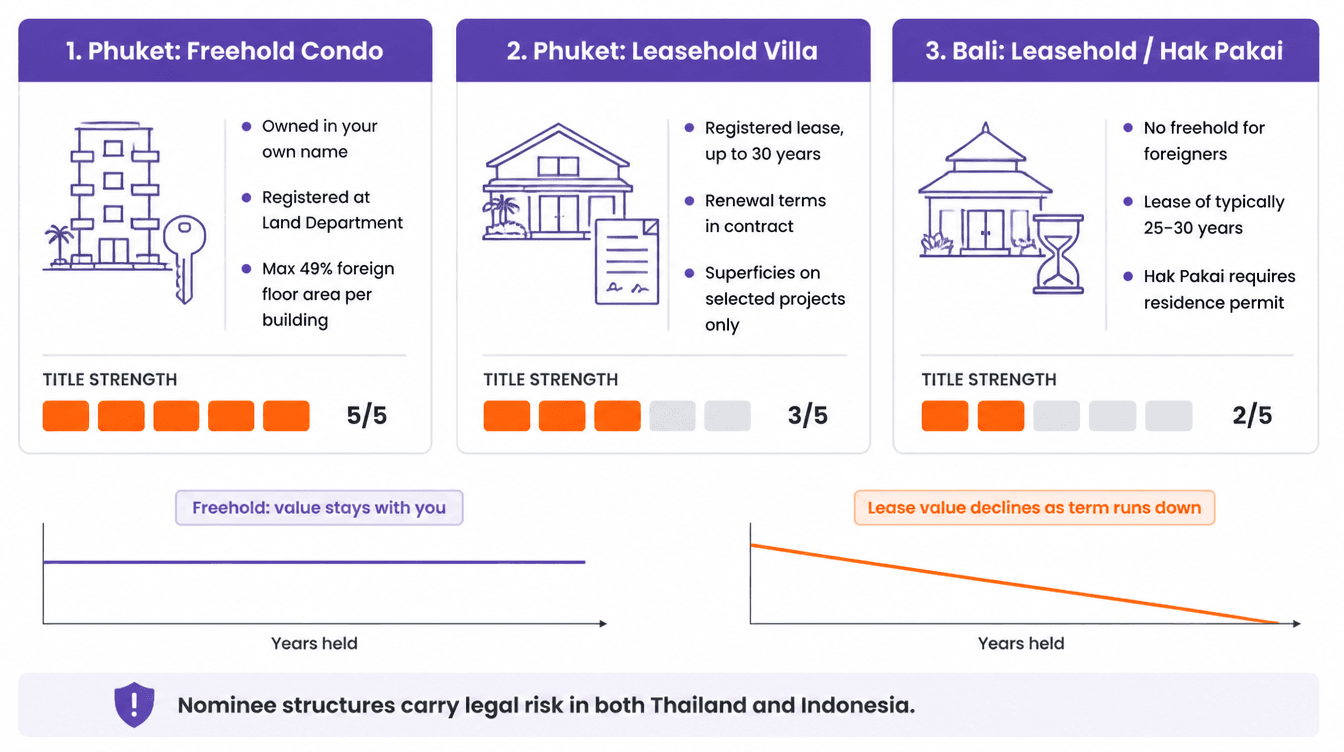
Ownership. Foreigners own Phuket condos freehold, in their own name, within the 49% foreign quota. In Bali, foreigners buy leasehold or Hak Pakai only — freehold is reserved for Indonesian citizens.
What happens over time. A Phuket freehold condo stays yours indefinitely and keeps its full resale value. A Bali lease shortens every year, and the asset returns to the landowner when it ends.
Buying costs. Phuket charges a 2% transfer fee on the appraised value, often split between buyer and developer. Bali buyers pay notary, lease registration and due-diligence costs on top of a price set by the remaining lease term.
Exit. Phuket sellers pay 3.3% Specific Business Tax only if they sell within five years; after that, a 0.5% stamp duty applies instead. A Bali exit is a lease assignment, and its value depends on how many years remain.
Developer base. Phuket's main projects come from listed and long-established developers such as Sansiri, Laguna Property and The Title. Bali's villa market is dominated by small and first-time builders.
Bali wins on headline price and lifestyle appeal for budget-conscious buyers. Phuket wins on title security, resale value and developer track record — the factors that protect your capital.
Phuket Freehold vs Bali Leasehold: Who Can Actually Own What
Title is the first filter for any serious investor. A strong rental return means little if the asset behind it expires, or if your claim to it rests on a structure you do not control.
Can Foreigners Own Freehold Property in Phuket vs Bali?
In Phuket, foreigners own condominium units outright. The Thai Condominium Act allows foreign nationals to hold up to 49% of the total saleable floor area in any registered condominium building. You receive a condominium title deed registered at the Land Department, on a building that sits on land held under a Chanote, Thailand's highest form of land title. You can sell, rent out or bequeath the unit like any Thai owner.
Two conditions apply:
The purchase funds must come from abroad in foreign currency. The receiving Thai bank converts them to baht and issues a Foreign Exchange Transaction form (FET form) for transfers of USD 50,000 or more. Smaller transfers are documented with a bank credit advice instead.
The unit must fall within the building's foreign quota at transfer. Popular projects in Bang Tao and Laguna sell their foreign quota first, so timing matters.
The FET form is where many first-time buyers stumble. A transfer labelled wrongly, or routed through the wrong account, cannot produce a valid FET — and without one the Land Department will not register your freehold unit. Papaya's team sets up the transfer with you before you send a single dollar: the remittance purpose wording, the receiving account and the currency timing.
Villas in Phuket follow a different route. Foreigners cannot own Thai land freehold, so villas are bought on a registered leasehold of up to 30 years, with renewal terms written into the contract. Some projects add superficies rights over the structure, but this is project-specific, not automatic. Papaya's legal team checks the title, the quota position and the lease structure on every project before you sign the Sale and Purchase Agreement (SPA).
How Does Leasehold Work in Bali for Foreigners?
Indonesian law reserves freehold title, Hak Milik, for Indonesian citizens. A foreign buyer in Bali chooses between two routes:
Leasehold (Hak Sewa). You lease the land and villa from an Indonesian owner for a fixed term, commonly 25–30 years. Extensions are negotiated with the landowner, at a price set at the time of renewal. When the lease ends without an extension, the property returns to the owner.
Hak Pakai (right-of-use title). Available to foreigners who hold a valid Indonesian residence permit. It is granted for an initial term with extensions, and it comes with conditions on property type and minimum value. Lose the residence permit, and you lose the basis for the title.
The practical result: a Bali villa is a depreciating asset. Every year you hold the lease reduces what remains for the next buyer, which shapes both resale value and access to financing. A Phuket freehold condo has no such clock.
Nominee arrangements — a local citizen holding title on your behalf — appear in both markets. They carry serious legal risk in Thailand and Indonesia alike, and Papaya does not recommend them.
Buying Property in Phuket vs Bali: Costs, Fees and Taxes
The list price is only part of what you pay. Compare the two markets on the full cost of buying, holding and selling, and the picture changes.
How Much Do You Need to Invest in Phuket Property?
Entry prices vary by area, unit type and construction stage. Off-plan launches in Bang Tao, Laguna and Layan offer the lowest entry point on the west coast. Pool villas in Layan and Bang Tao sit at the top of the range, and sea-view stock in Kamala commands a premium.
The investment case is built around units with two bedrooms or more. They serve families and groups — the core of Phuket's high-season demand — and they resell to a deeper pool of end-buyers.
How you buy changes the effective price. Papaya sells at developer-direct prices: you pay the same list price as at the developer's own sales office, with no agency markup on top. Partner developers including Sansiri, Laguna Property and The Title also offer terms that rarely exist on the resale market:
0% developer instalments. You pay a deposit, then the balance in stages tied to construction milestones, with no interest.
Cashback on selected projects. A direct rebate at transfer that lowers your effective entry price.
Buyers who want to leverage their purchase also have mortgage options through lenders that serve foreigners, and Papaya's team arranges this alongside the developer payment plan.
Phuket vs Bali: Which Has Lower Property Buying Costs?
In Phuket, the buyer's one-off costs are clear and fixed by law:
Transfer fee: 2% of the officially appraised value, paid at the Land Department. The SPA sets who pays it, and many new-build sales split it 50/50 between developer and buyer.
Condominium set-up costs: a one-time sinking fund contribution and the first year's common area maintenance fee, paid to the juristic person condominium.
In Bali, the costs sit in different places. You pay a notary to draft and register the lease, and you carry the cost of checking the landowner's certificate, the zoning of the plot and the building permits yourself. Bali's headline prices look lower because you are buying a time-limited lease, not the property — so measure them against the years you actually get, not against a Phuket freehold price.
What Are the Taxes on Selling Property in Thailand vs Bali?
In Thailand, the seller's taxes on a transfer are:
Specific Business Tax at 3.3% of the higher of the sale price or appraised value, if you sell within five years of acquisition. After five years, SBT falls away and a 0.5% stamp duty applies instead.
Withholding tax, calculated on the appraised value on a progressive scale that rewards longer holding periods.
Transfer fee share, as agreed with the buyer.
Hold for five years or more, and you remove the largest Thai exit tax entirely. Papaya's legal team sets out the full exit-cost picture for your specific unit before you commit, so the hold period is part of your plan from day one.
A Bali exit works differently. You do not sell the property — you assign the remaining lease to a new buyer, subject to the landowner's terms and Indonesian tax on the transaction. The fewer years left on the lease, the smaller your pool of buyers and the lower the price they will pay.
Phuket Condo vs Bali Villa Investment: Rental Demand and Returns
Ownership decides how safe your asset is. Rental demand decides how hard it works for you. Both islands run on short-stay tourism, but the returns behave differently over a full holding period.
Phuket's west coast draws families and groups from Europe, Russia, Australia and the Middle East, booking stays of one to four weeks. Demand peaks from November to April, and well-located managed condos earn the bulk of their annual income in that window. Bali's villa market draws a younger, longer-staying crowd to areas such as Canggu and Uluwatu, with strong headline rental figures.
The difference shows up in total return. A Phuket freehold condo earns rental income and keeps its capital value. A Bali villa earns rental income while its lease — and with it the resale value — runs down every year. Judge any Bali yield against that loss of capital.
What Rental Yield Can You Expect From a Phuket Condo?
Net yield in Phuket depends on four factors:
Location. Beach-adjacent areas with established infrastructure outperform inland stock.
Unit size. 2- and 3-bedroom units achieve higher nightly rates and longer bookings from families and groups.
Management model. Developer-run rental programmes handle marketing, cleaning and guest service on a revenue-share basis, and some partner projects offer guaranteed rental returns for a fixed period.
Legal setup for short stays. Thailand's Hotel Act restricts nightly letting of residential condos that are not licensed for it. A project with a licensed or professionally structured rental programme protects your income legally.
Always judge a project on net yield — after management fees, maintenance fees and taxes — not on the gross figure in a brochure.
Which Phuket Areas Have the Highest Rental Demand?
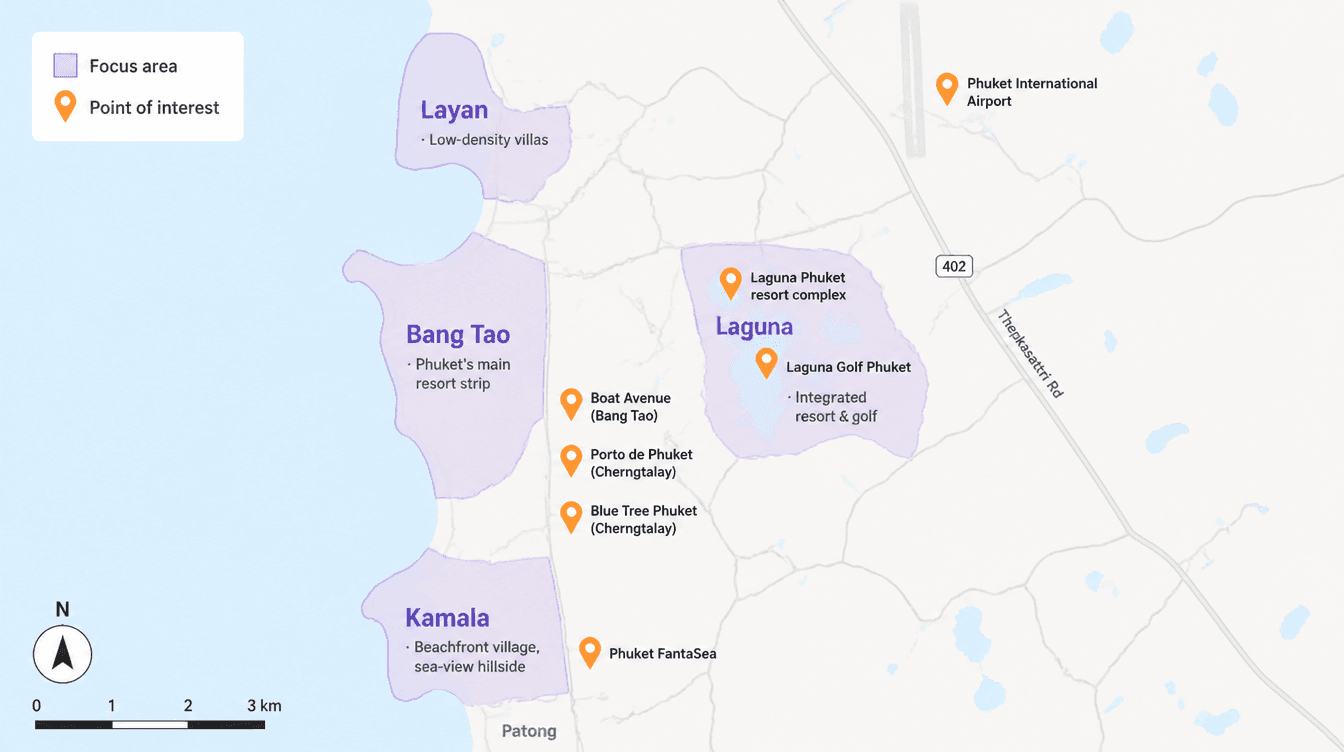
Papaya focuses on four west-coast areas, each with a distinct demand profile:
Bang Tao. Phuket's most developed resort strip, with an 8 km beach, the Laguna resort complex, international schools and Boat Avenue dining. It has the deepest year-round rental demand on the island.
Laguna. An integrated resort area with five-star hotels, a golf course and shared facilities. Laguna Property's branded residences benefit from resort-level management and guest flow.
Layan. A quieter, low-density stretch north of Bang Tao. Villa stock and limited land supply support strong capital appreciation and premium nightly rates.
Kamala. A beachfront village with hillside sea-view stock, close to Patong's nightlife but separate from it. It suits families and long-stay guests.
Sansiri, Laguna Property and The Title all have active or recently delivered projects across these areas, which gives investors a choice of developer, price point and handover date within the same high-demand corridor.
Off-Plan Risk: Buying Before Completion in Phuket and Bali
Off-plan buying gives you launch pricing and staged payments. It also asks you to trust a developer with your capital before the building exists. The two markets protect that capital very differently.
Is Off-Plan Property in Phuket a Safe Investment?
Off-plan in Phuket is safe when you control three variables: the developer, the contract and the construction.
Developer. Listed developers such as Sansiri, and established resort developers such as Laguna Property and The Title, have delivered multiple projects. Their balance sheets and reputations are public.
Contract. The SPA defines your payment milestones, completion date, specifications, late-delivery penalties and refund terms. Thailand has no mandatory escrow for off-plan condo payments, so the protections must be written into the SPA. Papaya's legal team reviews each SPA clause by clause, and checks land title, building permits, the environmental impact assessment (EIA) approval and the developer's licences before you pay the deposit.
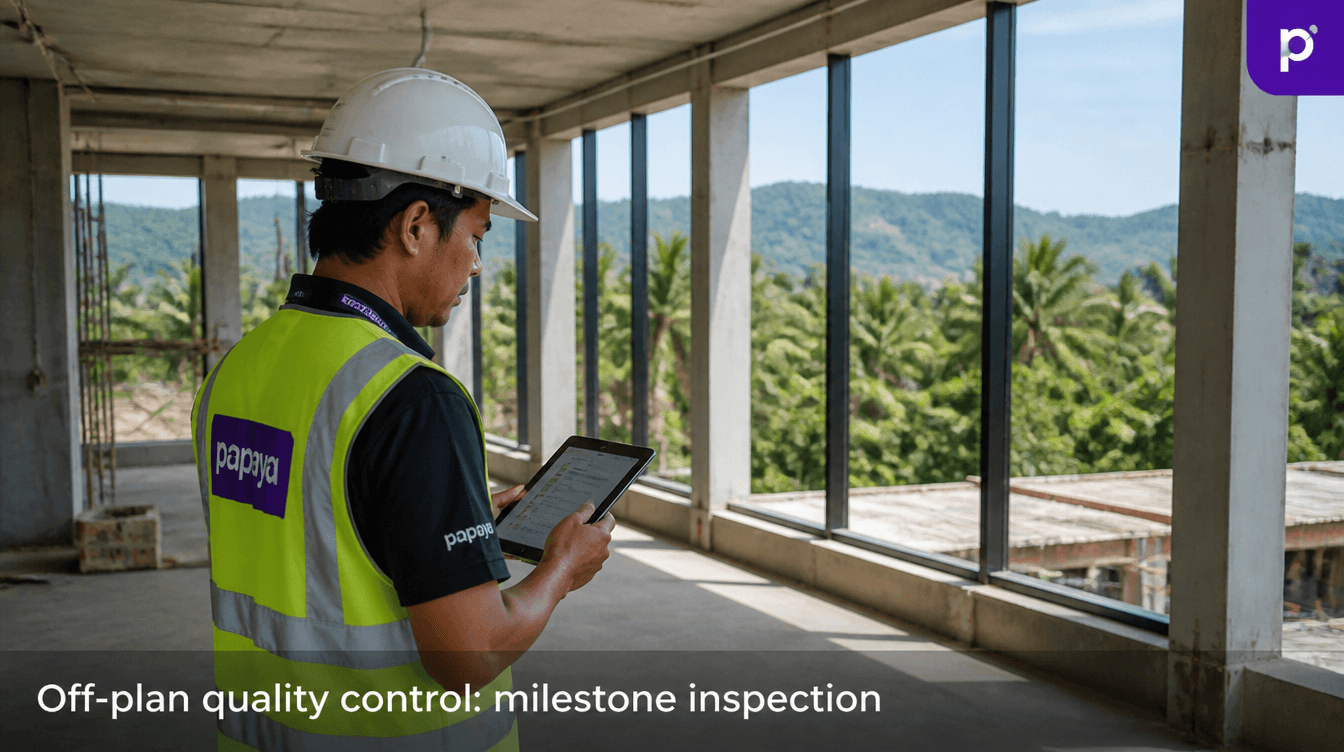
Construction. Papaya runs off-plan construction quality control on behalf of buyers: site inspections at key milestones, progress reports, and a pre-handover snagging inspection so defects are fixed before transfer, not after.
The payoff for this diligence is access to launch pricing — the lowest price point in a project's life — with the main off-plan risks covered.
How Developer Track Records Compare in Phuket and Bali
Phuket's west coast is built by developers with long, visible delivery histories, operating under Thailand's Condominium Act and Land Department registration. Bali's villa market is far more fragmented: many projects come from small or first-time builders, sometimes on land with unresolved zoning or permit questions, and a leasehold buyer has limited recourse if a project stalls.
In Phuket, independent legal due diligence plus construction monitoring closes most of the off-plan risk gap. In Bali, the same checks start from a weaker base.
Residency Options for Property Buyers
For many buyers, property and long stays go together. Neither market grants residency simply for buying property, but the routes differ.
Which Visa Options Come With Buying Property in Thailand or Bali?
Thailand. The Thailand Privilege programme is a paid long-stay visa, bought separately from your property. Owners who spend extended periods in Phuket combine a freehold condo with a Privilege membership or another long-stay category, such as the Long-Term Resident (LTR) visa. Your property title does not depend on your visa.
Bali. Indonesia offers residence permits such as the investor KITAS and the Second Home Visa. Here the link runs the other way: Hak Pakai title requires a valid residence permit, so your visa status and your property rights are tied together.
In Phuket, your ownership stands on its own. In Bali, the strongest title available to you depends on keeping your residence permit.
Is Phuket or Bali Better for Property Investment? The Verdict
The answer depends on what you want the property to do:
Choose Bali if you want a lifestyle base at a lower headline price and accept that you are buying a lease that loses value as it runs down.
Choose Phuket if you want registered freehold title in your own name, rental income from an established family-tourism market, a resale value that does not expire, and developers with a public track record.
For investors who care about protecting capital as much as earning income, Phuket is the stronger market. Buying developer-direct sharpens the case further: you pay the developer's own list price with no agency markup, spread payments with a 0% instalment plan, and selected projects in Bang Tao, Laguna and Layan add cashback at transfer.
Talk to the Papaya Team
Phuket and Bali reward different buyers, and the right choice depends on your budget, your holding period and how you plan to use the property.
If Phuket is on your shortlist, the Papaya team will put together a selection of developer-direct projects in Bang Tao, Laguna, Layan or Kamala, with payment plans and a full cost breakdown for your purchase. Message us on Telegram, WhatsApp or email for a free consultation, and a manager will get back to you directly.
Editor notes
Word count is about 2,550. No tables and no data placeholders in the article.
Double-check the Thai legal and tax figures against current regulation before release: 2% transfer fee, 3.3% SBT, 0.5% stamp duty, USD 50,000 FET threshold, 49% foreign quota, 30-year lease term.