

Developer Financing in Phuket: 0% Payment Plans Explained
Developer Financing in Phuket: Payment Plans, 0% Installments and Mortgage Options for Foreign Buyers
Most foreign buyers in Phuket's primary market never apply for a bank loan. They use developer financing in Phuket instead: a staged payment plan agreed directly with the developer, written into the Sale and Purchase Agreement (SPA) and paid in installments while the project is built. There is no credit check, no Thai bank and no income paperwork.
For an investor, this means capital goes in gradually instead of in a single transfer. For an end-buyer or relocator, it means locking in today's price for a unit while selling a home elsewhere or planning a move.
Payment plans still differ sharply between developers and projects. Some stay interest-free from reservation to handover. Some extend payments past completion. Others put most of the price into one large payment on handover day.
This guide covers:
how developer financing works and which developers offer it
the main plan types, including 0% and post-handover options
what you pay upfront, and how a typical schedule runs
developer financing compared with a mortgage for foreigners in Thailand
paying installments from abroad, including the FET form and currency exposure
the risks, and the SPA clauses that protect you
How Developer Financing in Phuket Works
Developer financing is a deferred payment arrangement between the buyer and the developer. Instead of paying the full price at transfer, you pay in stages set out in the SPA. The developer carries the arrangement, not a bank.
The model fits the off-plan market. Developers need cash flow during construction, and buyers want to spread their commitment over the build. In Phuket's off-plan condo and villa segment, staged payment is the standard structure, not a promotion.
Here are the essentials:
No bank underwriting. The developer does not assess your income, credit history or residency status.
Price fixed in Thai baht. The purchase price is set when you sign the SPA and does not change during the payment period.
Ownership at completion. The title transfers at the Land Department once the final payment due at transfer clears.
Freehold depends on documentation. A condo unit registers as freehold under the 49% foreign ownership quota only if every payment is documented as foreign currency sent from abroad. The FET section below explains how.
How Do Developer Payment Plans Work in Phuket?
Almost every plan follows the same four-step sequence:
Reservation deposit. You sign a reservation agreement and pay a deposit that takes the unit off the market.
SPA signing and down payment. Within a fixed window after reservation, you sign the SPA and pay the first tranche of the price.
Installments during construction. Payments follow either a fixed calendar (monthly or quarterly) or the completion of construction stages.
Final payment at handover. You pay the remaining balance at the Land Department on transfer day. For a condo, you receive the condominium title deed in your name. For a leasehold villa, the lease is registered against the land title, ideally a Chanote.
The SPA governs every part of this: amounts, due dates, late-payment terms, the completion date and each party's remedies. Read the installment schedule as closely as you read the price.
Which Phuket Developers Offer Payment Plans?
Staged payment is standard across Phuket's primary market. What differs is the split, the number of installments and whether payments continue after handover.
Sansiri is one of Thailand's largest listed developers, with Phuket projects aimed at both investors and owner-occupiers.
Laguna Property develops residences inside the Laguna Phuket integrated resort area in Bang Tao. Buyers there get access to established resort infrastructure from day one.
The Title focuses on resort-style condominiums with rental programmes.
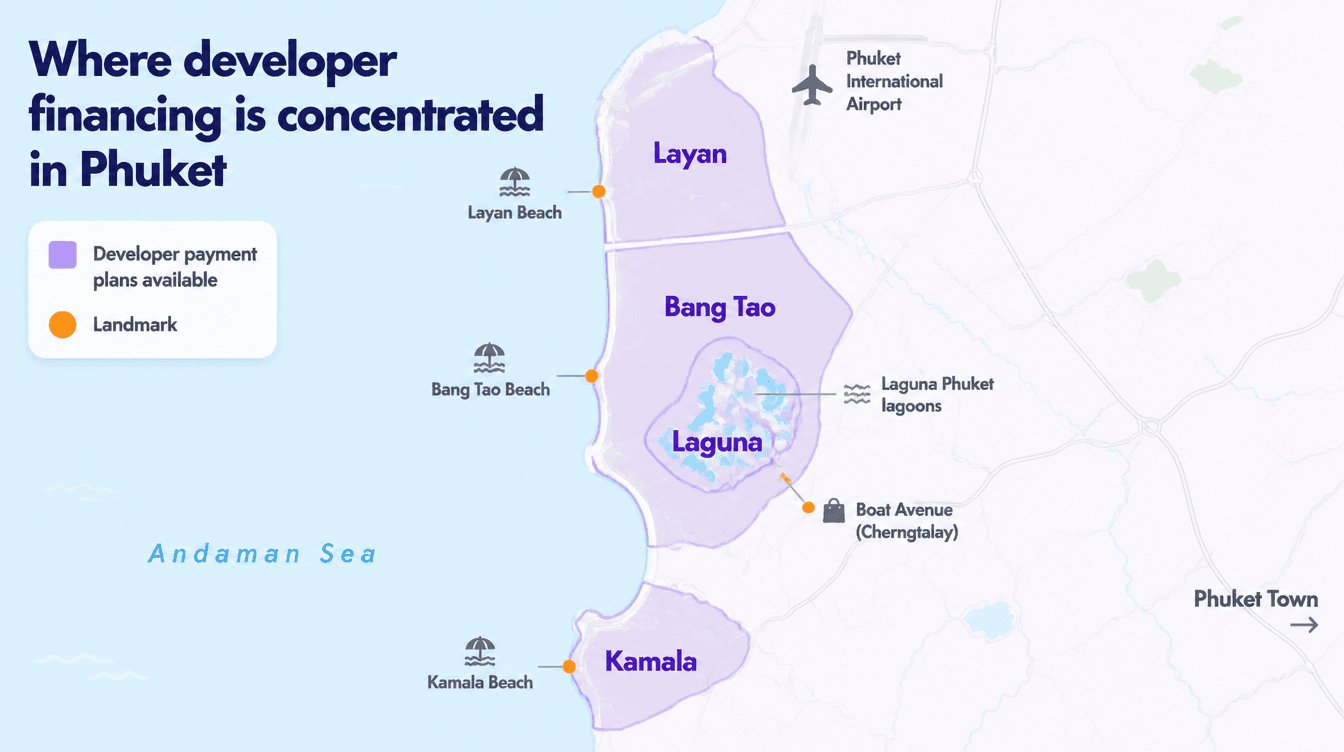
Most of the payment-plan stock is in Bang Tao, Laguna, Layan and Kamala. These areas have the highest concentration of active off-plan projects on the west coast.
Buyers often ask whether going through an agency changes the price or the plan. With Papaya, it does not. You get the developer's own price and the developer's own payment schedule, with no agency markup added to either. That lets you compare plans across Sansiri, Laguna Property and The Title on equal terms.
Types of Phuket Property Payment Plans
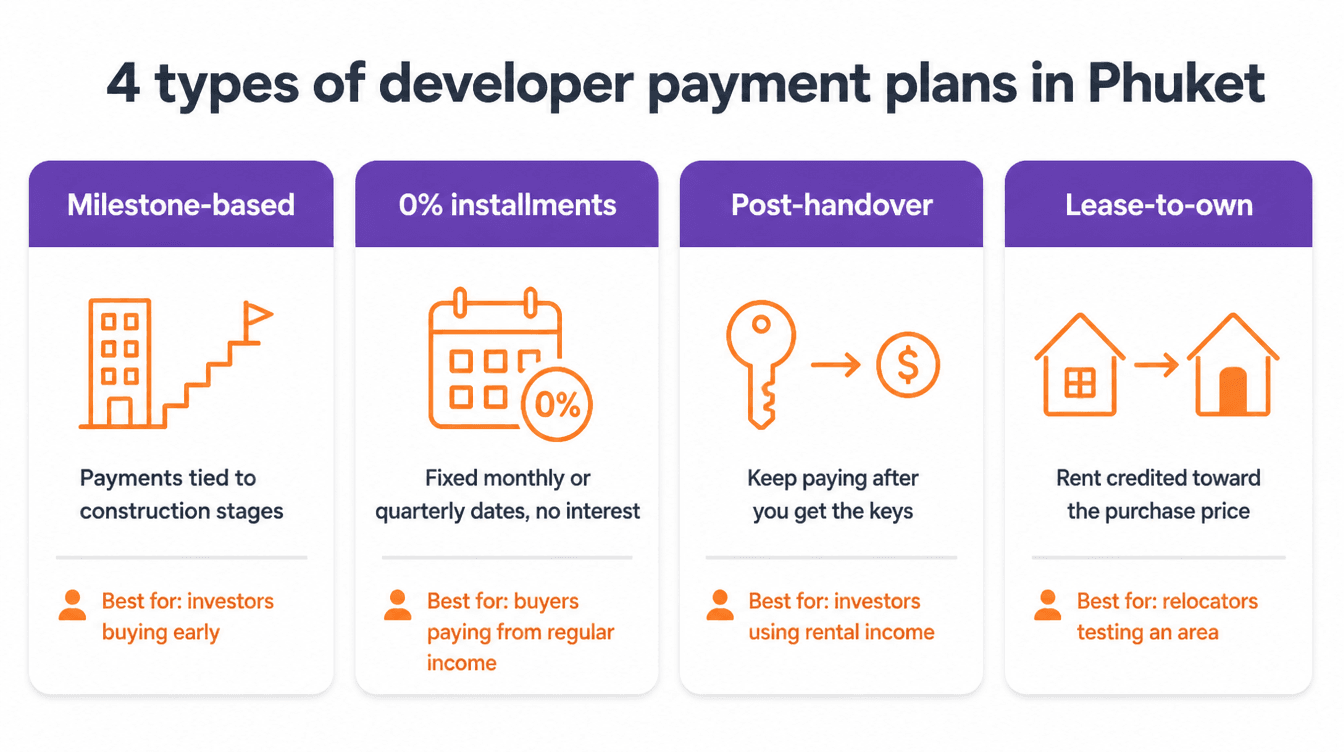
Phuket developers use four main structures. Each one spreads the price differently, and each suits a different type of buyer.
Off-Plan Payment Plan in Phuket: Milestone-Based Schedules
This is the most common structure for an off-plan condo. Installments are tied to construction milestone payments, with each one falling due when the developer completes a defined stage, such as:
foundation
structural frame
roof
mechanical, electrical and plumbing works
completion
The advantage is alignment. Your money follows visible progress, so if construction slows, the next milestone payment is not yet due.
Check the trigger carefully. Some SPAs describe a "milestone" schedule but set fixed calendar dates. Calendar-based payments fall due whether or not the building has reached that stage.
Most milestone plans end with a balloon payment at handover, which is the remaining balance due on transfer day. It is often the largest single payment in the schedule. Plan how you will fund it from day one, whether from savings, sale proceeds or a mortgage.
Best suited to: investors buying early in a project.
0% Interest Installment Plans: Is Developer Financing Really Interest-Free?
Yes, in the literal sense. During construction, developer installments carry no interest charge. The developer is collecting the agreed price in stages, not lending you money, so there is no interest line in the SPA.
That does not mean every plan costs the same. The cost of time shows up in other places:
A full-payment discount you forgo. Some developers price units lower for buyers who pay in full upfront.
Higher pricing on extended terms. Plans that run past handover are sometimes priced above the standard schedule.
Late-payment penalties. These only apply if you miss a due date.
The test is simple: ask for two quotes, one for full payment and one with the payment plan. The difference between them is the real cost of the interest-free installments.
Papaya presents both figures side by side for every unit we show. On selected partner projects, buyers also get 0% developer installments combined with cashback, which lowers the effective price further.
Best suited to: buyers paying from regular income on fixed monthly or quarterly dates.
Post-Handover Payment Plans in Phuket: What They Are and Who Offers Them
A post-handover payment plan, also called a post-completion payment plan, keeps installments running after you receive the keys. Instead of a large balloon payment at handover, you pay part of the price over a set period after completion.
For investors, this structure changes the cash-flow picture. The unit can start earning rental income while part of the price is still outstanding, so rental income contributes to the remaining installments.
Post-handover terms are offered on selected projects rather than across the market, and availability shifts as units sell. The Papaya team keeps track of which partner projects currently offer them.
Two points need confirming before you sign:
Title transfer timing. Some developers transfer the title at handover and secure the outstanding balance through the contract. Others transfer only after the final installment. The SPA states which applies.
Use restrictions. Confirm whether you can rent out or resell the unit before the plan is fully paid.
Best suited to: investors who want rental income to cover part of the price.
Lease-to-Own and Rent-to-Own: An Alternative for Completed Units
Lease-to-own (or rent-to-own) arrangements apply to completed, ready-to-move-in stock. You rent the property, part of the rent is credited toward the purchase price, and you have the right to buy within an agreed period.
This suits relocators who want to live in Bang Tao or Kamala before they commit. Before signing, check four terms:
the share of rent credited toward the price
the length of the option period
whether the purchase price is fixed at signing
what happens to the credited amount if you decide not to buy
If the goal is a freehold condo, ask your lawyer how rent credits count toward the foreign-currency remittance requirement. This matters for the FET documentation covered below.
Best suited to: relocators testing an area before buying.
What You Pay Upfront and When
How Much Deposit Do You Need to Buy an Off-Plan Condo in Phuket?
The upfront commitment comes in two parts:
Reservation deposit: paid when you reserve the unit, to take it off the market.
Down payment at SPA signing: the first percentage of the price, paid when you sign the contract.
Both count toward the purchase price, not on top of it. The exact amounts vary by developer and project, so confirm them before reserving.
Read the reservation agreement before paying, because refund terms vary by developer. Our reservation process guide covers this step in detail.
Because Papaya works at developer-direct prices, the deposit percentage applies to the developer's own price. There is no inflated figure, so you are not paying a percentage of an agency markup.
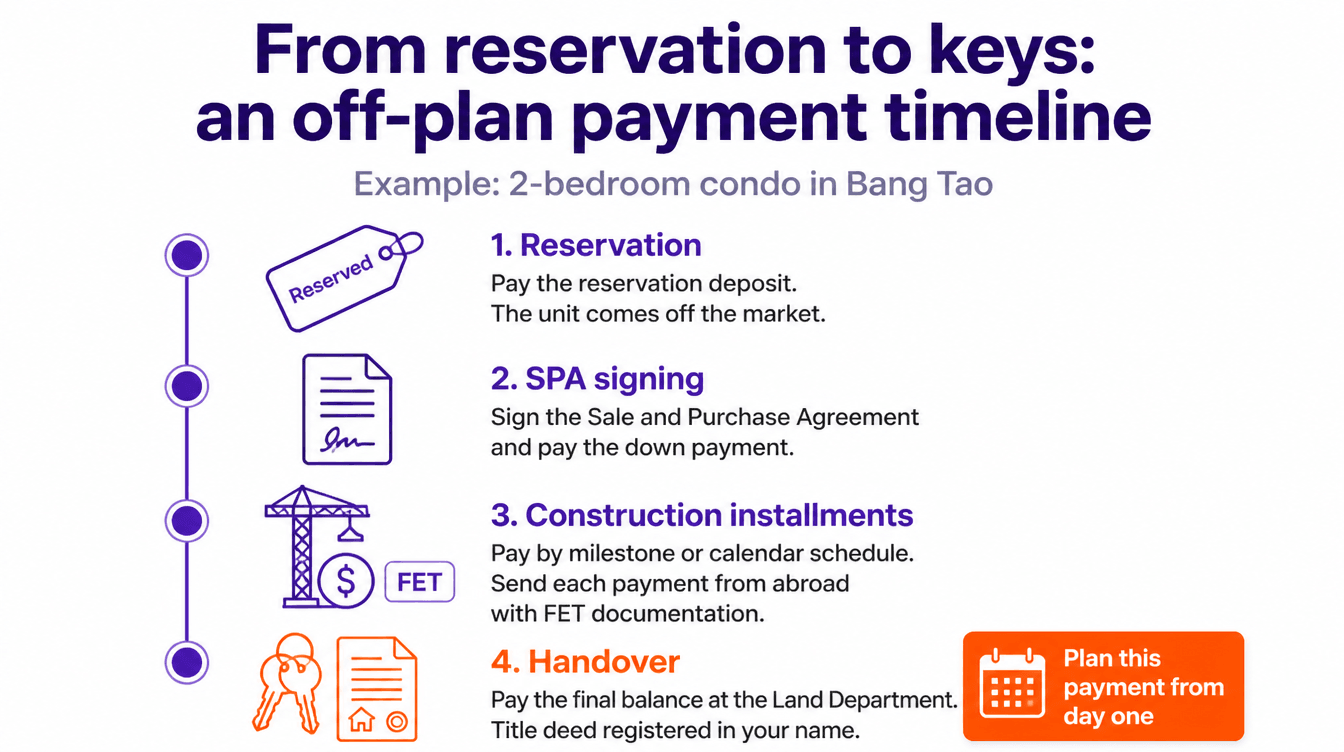
Example Payment Schedule: A 2-Bedroom Condo in Bang Tao
Here is how a typical off-plan plan for a 2-bedroom condo in Bang Tao runs from reservation to keys:
Reservation. You pay the reservation deposit, and the unit comes off the market immediately.
SPA signing. Within the window set in the reservation agreement, you sign the SPA and pay the down payment.
Construction period. Installments follow the milestone or calendar schedule in the SPA. Each payment is sent from abroad with FET documentation.
Handover. The final balance is paid at the Land Department, and the condominium title deed is registered in your name.
The stage buyers most often underestimate is the last one. Set your funding source for the handover payment at the reservation stage, not in the final months of construction.
Developer Financing vs Mortgage for Foreigners in Thailand
Can Foreigners Get Financing to Buy Property in Thailand?
Yes, but the options are narrow. Foreign buyers have three routes:
Developer financing: staged payments under the SPA, with no lending assessment.
A Thai bank mortgage: available to a limited group of foreign borrowers.
A loan in your home country: for example, refinancing or releasing equity from property in the UK, Australia, Singapore, Germany or the UAE, then sending the funds to Thailand.
Thai bank lending criteria for foreigners are strict. Banks typically look for a Thai work permit, Thai-source income or long-term residence. Non-residents have very limited access.
Home-country loans are often the most practical route for the handover payment. As a bonus, money sent from abroad in foreign currency also meets the condo remittance requirement.
Papaya's mortgage support for foreigners starts before reservation. We check which lenders accept your nationality, residency and income profile, so the handover payment is funded long before it falls due.
Can You Get a Mortgage on a Phuket Villa as a Foreigner?
It is harder than for a condo. Foreigners cannot own land in Thailand, so a villa is typically bought as a leasehold villa: the land is leased for a registered term, and the structure is owned or leased depending on the project.
Banks lend against collateral they can enforce, and leasehold structures narrow that pool considerably. Most villa buyers combine a developer payment plan during construction with cash or home-country financing for the balance.
Do not use a Thai nominee company to hold land or qualify for lending. Nominee structures, where Thai shareholders hold shares on a foreigner's behalf, are illegal under Thai law and put the entire investment at risk.
Developer Financing vs Mortgage: Which Is Better for Investors, End-Buyers and Relocators?
The three routes differ on four points:
Eligibility. Developer financing is open to any buyer. A Thai bank mortgage is limited to certain foreign profiles. A home-country loan depends on your own lender.
Credit check. Developer financing has none. Both bank routes require a full assessment.
Interest during construction. Developer installments carry none. Bank loans charge interest from the moment funds are drawn.
Off-plan fit. Developer financing is designed for off-plan purchases. A Thai bank mortgage typically applies only at completion. A home-country loan can fund any stage.
The right choice depends on why you are buying:
Investors use developer financing during construction to keep capital free. Buying early in a project gets the best choice of units on the developer's starting price list.
End-buyers combine both routes: the developer plan covers the construction installments, and a mortgage or home-country loan covers the handover payment.
Relocators with a Thai work permit gain access to Thai bank mortgages. Lease-to-own lets them live in an area before buying.
Paying Installments from Abroad: FET Form and Currency
Do Installment Payments for a Thai Condo Need an FET Form?
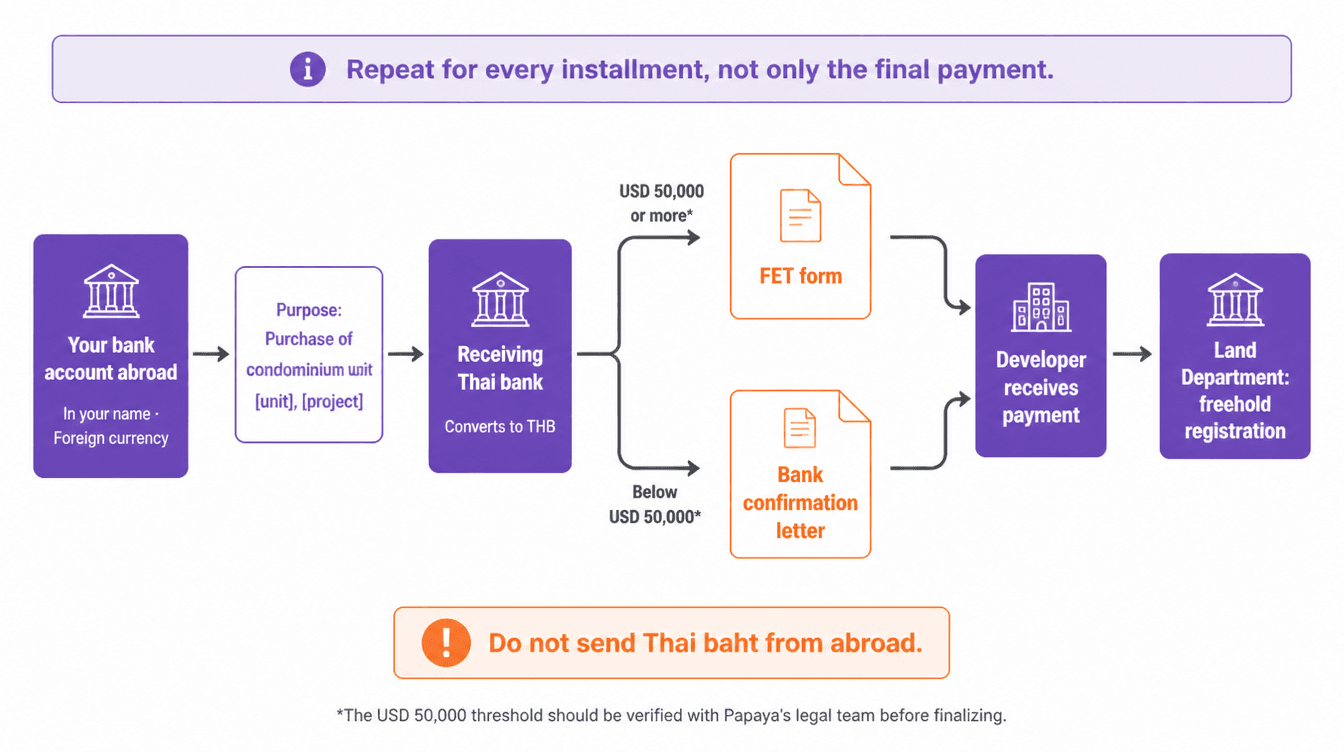
Yes. Every installment matters, not only the final one. To register a freehold condo under the foreign quota, the Land Department requires proof that the purchase money entered Thailand from abroad in foreign currency.
The proof depends on the size of each transfer:
USD 50,000 or more (or the equivalent in another currency): the receiving Thai bank issues a Foreign Exchange Transaction (FET) form.
Below USD 50,000: the receiving bank issues a letter confirming the foreign-currency inflow.
For every installment, follow the same rules:
Send the money from an account in your own name.
Transfer it in foreign currency, not Thai baht.
State the purpose clearly, for example: "Purchase of condominium unit [unit number], [project name]".
Keep each document as the payment is made. A missing record at transfer stage is difficult to recreate and can block freehold registration.
Leasehold villa buyers do not need FET documentation to register a lease. Documented inflows still make it easier to send sale proceeds back abroad later.
Papaya's fund transfer support covers this step for every installment. We confirm the exact transfer instructions with the developer's bank and check that each FET form or bank letter is issued correctly. Our FET form guide explains the full process.
Managing Currency Risk Across a Multi-Year Payment Schedule
Your price is fixed in Thai baht, but your income is in pounds, Australian dollars, Singapore dollars, euros, dirhams or rubles. Over a construction period of several years, the exchange rate will move, and every installment costs a different amount in your home currency.
Four habits keep this exposure under control:
Build a buffer. Budget each installment with a margin against adverse currency moves.
Track the schedule. Know every due date in advance so you can transfer when the rate suits you within the payment window, not on the last day.
Prepare the large payment early. The balloon payment at handover carries the largest exposure, so start planning its conversion well ahead.
Send foreign currency. Let the receiving Thai bank convert it. Baht transferred from abroad creates documentation problems for condo registration.
Risks and How to Protect Yourself
What Happens If You Miss an Installment on an Off-Plan Property in Thailand?
The SPA defines the consequences, and they escalate. The standard sequence is:
Late-payment interest runs from the due date.
The developer sends a written notice with a cure period.
If the payment is still outstanding after the cure period, the developer has the right to terminate the SPA and keep part or all of the amounts already paid, as the contract specifies.
Prevention is straightforward. Know the cure period before you sign, keep a funding buffer, and contact the developer before a due date if your circumstances change. Developers reschedule payments far more readily before a default than after one.
SPA Clauses to Check Before You Sign a Payment Plan
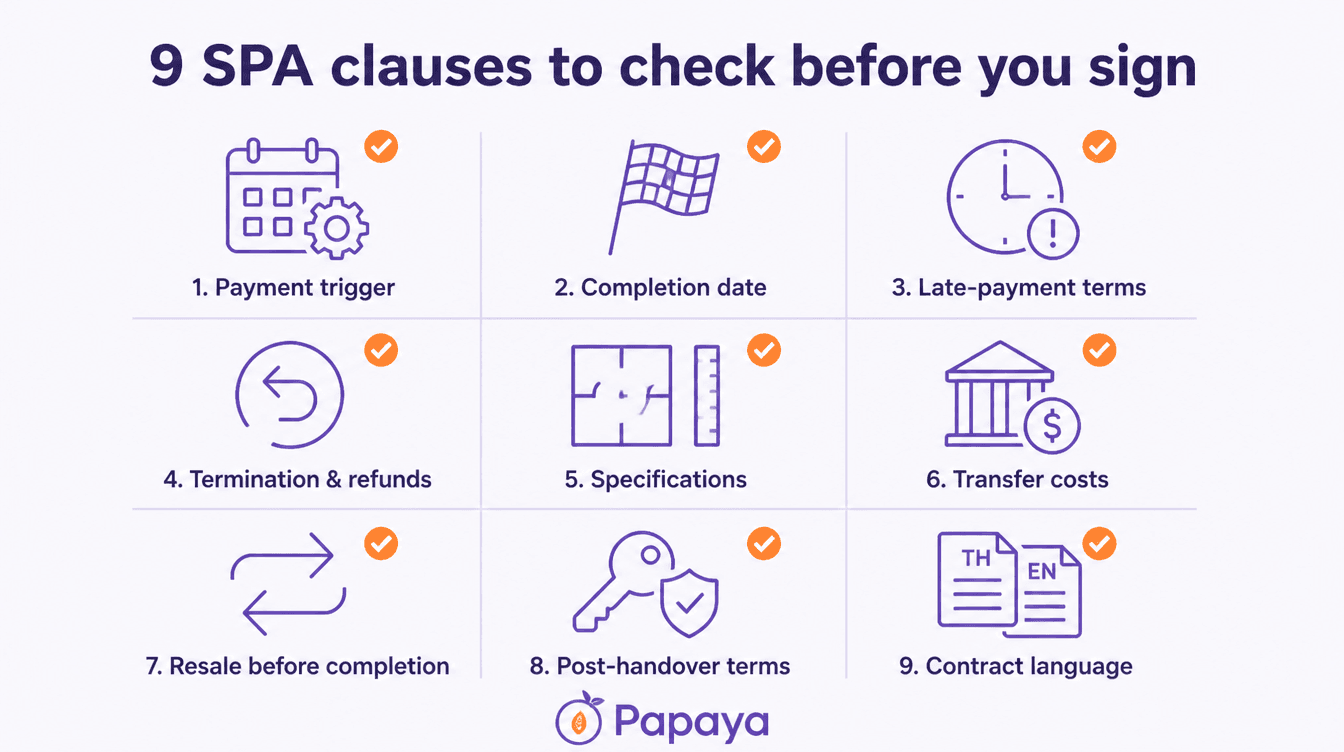
Review these clauses before you pay anything beyond the reservation deposit:
Payment trigger: fixed calendar dates or verified construction milestones
Completion date: and the penalty the developer pays for late delivery
Late-payment terms: the interest rate and the cure period
Termination and refunds: for both parties, not only the buyer
Specifications: the finishes and the permitted tolerance on unit area
Transfer costs: how fees and taxes at the Land Department are split
Resale before completion: whether you can assign the contract, and the fee
Post-handover plans: when the title transfers and what security the developer holds
Language: which version of the contract prevails if it exists in Thai and English
Papaya provides legal support and due diligence on every purchase. That includes a lawyer's review of the SPA and checks on the project itself:
the land title (a Chanote confirms surveyed, registered land)
the construction permit
EIA approval where the project requires it
availability under the 49% foreign quota for condo units
Our SPA and due diligence guides cover each check in full.
Linking Payments to Verified Construction Progress
A milestone schedule protects you only if someone confirms that each milestone has actually been reached. From London, Sydney or Dubai, buyers have no way to check.
Papaya's off-plan construction quality control closes that gap. Our team monitors progress on site and reports to you before each milestone payment falls due. We flag defects while they are still cheap to fix and carry out a full inspection with a snag list before handover. You pay for work that has been verified, not work that has been reported.
FAQ
Can I buy a condo in Phuket on installments without living in Thailand?
Yes. Developer payment plans require no residency, work permit or Thai bank account.
You pay each installment from abroad with FET documentation. SPA signing and much of the rest of the process run remotely, and the transfer at the Land Department can be completed through a power of attorney.
Can I pay off a payment plan early?
Most SPAs allow early settlement. Check the clause before signing, and ask whether paying early earns a discount.
Is the price the same with a payment plan as with a full cash payment?
Not always. Some developers offer a lower price for full upfront payment, so always ask for both quotes and compare them. Through Papaya, both figures are the developer's own prices, with no agency markup.
Conclusion
Developer financing in Phuket is the most accessible way for foreign buyers to purchase in the primary market. It requires no bank approval and no interest during construction, and payments are spread across the build. The right plan depends on your cash flow:
milestone-based for investors buying early
post-handover for buyers who want rental income to cover part of the price
a developer plan combined with a mortgage for end-buyers funding the handover payment
Three rules apply whatever plan you choose. Read the SPA before you commit. Document every installment for the FET requirement. Fund the handover payment long before it falls due.
If you are comparing payment plans across Bang Tao, Laguna, Layan or Kamala, the Papaya team can set out current terms on Sansiri, Laguna Property and The Title projects side by side. We show the developer-direct price, the payment plan price and any cashback for each unit. Message us on Telegram or WhatsApp, or send an email, for a free consultation with a Papaya manager.