

Short-Term vs Long-Term Rental in Phuket: Which Pays More?
Short-Term vs Long-Term Rental in Phuket: Income, Rules and Strategy for Investors
The choice between short-term vs long-term rental in Phuket shapes your real return more than the purchase price does. The same two-bedroom condo in Bang Tao produces a very different income, workload and risk depending on whether you let it by the night, by the month or by the year.
Thai law decides which of those strategies are open to you before income comes into it. Thailand's rules on stays under 30 days are strict, enforcement tightened in 2025, and a new accommodation law is still going through parliament. Investors who understand the rules choose properties that fit their strategy from day one.
This guide covers:
how short-term and long-term rentals work in Phuket, and who rents each way
what is legal for condos and villas under the Hotel Act
how income compares across the seasons
the costs and taxes that turn gross yield into net
developer rental programmes, the licensed route to short-term income
the best areas for each strategy, and how to choose
How Short-Term and Long-Term Rentals Work in Phuket
What Counts as a Short-Term Rental in Thailand?
Thai law draws the line at 30 days. Letting accommodation for less than a month is treated as operating a hotel under the Hotel Act B.E. 2547 (2004). Letting for 30 days or longer is an ordinary residential lease.
That gives Phuket investors three practical models:
Short-term: nightly or weekly stays, priced at a nightly rate and booked through platforms or a hotel operator.
Mid-term: monthly lets of one to six months, popular with high-season visitors and remote workers.
Long-term: leases of six to twelve months or more, priced at a monthly rent, usually to residents.
Mid-term and long-term lets fall on the legal side of the 30-day line. Short-term lets need a licensed structure, which the next section explains.
Long-Term Rental Phuket Condo: Who Rents Long-Term in Phuket?
The long-term market on the west coast is driven by people who live on the island, not by holidaymakers:
relocating families, often choosing homes near the international schools around Thalang and Laguna
remote workers and entrepreneurs who base themselves in Phuket for a year or more
professionals on contracts in hospitality, healthcare, education and yachting
buyers renting first while they choose a property to purchase
Long-term tenants want a furnished condo or villa with two or more bedrooms, reliable internet, parking and space to work from home. These tenants rarely look at studios and one-bedroom units, which is one reason those units make weaker investments.
Is Airbnb Legal in Phuket? The Rules You Need to Know
Is Short-Term Rental Legal in Phuket Condos?
No. In an ordinary condominium, renting for less than 30 days is not legal. Three sets of rules apply:
The Hotel Act. Stays under 30 days count as hotel operation, which requires a hotel licence. Standard residential condo buildings do not hold one.
The Condominium Act. Units in a residential condominium are not for commercial use, and the Land Department does not allow condo units to be used for hotel operation.
The building's own rules. The juristic person, meaning the owners' management body, sets regulations for the building. Most Phuket condominiums ban short-term letting outright and fine owners who break the rule.
In July 2026, the House of Representatives accepted Hotel Act amendment bills in principle and sent them to committee. The drafts aim to bring small operators into a registration system, but versions differ on condos, and none of them is law yet. Until a final Act is published in the Royal Gazette, the current rules apply.
There is one legal route to short-term income from a condo: buying in a project that holds a hotel licence and runs a rental programme. Section 6 covers how that works.
Before you buy for rental income, Papaya's legal support and due diligence answers the questions that decide your strategy:
Does the project hold a hotel licence?
What do the juristic person's regulations allow?
Do the SPA and the rental programme agreement match what the sales materials promise?
Can You Rent Out a Villa Short-Term in Phuket?
The rules for villas are different, but villas still need a licence or registration. Under current regulations, small properties with up to 8 rooms and up to 30 guests can register as non-hotel accommodation with the district office instead of applying for a full hotel licence. The property must meet basic safety requirements, such as fire extinguishers, smoke detectors, emergency lighting and marked exits.
Foreign owners face two more rules:
Foreign Business Act. Running the rental is a business, and hotel operation is restricted for foreigners under the Act.
Work permit. Handling bookings and guests yourself counts as work in Thailand, and work requires a work permit.
The practical route for a foreign villa owner is a licensed management company that holds the registration and runs the rentals. In Layan, Bang Tao and Laguna, many villa projects offer exactly that through the developer or its operator. Never use a Thai nominee company to get around these rules. Nominee structures are illegal and put the whole property at risk.
What Happens If You Break the Rules?
Penalties under the Hotel Act are real and enforced:
up to one year in prison
a fine of THB 20,000
a further THB 10,000 for every day the offence continues
In 2025, the authorities carried out inspections and prosecutions in several tourist provinces, and booking platforms share data with the tax authorities. In condos, the juristic person adds its own fines and can bar guests at the lobby.
Every host also has an immigration duty. When a foreign guest or tenant stays at your property, the house owner or manager must file a TM30 registration with Immigration within 24 hours. This applies to long-term tenants as well as short stays.

Short-Term vs Long-Term Rental in Phuket: Income Compared
Which Earns More in Phuket: Short-Term or Long-Term Rental?
On gross income, legal short-term rental earns more in a strong year. Nightly rates in high season are far above the equivalent daily cost of a long-term lease, so a well-run, licensed short-term unit brings in more revenue over twelve months.
Net income tells a different story. Short-term rental carries the costs of cleaning, linen, utilities, platform or operator commission, and furniture wear. It also carries the empty nights between guests. Long-term rental gives up some upside in return for:
one tenant and one contract
utilities paid by the tenant
lower management fees
little wear on the furniture
predictable monthly income
The right comparison is not short-term against long-term in general. It is legal short-term income through a licensed programme against long-term rent on a property you could otherwise use yourself.
High Season, Low Season and Occupancy
Phuket's rental year has two halves:
High season, roughly November to April: dry weather, peak tourist arrivals, the highest nightly rates and the strongest occupancy.
Low season, roughly May to October: the southwest monsoon brings rain and rougher seas on the west coast, nightly rates drop and occupancy softens.
Short-term income follows that curve. Owners earn most of the year's revenue in the high-season months and accept thinner months in the monsoon.
Long-term income does not follow the curve. A twelve-month lease pays the same rent in September as in January. That stability is why many owners in Bang Tao and Laguna choose long-term tenants or mid-term monthly lets in high season over chasing nightly rates.

Phuket Rental Yield: Costs That Turn Gross into Net
What Rental Yield Can You Expect from a Phuket Condo?
Your yield depends on three things more than the area average:
The purchase price. Every baht saved at purchase raises the yield on the same rent.
The unit. A two-bedroom unit with a view and a usable layout rents faster and for more than a smaller unit in the same building.
The rental model. It sets your occupancy, your costs and whether short-term income is legal at all.
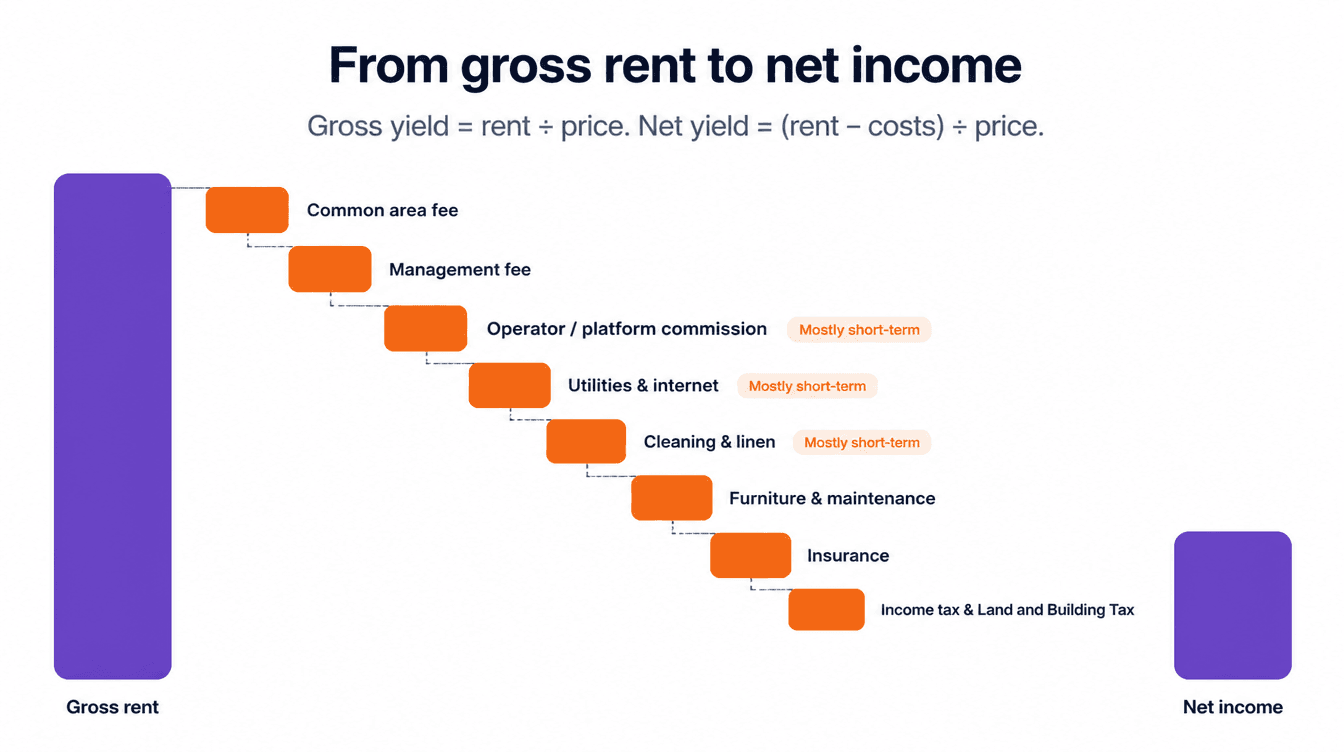
Always separate gross yield from net yield:
Gross yield is annual rent divided by the purchase price.
Net yield is annual rent minus all costs and taxes, divided by the purchase price.
Sales materials quote gross figures. Your bank account receives net.
The purchase price is the part of the formula you control on day one. Papaya sells at developer-direct prices, with no agency markup, so the same rent produces a higher yield than it would on an inflated price. On selected projects, cashback lowers the effective entry price further.
What Are the Costs of Renting Out Property in Phuket?
Plan for these costs before you calculate a yield:
Common area fee: paid to the juristic person every year, whether the unit is let or empty.
Sinking fund: a one-time contribution at transfer for the building's long-term repairs.
Property management fee: a percentage of rent for finding tenants, check-ins and maintenance. It is higher for short-term than for long-term rental.
Operator or platform commission: for short-term stays and rental programmes.
Utilities and internet: paid by the owner in short-term rental, usually by the tenant in long-term rental.
Cleaning and linen: a recurring cost for short-term rental only.
Furniture and maintenance: replacement cycles are much shorter for short-term units.
Insurance: building and contents cover, plus landlord liability.
Taxes: income tax on rent and the annual Land and Building Tax.
Our hidden costs guide covers the purchase-side fees in detail.
Do You Pay Tax on Rental Income in Thailand as a Foreigner?
Yes. Rent from a Thai property is Thai-source income, so it is taxable in Thailand whether or not you live here. The key rules:
Tax ID. You need a Thai Tax ID before you can file.
Rates. Rental income is taxed under the Revenue Code at progressive personal income tax rates from 0% to 35%.
Deduction. Landlords can deduct a standard 30% for expenses, or actual expenses with receipts.
Withholding. When the tenant is a company, it withholds tax at source. For non-residents the rate is generally 15%.
Land and Building Tax. It is assessed each year on the property, and the rate depends on how the property is used.
Double tax treaties. Thailand has treaties with many countries, including the UK, Australia, Singapore, Germany and the UAE. They decide how rental income is treated in your home country.
Use a Thai tax adviser to file correctly. Our taxes guide explains the purchase and ownership taxes alongside these.
Phuket Condo Rental Programmes: The Licensed Route to Short-Term Income
How Do Developer Rental Programmes Work in Phuket?
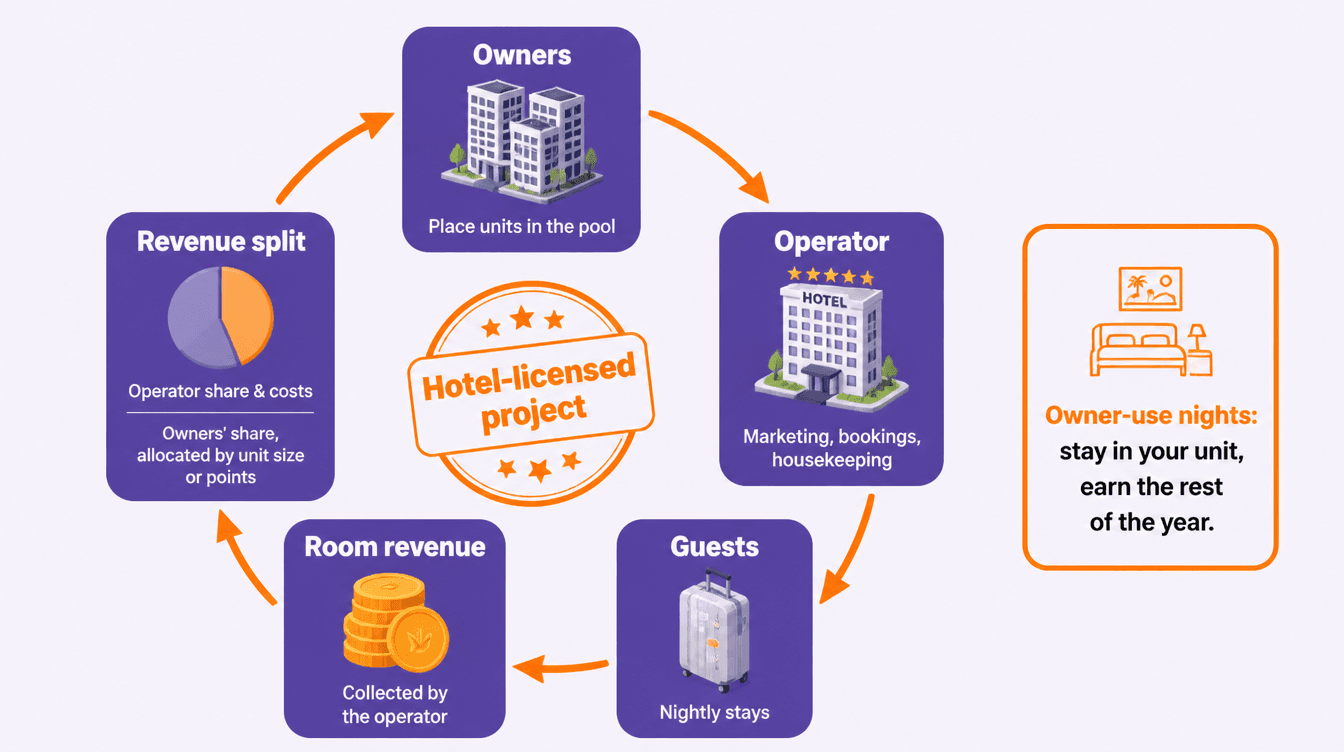
A rental programme lets you earn short-term income legally from a condo or villa, because the project and its operator hold the licence. You own the unit, and a hotel or resort operator markets and manages it alongside the rest of the inventory.
Most programmes follow one of two structures:
Rental pool. All participating units go into one pool. Net room revenue is shared between the operator and the owners, and each owner's share is allocated by unit size or points.
Individual unit programme. Your unit's own bookings decide your income, after the operator's share and costs.
Most programmes allow a set number of owner-use nights each year, so you can holiday in your own property and earn from it the rest of the time.
Partner developers build rental-ready product on the west coast:
Laguna Property develops residences inside Laguna Phuket, an integrated resort with established hotel operations.
The Title builds resort-style condominiums designed around rental programmes.
Sansiri offers projects in Phuket aimed at both investors and owner-occupiers.
Ask the Papaya team which current projects run licensed programmes and on what terms.
Are Guaranteed Rental Returns in Phuket Worth It?
A guaranteed rental return pays you a fixed percentage of the purchase price each year for a set period, whatever the occupancy. It turns a hotel investment into predictable income, which is why many first-time investors find it attractive.
A guarantee is only as good as its terms. Check:
Who guarantees it: the developer, the operator or a separate company, and how strong that company's finances are.
Whether it is priced in: compare the unit price with similar units that have no guarantee.
What happens when it ends: whether the unit moves into a revenue-share pool, and what that pool has historically paid.
Owner use: the limits on personal use during the guarantee period.
Costs: whether the guaranteed figure is gross or net of common area fees, furniture and maintenance.
Exit: whether you can sell the unit during the guarantee, and whether the guarantee passes to the buyer.
Papaya's legal team reviews the rental programme agreement alongside the SPA before you commit. A strong guarantee from a strong operator is a solid basis for income. A weak one is a discount you paid for in advance.
Which Areas in Phuket Are Best for Rental Investment?
Bang Tao and Laguna: Year-Round Demand
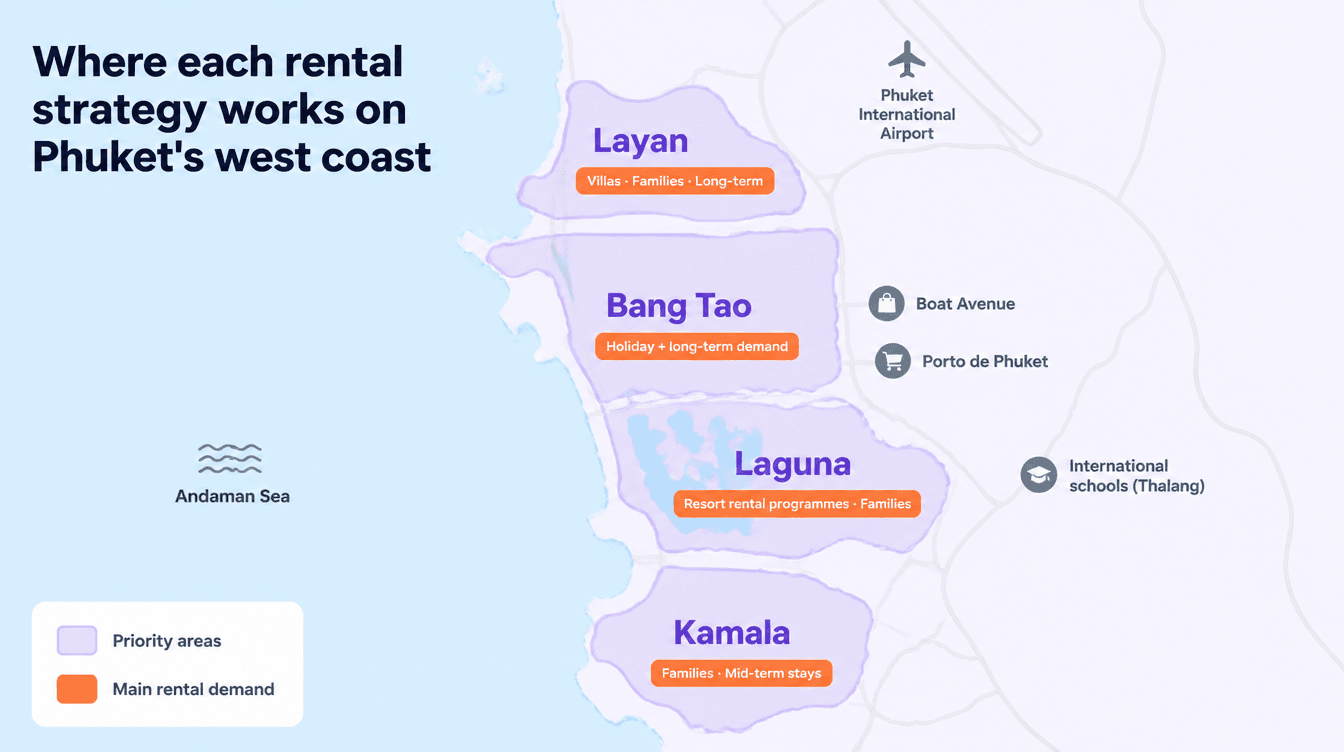
Bang Tao and Laguna draw both rental markets:
Short-term: holiday guests come for the long beach, resort hotels and beach clubs.
Long-term: families and professionals come for international schools in Thalang, the shops and restaurants of Boat Avenue and Porto de Phuket in Cherngtalay, and quick access to the airport.
That balance is the area's strength for investors. A two-bedroom condo here works in a licensed rental programme, on a long-term lease to a relocating family, or on monthly lets to high-season visitors.
Laguna adds the infrastructure of an integrated resort: lagoons, golf, hotel operations and a settled community of residents.
Layan and Kamala: Villas and Family Rentals
Layan, at the northern end of Bang Tao Bay, is quieter and greener. It suits pool villas let through licensed management companies to families and groups, and long-term leases to residents who want space and privacy.
Kamala is a smaller beach community with a village feel and hillside views. It attracts families on longer holidays, mid-term visitors and residents who want the west coast without the busier areas.
For investors, the unit type matters as much as the area. Across all four areas, two-bedroom and larger condos and villas rent to the widest pool of tenants in both markets.
Choosing Your Strategy: Short-Term, Long-Term or Hybrid
Most investors fit one of three profiles.
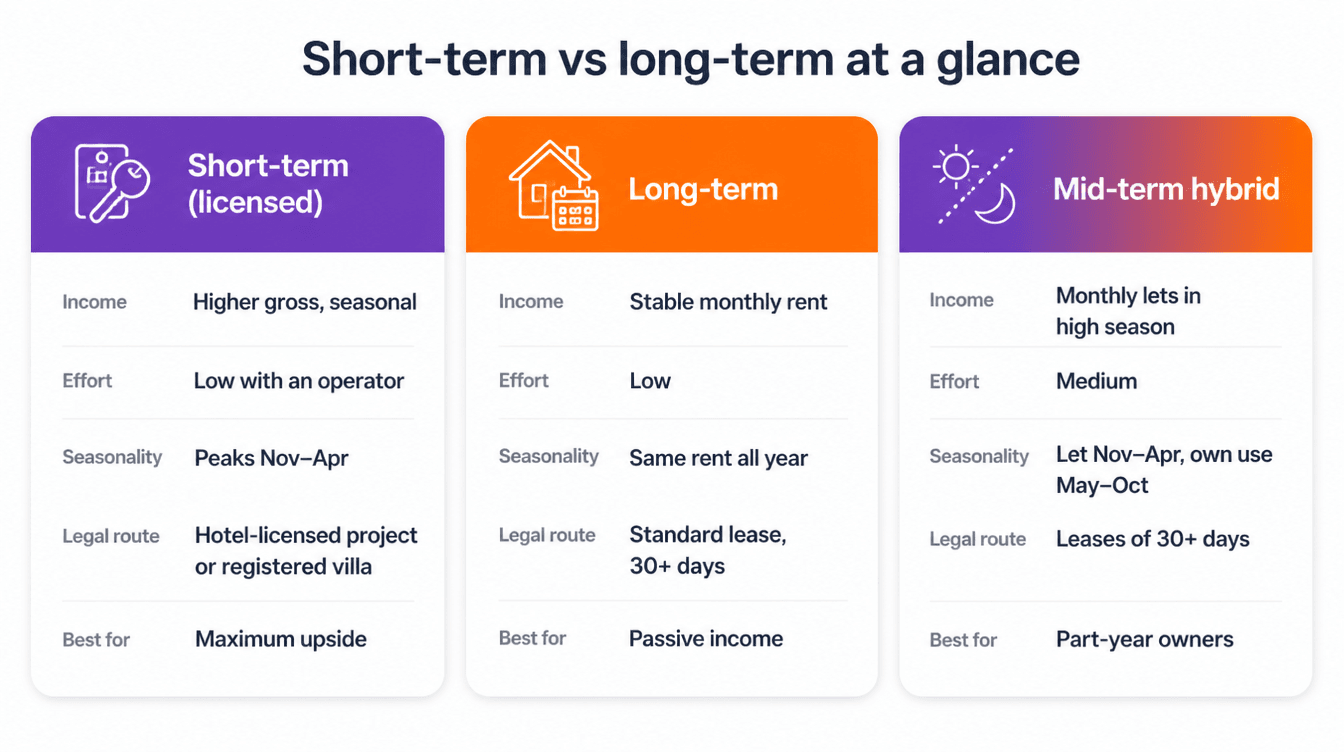
The passive income investor wants predictable returns with no involvement. The best fit is a long-term lease on a two-bedroom condo or villa in Bang Tao or Laguna, or a unit in a licensed programme with a guaranteed rental return from a strong operator.
The maximum upside investor wants the highest gross income and accepts seasonal swings. The best fit is a unit in a hotel-licensed project with a rental pool, ideally in Laguna or Bang Tao, where hotel demand is strongest. This is the only legal way to capture nightly rates from a condo.
The part-year owner wants to use the property and earn when away. There are two legal options:
A rental programme with owner-use nights. The operator rents the unit when you are not using it.
A mid-term hybrid. Let the property on monthly contracts during high season, when demand for one- to three-month stays peaks, and use it yourself in the quieter months. Every let runs 30 days or longer, so the strategy stays within the law.
The best rental strategy starts with the property's legal status. Decide how you want to rent before you choose the unit, not after.
FAQ
What is the best rental strategy for Phuket property?
For most foreign investors, the best rental strategy for Phuket property is one of two options:
a long-term lease on a two-bedroom or larger unit on the west coast, for stability
a unit in a hotel-licensed rental programme, for short-term income
Unlicensed nightly letting from an ordinary condo is not a legal option.
Can I switch from long-term to short-term rental later?
Only if the property can legally take short-term guests. An ordinary condo cannot switch to nightly letting, whatever the owner decides. A villa can switch if it is registered or licensed and managed through a compliant operator. If short-term income matters to you, choose a project with a licensed programme at the point of purchase.
Do I need a Thai company to rent out my property?
No. A foreign individual can own a freehold condo under the 49% foreign quota and earn rent on it, and can lease out a villa held under a registered leasehold. Never use a Thai nominee company to hold property or run rentals. Nominee structures are illegal under Thai law and put the entire investment at risk.
Conclusion
Short-term vs long-term rental in Phuket is not only a question of which earns more. It is a question of which strategy the property can legally support, which costs it carries and how much involvement you want.
Long-term leases give stable, low-effort income.
Licensed rental programmes give the upside of nightly rates without breaking the rules.
Monthly lets in high season give part-year owners a legal hybrid.
Start with the legal status, then the unit, then the area.
If you are comparing rental-ready projects in Bang Tao, Laguna, Layan or Kamala, the Papaya team can show you current options from Sansiri, Laguna Property and The Title at developer-direct prices. We'll also review the rental programme terms with you. Message us on Telegram or WhatsApp, or send an email, for a free consultation with a Papaya manager.