

Hidden Costs of Buying Property in Phuket: Full Breakdown
Hidden Costs of Buying Property in Phuket: What to Budget Beyond the Price
The figure on a developer's price list is where your budget starts, not where it ends. Between reservation and handover you pay government fees, currency transfer costs, legal fees and handover charges. Once you hold the keys, annual fees begin. Almost all of these are fixed by law or written into the Sales and Purchase Agreement (SPA), which makes them predictable. You just need to know them before you sign.
This guide breaks down the hidden costs of buying property in Phuket, from the Land Department fee on transfer day to the maintenance bill in your first year. You'll see which costs fall on you and which fall on the developer. You'll also see which ones apply only to foreign buyers, and what a full budget looks like for a 2-bedroom condo in Bang Tao.
One point to settle first: the 0.01% transfer fee in recent headlines doesn't apply to you. It's a Thai-nationals-only measure, and foreign buyers pay the standard rate.
The Hidden Costs of Buying Property in Phuket at a Glance
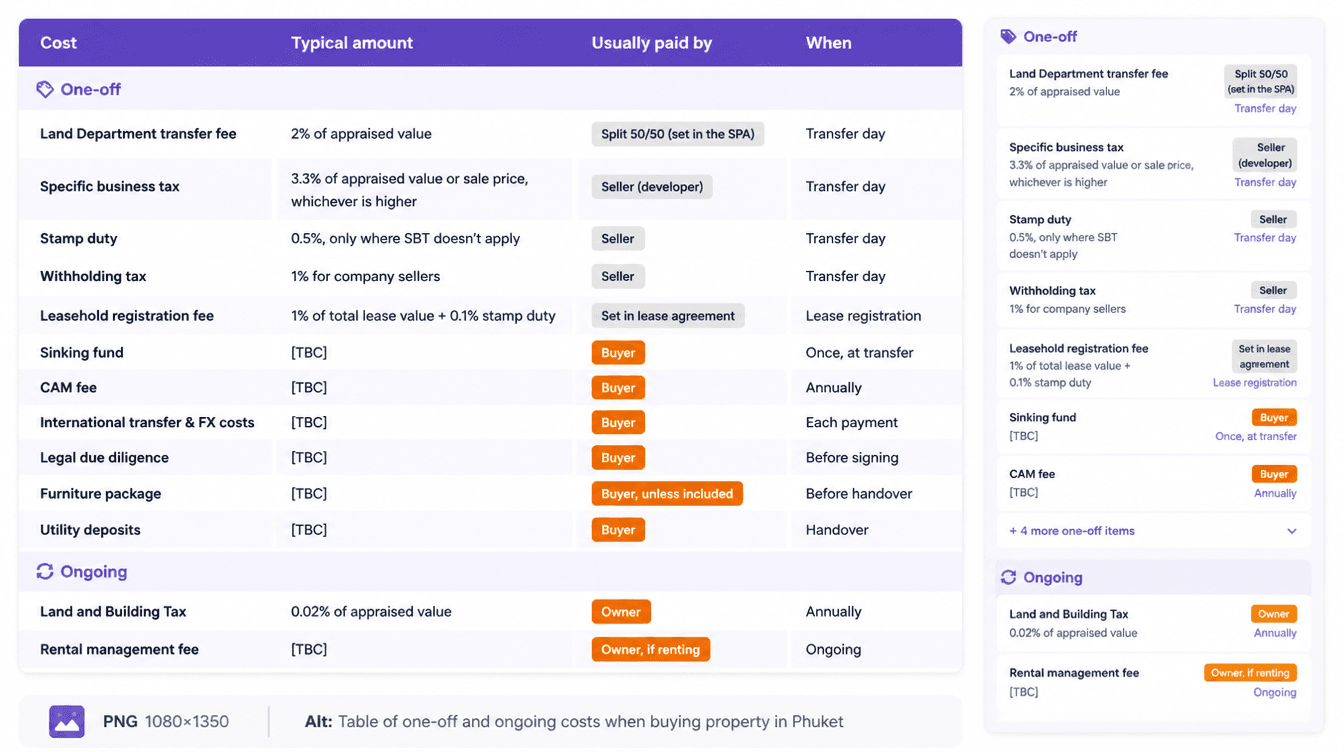
Every extra cost falls into one of two groups. One-off costs cluster around transfer day and handover. Ongoing costs start the month you take ownership and run for as long as you hold the property.
One-off costs at purchase:
Land Department transfer fee: 2% of appraised value, split 50/50 on most new builds (set in the SPA). Due on transfer day.
Specific business tax: 3.3% of appraised value or sale price, whichever is higher. Paid by the seller (developer) on transfer day.
Stamp duty: 0.5%, only where SBT doesn't apply. Paid by the seller.
Withholding tax: 1% for company sellers. Paid by the seller.
Leasehold registration fee: 1% of total lease value + 0.1% stamp duty. The lease agreement sets who pays.
Sinking fund. Paid by the buyer, once, at transfer.
International transfer and FX costs. Paid by the buyer on each payment.
Legal due diligence fee. Paid by the buyer before signing.
Furniture package. Paid by the buyer unless included in the price.
Utility connection deposits. Paid by the buyer at handover.
Ongoing costs of ownership:
Common area maintenance (CAM) fee. Billed annually, in advance.
Land and Building Tax: 0.02% of appraised value for residential property under THB 50 million. Annual.
Rental management fee. Only if you rent the property out.
Note the basis for the government fees. The Land Department calculates them on its own appraised value, not your contract price. On new-build condos, the appraised value usually sits below the contract price, so these lines come in at or under the percentages above.
Property Transfer Fees in Phuket: What's Due at the Land Department
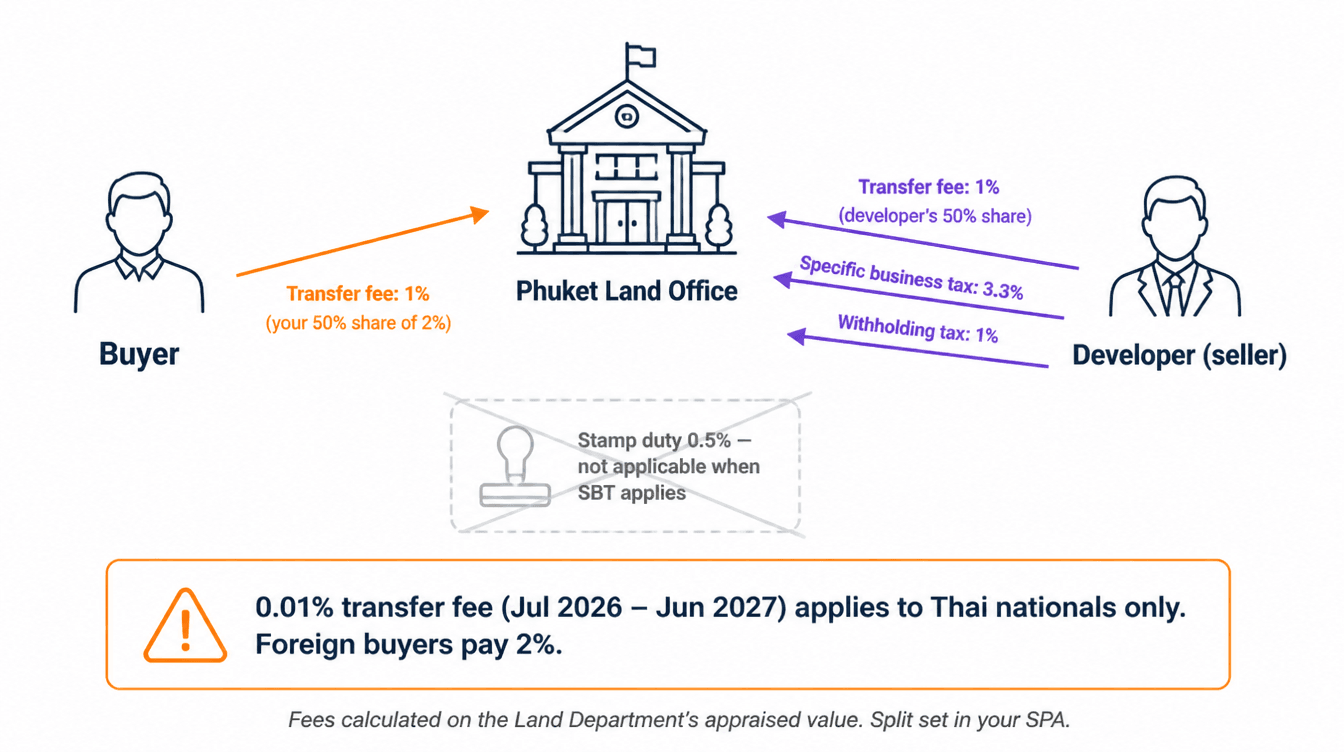
On transfer day, you and the developer's representative meet at the Phuket Land Office. For a condo, the office registers a condominium title deed in your name. For a leasehold villa, it registers your lease against the land's Chanote. Four charges come due at the counter. None of them is optional, and the Land Office calculates all of them. What's negotiable is who pays.
Who Pays Transfer Fees When Buying Property in Thailand?
Thai law doesn't fix the split. Your SPA does. On new-build projects the standard arrangement is a 50/50 split of the 2% transfer fee. The developer, as seller, also covers specific business tax and withholding tax. Some developers absorb the full transfer fee as a launch promotion.
Because the SPA records the split, it's settled long before transfer day, usually around reservation. That's the moment to check it, not three years later at the Land Office counter. Papaya's legal team reviews every SPA before you sign, including the fee and tax clauses. A clause that quietly shifts the developer's taxes onto you is caught at that stage.
About the 0.01% rate: from 1 July 2026 to 30 June 2027, Thailand has cut transfer and mortgage registration fees to 0.01%. The cut covers only Thai individuals buying property worth up to THB 7 million. Foreign buyers pay the full 2%. If an agent or listing quotes 0.01% to a foreign buyer, the figure is wrong.
Specific Business Tax vs Stamp Duty: Which One Applies
These two taxes never apply together. Specific business tax (SBT) at 3.3% applies when the seller is a company, which covers every developer. It also applies when an individual sells within five years of buying. Stamp duty at 0.5% applies only when SBT doesn't.
On a primary-market purchase the developer is the seller, so SBT applies and stamp duty drops out. Under standard SPAs, the developer pays it.
Both taxes become relevant to you when you sell. In most cases, a resale within five years triggers SBT. After five years, the lower stamp duty applies instead. Withholding tax works the same way. The Land Office deducts it from the seller's proceeds at transfer: 1% for companies, and a progressive rate for individuals, based on appraised value and years held.
How Much Are Leasehold Registration Fees in Thailand?
Leasehold is the standard structure for foreign buyers of villas, and it involves no freehold transfer. Instead, the Land Office registers your lease against the land's Chanote. The fee is 1% of the total rent across the registered lease term, plus 0.1% stamp duty. On a pre-paid 30-year lease, the total rent is the lease price you pay the developer.
The lease agreement sets who pays this fee, so read that clause as closely as the price. Some projects also grant a superficies right over the building, which is registered separately. This is project-specific, not automatic with every leasehold villa. Where it applies, budget for its registration fee as well.
Thailand Property Buying Costs for Foreigners
Three costs exist only because you're buying from abroad: moving your money into Thailand correctly, converting it to baht, and independent legal work. None of them appears on a developer's price list, and all three are within your control.
How Much Does It Cost to Transfer Money to Thailand to Buy a Condo?
Foreigners can own a condo freehold, within the 49% foreign ownership quota of the building. To do so, you must bring the purchase funds into Thailand in foreign currency, and the receiving Thai bank converts them to baht. The bank then issues the Foreign Exchange Transaction form (FET form). The Land Department requires it to register the unit in your name. Without it, the unit can't be registered as foreign freehold ownership.
The FET form itself is free. The costs sit around it:
Your sending bank's outgoing transfer fee.
Intermediary (correspondent) bank fees deducted in transit.
The receiving Thai bank's incoming fee.
The exchange-rate margin on conversion, usually the largest of the four on a property-sized transfer.
Three details prevent costly problems:
The sending account must be in the buyer's name.
The payment reference must state that the funds are for a condominium purchase, with the project and unit.
Every off-plan instalment generates its own FET documentation, so keep all of it. The Land Office checks that the documents cover the full purchase price.
Papaya helps structure these transfers: the wording, the FET paperwork for each instalment, and the timing of conversions across a payment schedule.
Do I Need a Lawyer to Buy Property in Phuket?
Thai law doesn't require one. Use one anyway. The developer's lawyers drafted the SPA, and they drafted it to protect the developer.
Independent legal due diligence checks:
The developer's title to the land (the Chanote) and any mortgages or encumbrances on it
Construction permits and environmental (EIA) approval for the project
That your unit falls within the building's foreign quota
The SPA terms: payment schedule, penalties for construction delays, defects liability and the fee split
The legal due diligence fee runs , which is small against the price of the unit. Papaya provides legal support and due diligence on the purchases we handle.
What Taxes Do Foreigners Pay When Buying a Condo in Thailand?
At purchase, very little. Property sales in Thailand aren't subject to VAT. On a new-build purchase, SBT and withholding tax are the developer's, so your tax cost at transfer is your agreed share of the transfer fee.
After purchase, you pay:
Land and Building Tax: annual, at 0.02% of the appraised value for residential property under THB 50 million
Tax on rental income, if you rent the unit out.
SBT or stamp duty, plus withholding tax, when you resell
Separately, every condo owner pays fees to the juristic person condominium, the owners' body that runs the building. These aren't taxes, but they're compulsory. They're covered under ongoing costs below.
Off-Plan Extras That Rarely Appear in the Brochure
Buying off-plan spreads the price across the construction period. A handful of costs then arrive at handover, at the point when most buyers have budgeted for the final instalment and nothing else.
Are Furniture Packages Included in Phuket Off-Plan Prices?
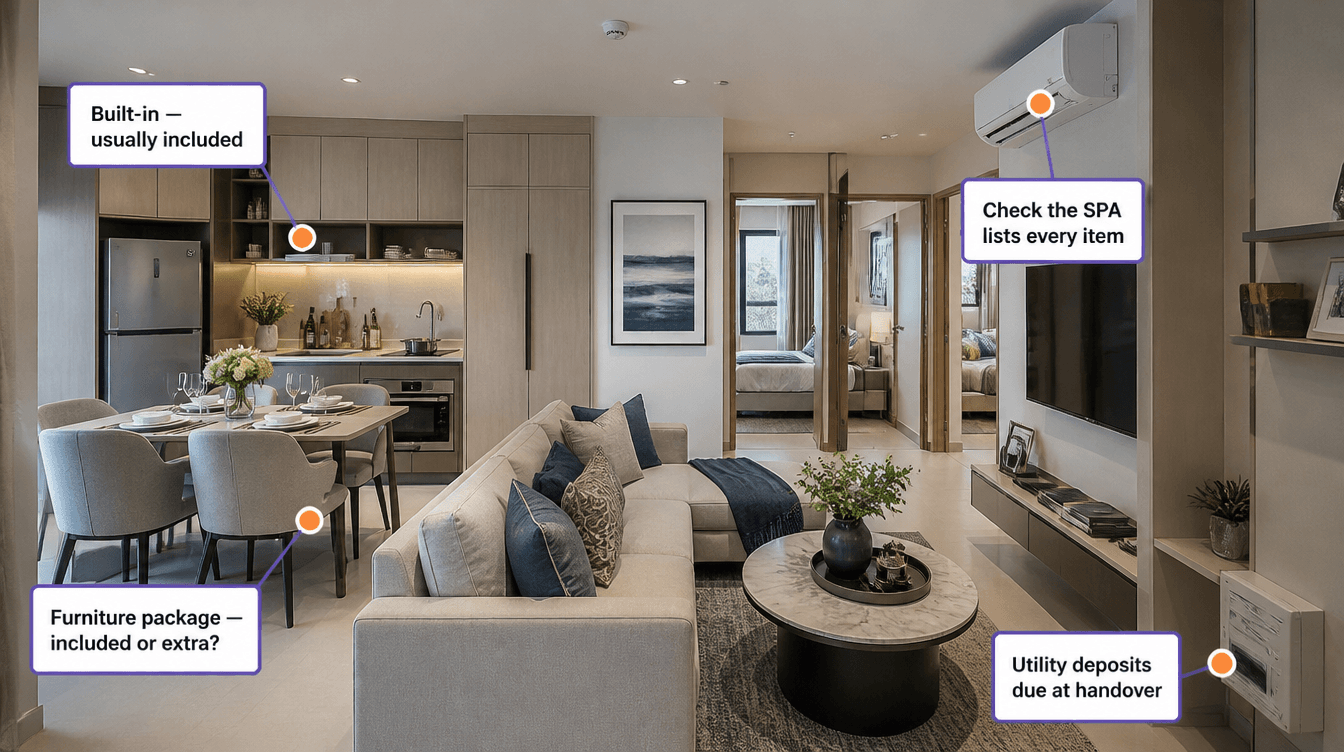
Sometimes. Developers handle furniture in one of three ways:
Fully furnished, with furniture included in the contract price
Optional package at a fixed extra price
Unfurnished, with only the built-in kitchen and wardrobes
The difference is That's enough to change how two projects compare. Confirm which model applies before you reserve. Then check that the SPA lists the package contents, not just the word "furnished." If you plan to rent the unit out, a furnished handover lets you list it from day one.
Utility Connection Deposits and Handover Charges
At handover, several bills arrive together:
Sinking fund contribution: a one-off, per-sqm payment (explained below)
CAM fees in advance: typically the first year, billed by the juristic person or by the developer until the juristic person is formed
Electricity meter deposit with the Provincial Electricity Authority (PEA)
Water meter deposit
The other handover risk is defects. Once you formally accept the unit, getting defects fixed becomes slower and harder. Papaya's off-plan quality control covers this: our team monitors construction stages and inspects the unit before you accept it, so defects are fixed at the developer's cost, not yours. On projects with 0% developer instalments, spreading the price also leaves cash free for these handover bills.
Phuket Condo Maintenance Fees and Other Ongoing Costs
Ongoing costs start on transfer day and continue for as long as you own the property. They determine your real cost of ownership and, for investors, the gap between gross and net yield.
How Much Are Condo Maintenance Fees in Phuket?
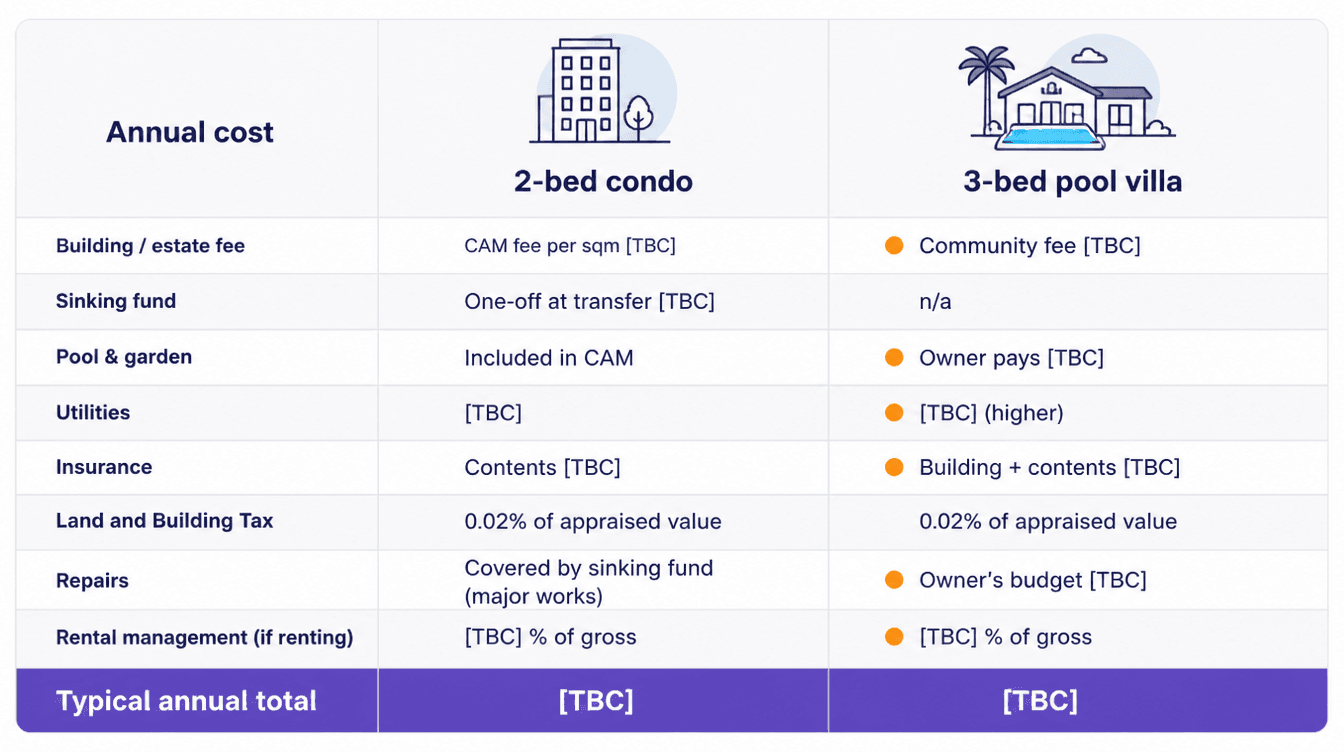
The common area maintenance (CAM) fee is charged per square metre and billed by the juristic person condominium, usually annually in advance. It pays for security, the pool, gardens, common-area cleaning, lifts, common-area insurance and the juristic office staff.
Rates follow the facilities. A resort-style project with a large pool deck, gym and full-time staff charges more per sqm than a compact building. Typical CAM rates in partner projects in Bang Tao, Laguna, Kamala and Layan run.
The developer sets the initial rate, and the owners' meeting can change it later. Before you commit, get the current rate in writing. For a completed building, ask for the juristic person's annual budget as well.
What Is a Sinking Fund in a Thai Condominium?
A sinking fund is a one-off payment at transfer, charged per sqm, into a reserve that the juristic person uses for major repairs: roof, lift replacement, façade, structural work.
It isn't refundable when you sell. The money stays with the building, and the buyer of your unit doesn't pay it again. A well-funded sinking fund protects owners from extra levies when large repairs fall due. It's worth a look on any resale purchase.
What Are the Annual Running Costs of a Villa in Phuket?
Villas have no juristic person, but villas in a managed estate pay a community fee for roads, security and shared landscaping. Laguna Property's estates and the developments around Layan work this way.
On top of that, a villa owner pays:
Pool cleaning and maintenance
Garden care
Utilities, which are higher than a condo's
Building insurance
Land and Building Tax
A repair budget for a standalone structure
Typical annual running costs for a 3-bedroom pool villa run. Budget them before comparing villa and condo yields.
Rental Management Fees and What They Cover
If you rent the property out, a management company handles marketing, bookings, guest check-in and housekeeping. It takes.
Several costs often sit outside that percentage:
Online booking platform commissions
Cleaning and linen per stay
Utilities between guests
Wear-and-tear repairs
When a project quotes a rental yield, ask whether the figure is gross or net of these costs. The difference decides whether the numbers work.
Cost of Buying a Condo in Phuket: A Worked Example
Here's how the costs stack up on an illustrative purchase: a 2-bedroom condo in Bang Tao, bought off-plan from the developer, freehold within the foreign quota. The contract price is THB 10,000,000. As a ceiling estimate, assume the Land Department appraises the unit at the full contract price.
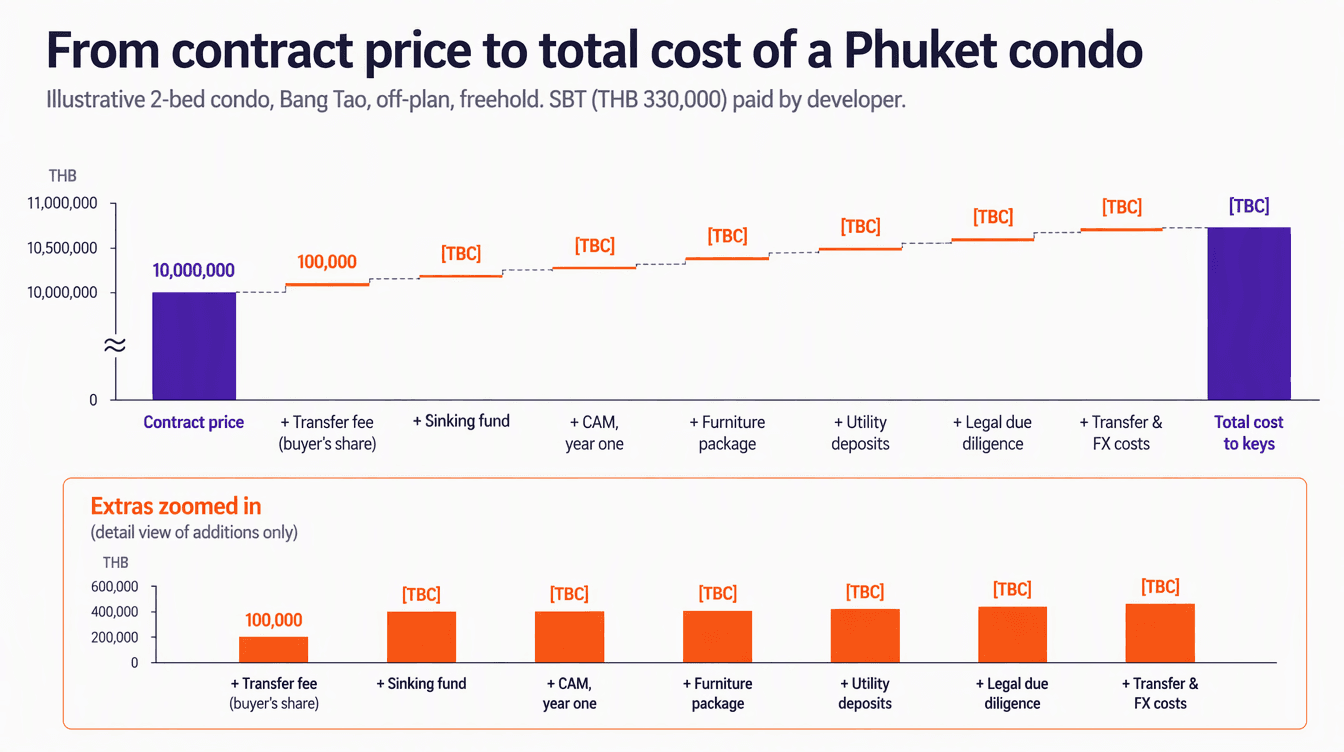
Contract price: THB 10,000,000 (illustrative)
Transfer fee, buyer's 50% share: THB 100,000 (1% of appraised value)
SBT and withholding tax: THB 0 to the buyer, paid by the developer under the SPA
Sinking fund, one-off
CAM fees, year one, billed at handover
Furniture package, or included in the price
Utility deposits, at handover
Legal due diligence, before signing
International transfer and FX costs, across all instalments
Total cost to keys.
The developer's SBT on this unit comes to THB 330,000. That's why the tax clause in the SPA matters: an SPA that shifts SBT to the buyer adds more than three times the buyer's transfer fee.
In year one, add CAM fees, Land and Building Tax (THB 2,000 at 0.02% of THB 10 million), contents insurance and utilities.
The largest figure in this budget is the contract price itself. When you buy through Papaya, that figure is the developer's own price, with no agency markup on top.
How to Keep Hidden Costs Under Control
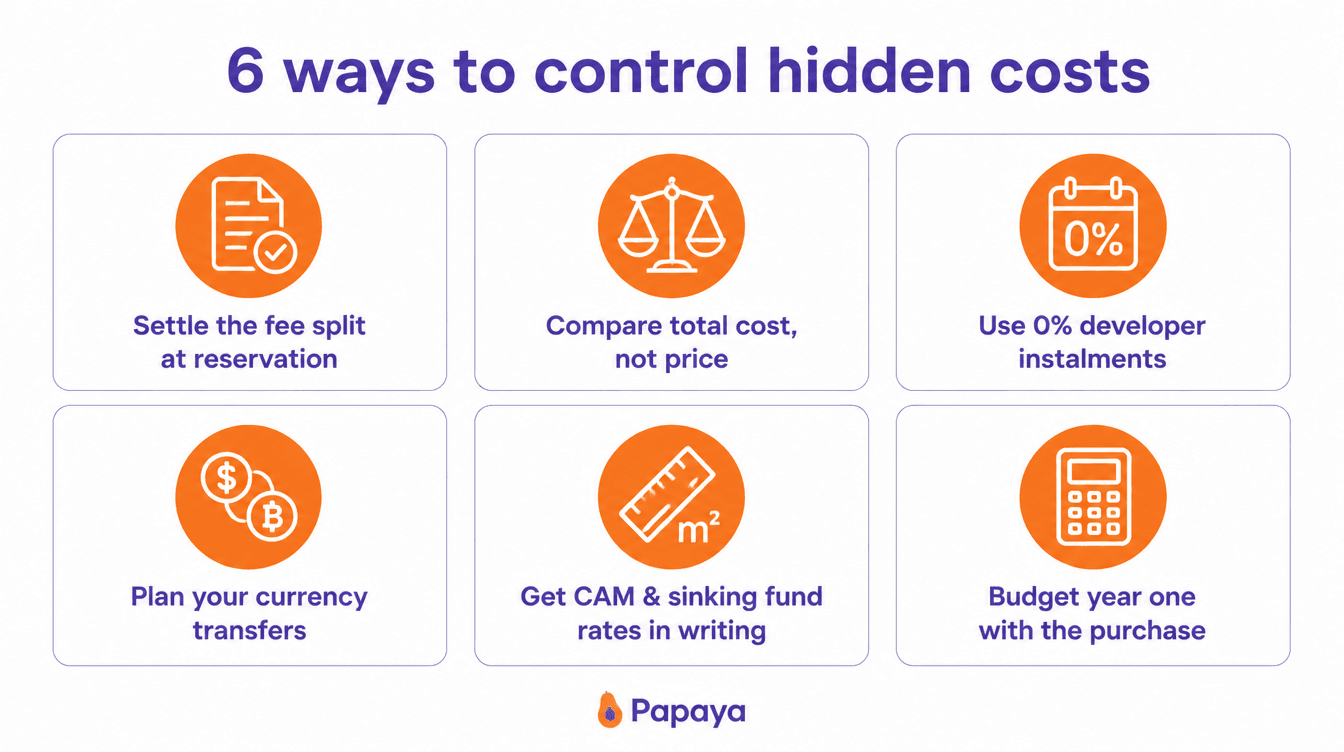
Most of these costs are fixed in amount, but you control when you discover them and how they're shared. Six moves make the difference:
Settle the fee split at reservation. Get the transfer fee and tax split confirmed in writing before you pay the reservation deposit.
Compare projects on total cost, not price. Included furniture or developer cashback shifts the real number. Papaya offers cashback on selected projects.
Use 0% developer instalments. Spreading payments across the build period reduces how much cash you hold at any one time and spreads your currency conversions. Several projects from partners including Sansiri, Laguna Property and The Title offer such plans.
Plan your currency transfers. Fewer, larger transfers with consistent wording cut bank fees and keep the FET paperwork clean.
Get CAM and sinking fund rates per sqm in writing before you commit, not at handover.
Budget year one as part of the purchase. First-year running costs belong in the same budget as the price.
Conclusion
The hidden costs of buying property in Phuket aren't hidden once you know where to look. Government fees follow fixed rates, the SPA sets who pays them, and building fees are quoted per square metre. Buyers who get caught out usually saw the price but never the full budget.
If you're weighing a specific project in Bang Tao, Kamala, Laguna or Layan, contact the Papaya team on Telegram, WhatsApp or email for a free consultation. We'll prepare a line-by-line cost estimate for the unit you're considering, from contract price to keys. For the wider buying process.