

Phuket Property Exit Strategy: Sell, Assign or Hold
Phuket Property Exit Strategy: How to Plan Your Sale Before You Buy
Most investors think about selling when they're ready to sell. By then, the decisions that matter most are years behind them. These include the unit you chose, the clauses in your Sales and Purchase Agreement (SPA), and how your money entered Thailand. Each one decides how easily you leave and how much you take with you.
A Phuket property exit strategy starts at reservation, not at resale. This guide covers the four exit routes open to foreign investors and how selling works for freehold condos and leasehold villas. It also covers the taxes due at sale and how to bring the proceeds home. The last section turns all of it into a checklist for the purchase itself, because the purchase is where the exit gets built.
Four Exit Routes for Phuket Property Investors
Every investment in Phuket property ends one of four ways. Each route suits a different investor, timeline and appetite for involvement.
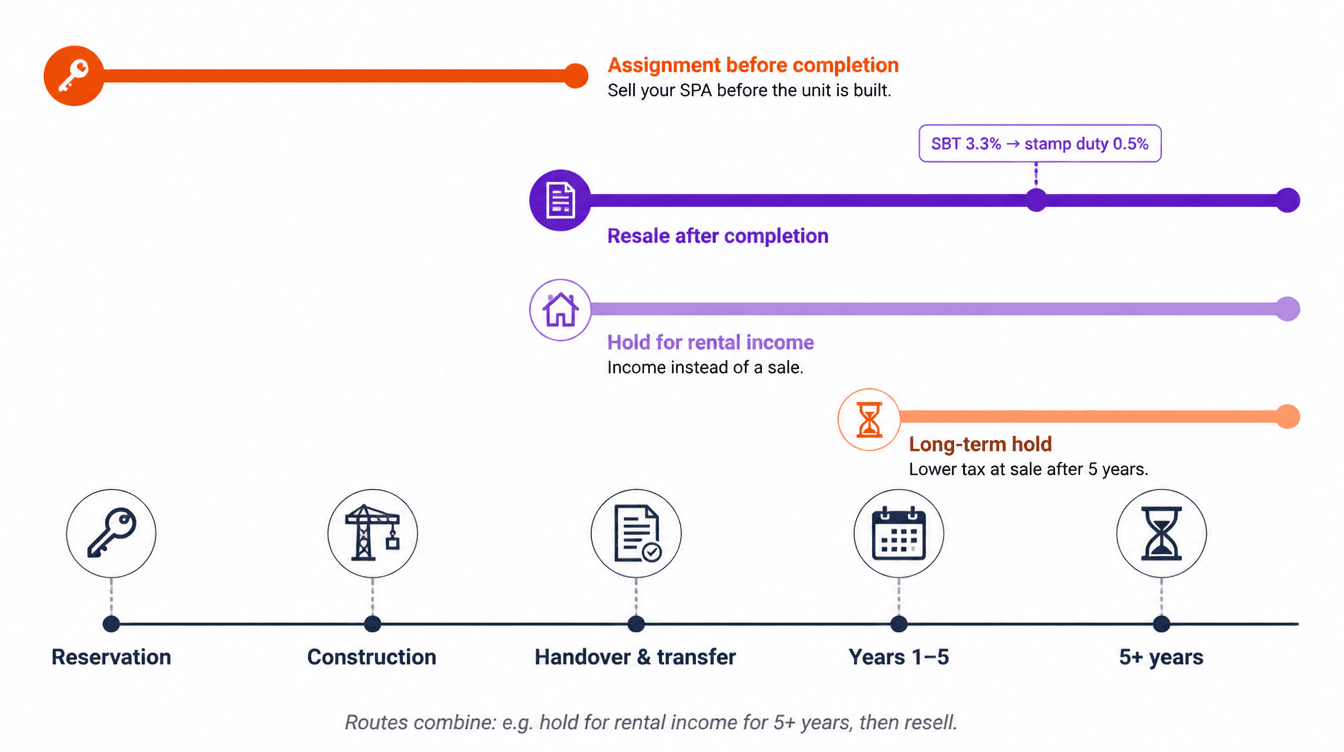
Assignment before completion. You sell your off-plan contract to a new buyer before the unit is built. The buyer takes over your SPA and remaining payments. This is the shortest route, measured in the months or years of construction.
Resale after completion. You take ownership at the Land Office, then sell the finished unit on the open market. This is the most common route, and it carries the most paperwork and tax.
Hold for rental income. You keep the property and rent it out, short-term to holidaymakers or long-term to residents. The exit becomes a cash flow rather than a sale.
Long-term hold. You keep the property for personal use or as a store of value, and sell or pass it on years later. The holding period changes the taxes due at sale, so time matters here.
These routes combine. A common pattern is to hold for rental income through the first five years and then resell. Another is to assign the contract if construction-stage gains arrive early, and hold if they don't. What matters is choosing the route you're aiming for before you buy, because each one rewards a different unit.
Is It Better to Sell or Rent Out Property in Phuket?
It depends on what you need the money to do. Selling turns capital appreciation into cash in one transaction. Renting turns the property into income while you keep the asset.
The numbers to compare:
Net rental yield in your area after management fees, maintenance and vacancy.
Capital appreciation on comparable units since launch.
Seller-side costs if you sell now rather than later, covered in the taxes section below
If net yield beats what the sale proceeds would earn elsewhere, holding wins. If appreciation has run ahead of rents, selling locks in the gain. Investors who hold past five years also change their tax position at sale, which tilts the decision further toward holding.
Selling Before Completion: Contract Assignment
Buying off-plan creates an exit that doesn't exist with completed property. Between reservation and handover, you hold a contract rather than a title. If the project's value rises during construction, you can sell that contract and step out before transfer.
Can I Sell an Off-Plan Condo Before Completion in Phuket?
Yes, if your SPA allows it. Contract assignment transfers your position in the SPA to a new buyer. The new buyer pays you for the contract and takes over the remaining instalments to the developer. The developer records the change and issues an updated agreement.
The assignment runs through the developer, not the Land Office, because no title exists yet. The tax treatment of your profit depends on your circumstances, so confirm it with a Thai lawyer before you list the contract.
Your margin on an assignment comes from the gap between your entry price and what the next buyer pays. That's why entry price matters more here than anywhere else. When you buy through Papaya, you pay the developer's own price with no agency markup, so your margin starts from the lowest available base. Developer instalment plans with 0% interest help too. They keep less of your capital tied up before you exit, which lifts your return on the cash you actually committed.
Assignment Fees and Developer Conditions
Developers control assignment through the SPA, and terms differ by project. Before reserving, check four points in the contract:
Is assignment permitted at all? Some SPAs prohibit it outright.
When is it allowed? Many developers require a minimum share of the price paid, or a set period after signing, before they approve an assignment.
What does it cost? Developers charge an assignment fee.
Does the developer compete with you? If the developer still has unsold units in the same building, your contract competes with their own sales stock, often with launch promotions you can't match.
Get these terms in writing before you sign, not when you're ready to sell.
Selling a Condo in Phuket as a Foreigner
Once your unit is complete and registered in your name, selling it follows a set process. Foreign sellers face the same steps as Thai sellers, plus attention to the buyer's nationality and the foreign ownership quota.
How to Sell a Condo in Thailand as a Foreigner
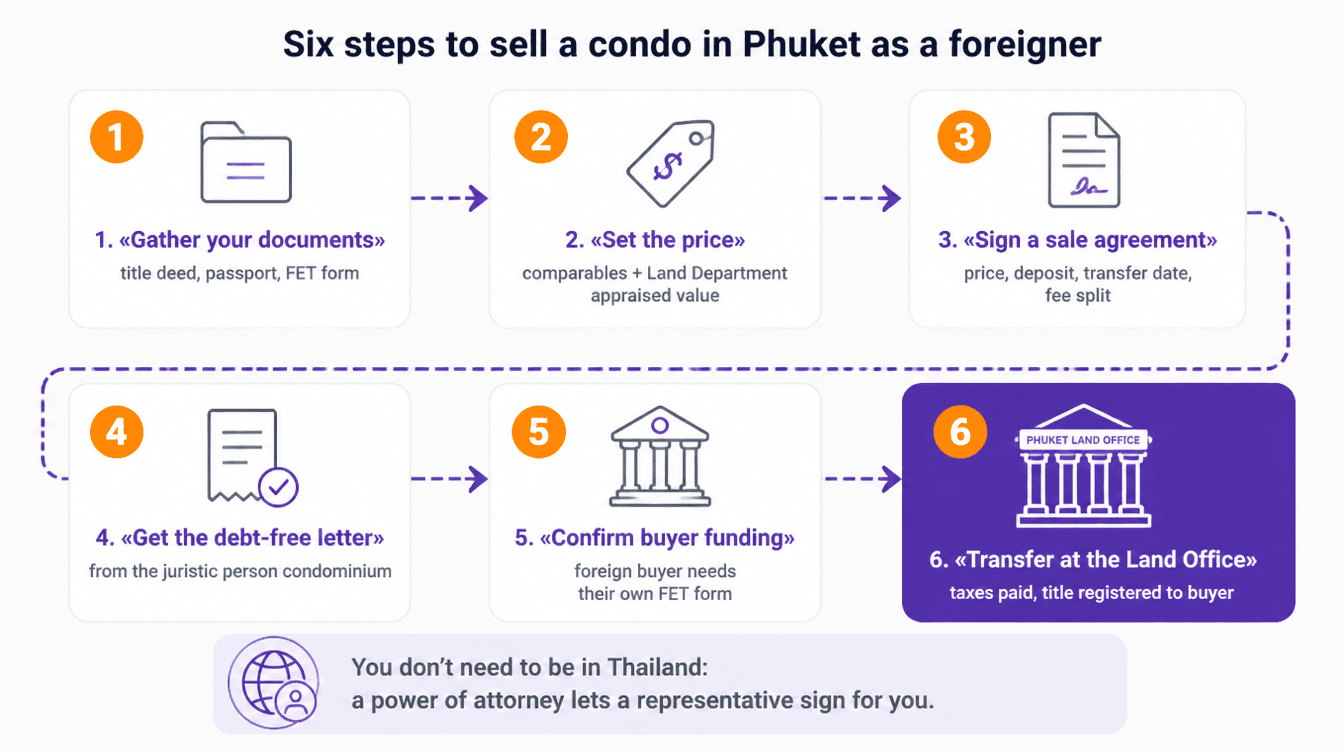
The process runs in six steps:
Gather your documents. These are the condominium title deed, your passport, the FET form from your purchase, and your original purchase documents.
Set the price. Base it on recent sales of comparable units in the building and area. Check the Land Department appraised value as well, because taxes at sale are calculated on it, not only on your price.
Find a buyer and sign a sale agreement. The agreement records the price, deposit, transfer date and who pays which fees.
Request the juristic person debt-free letter. The juristic person condominium issues this certificate to confirm you owe no maintenance fees. The Land Office won't register the transfer without it.
Confirm the buyer's funding. A foreign buyer needs their own FET form to register the unit under the foreign quota.
Complete the transfer at the Land Office. Seller and buyer, or their representatives under power of attorney, attend the Phuket Land Office. Taxes and fees are paid, and the title deed is registered in the buyer's name.
You don't need to be in Thailand for the transfer. A power of attorney lets a lawyer or representative sign on your behalf.
Who Can I Sell My Condo To in Thailand?
You can sell to two groups of buyers.
Foreign buyers. Selling your foreign-owned unit to another foreigner keeps it within the building's 49% foreign ownership quota, so quota space is no obstacle. The buyer needs to bring funds into Thailand from abroad and obtain their own FET form.
Thai buyers. A Thai national can buy any unit without quota restrictions. Once sold to a Thai buyer, the unit moves out of the foreign quota.
A wider buyer pool means a faster, stronger sale. Units that appeal to both groups sell more easily than units designed only for short-stay foreign investors.
How Long Does It Take to Sell a Condo in Phuket?
The time splits into two stages. Finding a buyer takes the longest, and it depends on price, area and unit type.
Once you have a buyer, the closing stage is predictable. Documents, the debt-free letter and the Land Office appointment typically take. Have your documents ready before you list, so the closing stage doesn't hold up a willing buyer.
Selling a Leasehold Villa
Leasehold is the standard structure for foreign buyers of villas. Because a foreigner can't own the land, a leasehold exit works differently from a condo sale. You aren't selling a title; you're transferring your rights under the lease.
Can You Sell a Leasehold Villa in Thailand?
Yes, within the limits your lease sets. The lease is registered against the land's Chanote at the Land Office. To exit, the lease is either assigned to the new buyer or cancelled and re-registered in their name for the remaining term. Which route applies, and whether the landowner must consent, depends on the lease wording. The registration fee is calculated on the remaining lease value.
Two terms shape the price a buyer will pay:
Remaining lease term. A buyer pays for the years left on the registered lease, not the years originally granted.
Renewal rights. Renewal options beyond the first registered term are contractual promises, not automatic rights. Buyers price them on how clearly the lease defines them.
Some projects also grant a superficies right over the building. This is project-specific, not automatic with every leasehold villa. Where it exists, check how it transfers alongside the lease.
The time to check assignment rights is before you buy, not when you sell. Papaya's legal team reviews lease agreements before signing, including assignment clauses, landowner consent and renewal terms. A lease that blocks transfer is a lease without an exit.
Taxes and Costs When You Sell
Taxes at sale follow the same rules covered in but this time you're the seller. On a resale, the costs that the developer covered on your purchase become yours.
What Taxes Do I Pay When Selling Property in Thailand?
Thailand has no separate capital gains tax on property sales. Instead, the sale is taxed at the Land Office on transfer day, through four charges:
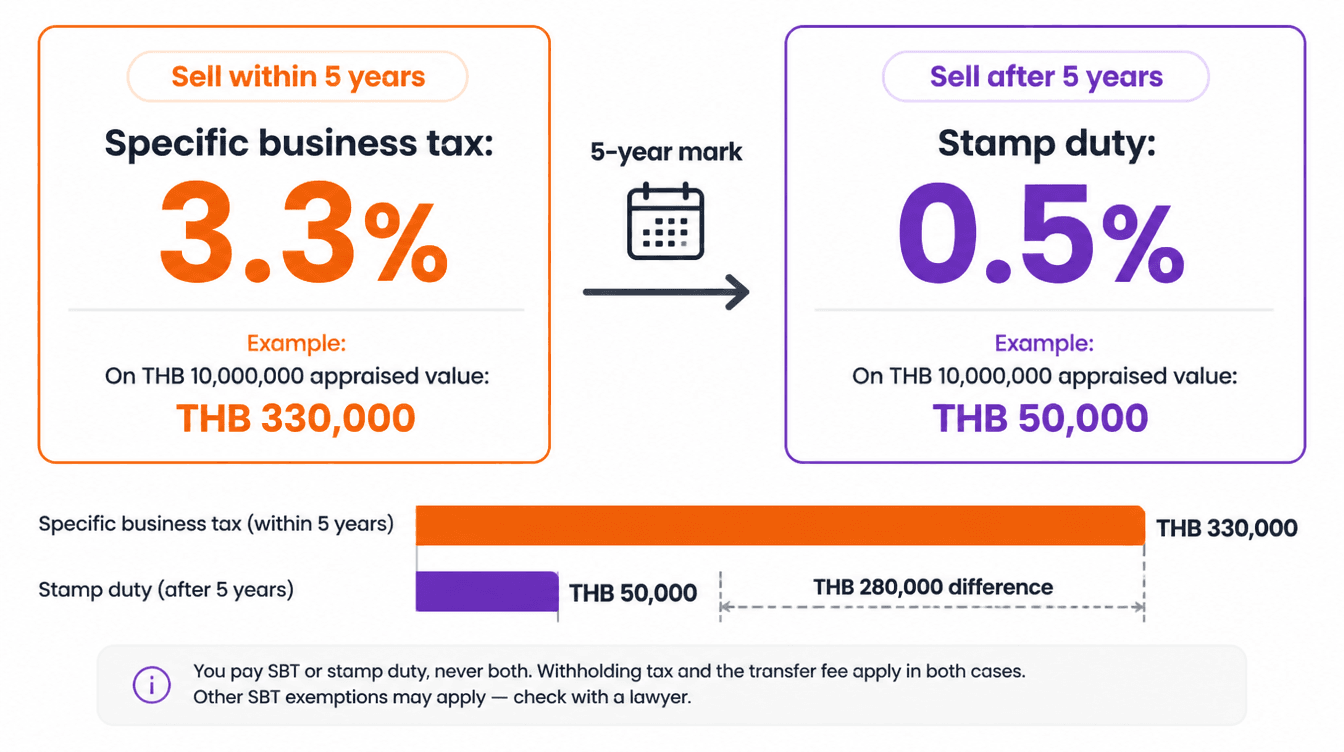
Specific business tax (SBT): 3.3% of the appraised value or sale price, whichever is higher. It applies if you sell within five years of acquiring the property.
Stamp duty: 0.5%, which applies only when SBT doesn't. You pay one or the other, never both.
Withholding tax: calculated on the Land Department appraised value using a progressive formula based on your years of ownership. The Land Office deducts it from your proceeds at transfer.
Transfer fee: 2% of the appraised value. Buyer and seller agree the split in the sale agreement.
Your home country taxes the sale too, depending on your residency. Buyers from the UK, Australia, Germany, Singapore and elsewhere should check their home-country rules on foreign property gains before selling.
What Is the 5-Year Rule for Selling Property in Thailand?
The holding period decides which tax you pay. Sell within five years and SBT at 3.3% applies. Hold for more than five years and SBT drops away, replaced by stamp duty at 0.5%.
On a property appraised at THB 10,000,000, that's the difference between THB 330,000 in SBT and THB 50,000 in stamp duty. The five-year mark is the single largest tax lever a seller controls. It's also why assignment before completion and holding beyond five years are often the two most tax-efficient routes.
Other exemptions from SBT exist, including one linked to house registration. Check your position with a lawyer before setting a sale date.
How to Transfer Money Out of Thailand After Selling Property
For foreign investors, this is the question that matters most: can the money come home? The answer is yes, and how smoothly it happens depends on paperwork you created years earlier.
Can I Take Money Out of Thailand After Selling Property?
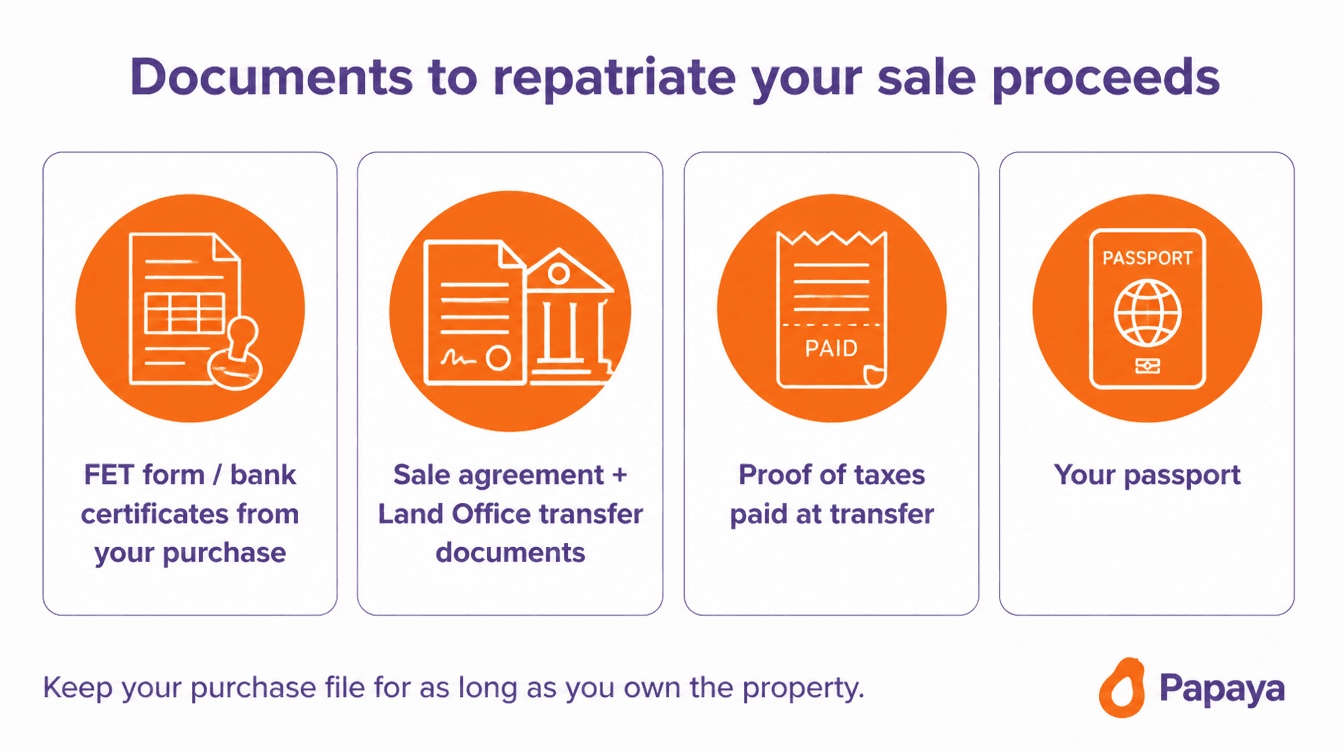
Yes. Thai rules allow foreigners to repatriate the proceeds of a property sale when the original investment came into Thailand from abroad. Repatriation of funds runs through a Thai bank, which checks your documents before sending the money abroad.
Expect the bank to ask for:
The FET form, or the bank certificates from each payment, showing that your purchase funds entered Thailand in foreign currency
The sale agreement and the Land Office transfer documents
Proof of taxes paid at transfer
Your passport
With complete documents, repatriation is a routine banking transaction. Without them, it becomes a request the bank has to evaluate, and that is where delays start. For the full process.
Why the FET Form From Your Purchase Matters at Exit
The FET form is the document that registered your condo as foreign freehold ownership. At exit, it does a second job: it proves the money was foreign capital from the start. That proof supports your repatriation request.
This is why an exit strategy starts at purchase. A clean transfer trail means remittances in your own name, with clear payment references and FET documentation for every instalment. Papaya sets up that trail when you buy: the remittance wording, the FET paperwork for each payment, and a complete document set at transfer. Keep that file for as long as you own the property.
Choosing Your Phuket Property Exit Strategy Before You Buy
Every section above leads back to decisions made at purchase. The investors with the strongest exits chose with the exit in mind.
What Sells on the Phuket Property Resale Market
Resale buyers pay for the same things that drew you in, plus evidence that the project delivered. These features hold value on the Phuket property resale market:
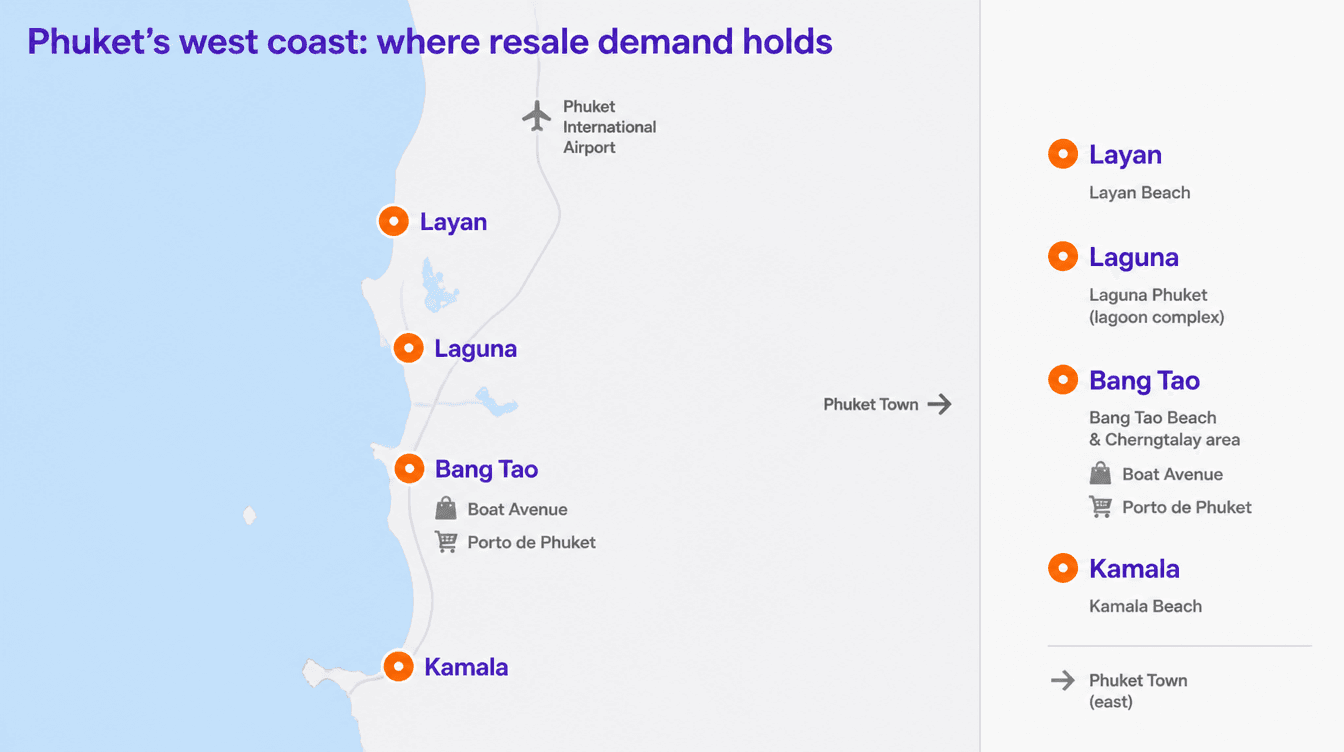
Area with steady demand. Bang Tao, Laguna, Kamala and Layan on Phuket's west coast combine beach access, established infrastructure and year-round rental demand.
Units that suit more than one buyer type. Two-bedroom units and larger appeal to end-users, relocating families and investors alike, so your buyer pool stays wide.
Developer track record. Completed projects from established developers such as Sansiri, Laguna Property and The Title give resale buyers built quality and a working juristic person to judge, not a brochure.
Foreign quota headroom. Units in buildings with foreign quota space sell to the widest buyer pool. Check the quota position at purchase.
A clean SPA. Assignment rights, a defined defects period and clear fee terms make the unit easier to sell at every stage.
Two Papaya services build the exit in at purchase. Legal due diligence checks the SPA's assignment terms, the quota position and the developer's title before you commit. Developer-direct pricing means your entry price, the starting point of every profit calculation, carries no agency markup.
Conclusion
A Phuket property exit strategy isn't something you work out when you want to sell. You build it at reservation through the unit, the area, the contract terms and the paperwork that brings your money into Thailand. Get those right, and each exit stays open: assignment during construction, resale after completion, rental income, or a long-term hold that shifts your taxes in your favour.
If you're weighing a project in Bang Tao, Kamala, Laguna or Layan and want to check its exit potential before you reserve, contact the Papaya team on Telegram, WhatsApp or email for a free consultation. We'll walk you through the assignment terms, the quota position and the numbers for the unit you're considering.